Key Takeaways
Investment stage: Private equity usually targets established businesses, while venture capital focuses mainly on early-stage and high-growth companies.
Ownership: PE may involve significant or controlling ownership, while VC typically involves minority positions.
Risk and returns: PE often relies on operational improvement and financial structuring, while VC depends more heavily on growth potential.
Due diligence: PE typically examines historical financial and operational performance in depth, while VC focuses more on team, market, product and traction.
Exit strategy: PE commonly targets strategic sales, secondary buyouts or IPOs, while VC exits often involve M&A, IPOs or secondary transactions.
Data rooms: Both models rely on structured document sharing as investment processes become more complex and involve more participants.
Introduction
Private equity and venture capital both invest in private companies, but they typically operate at different stages and follow different deal logic. Their approaches to ownership, risk, value creation and due diligence can vary significantly. Understanding these differences is useful for founders, CFOs, business owners, investors and advisers involved in fundraising, acquisitions or exits.
What Is Private Equity?
Private equity (PE) refers to investment in private companies and, in some cases, public companies taken private. PE investors often target established businesses with proven business models, meaningful revenue and opportunities for operational or financial improvement.
Core Investment Strategies
Buyouts: Acquiring a significant or controlling stake, sometimes using a combination of equity and debt financing.
Growth Equity: Investing in established companies seeking capital for expansion while retaining a degree of existing management control.
Minority Investments: Taking a significant but non-controlling position alongside founders or existing shareholders.
Add-On Acquisitions: Acquiring additional businesses to expand or strengthen an existing portfolio company.
Exits and Secondary Sales: Realising an investment through a strategic sale, secondary buyout, IPO or another liquidity event.
PE firms may create value through operational improvements, cost optimisation, management changes, expansion initiatives and acquisitions. Because these transactions can involve complex financial and operational considerations, PE investors typically conduct extensive financial, legal, tax and operational due diligence.
What Is Venture Capital?
Venture capital (VC) focuses primarily on startups and high-growth companies with significant expansion potential. These businesses may have limited operating histories or may still be investing heavily in product and market development.
Key Deal Dynamics
Seed and Early-Stage Funding: Capital used to develop products, validate demand and establish product-market fit.
Series A, B and Later Rounds: Financing provided as companies demonstrate traction and build scalable growth.
Lead Investors and Syndicates: A lead investor may anchor a round alongside other participating investors.
Follow-On Funding: Existing investors may participate in later rounds as the company grows.
Exits: Common liquidity routes include acquisition, IPO or secondary transactions.
VC investors typically take minority positions, although ownership and deal structures vary by company and financing round. Their evaluation often focuses on the founding team, market opportunity, product, technology, traction, unit economics and potential for scalable growth.
Private Equity vs Venture Capital: Core Differences
Although both models deploy private capital, their investment criteria and transaction structures differ.
Target Company Stage. Private Equity (PE): Established businesses with proven operations. Venture Capital (VC): Early-stage and high-growth companies.
Typical Ownership. Private Equity (PE): May involve significant or controlling ownership. Venture Capital (VC): Usually a minority position.
Control & Governance. Private Equity (PE): Often greater involvement in governance and operations. Venture Capital (VC): Board participation and investor protections are common.
Capital Structure. Private Equity (PE): Equity may be combined with debt, particularly in buyouts. Venture Capital (VC): Primarily equity or convertible instruments.
Value Creation. Private Equity (PE): Operational improvement, expansion, acquisitions and financial structuring. Venture Capital (VC): Growth, market expansion, product development and innovation.
Risk Profile. Private Equity (PE): Often based on more established business performance. Venture Capital (VC): Higher company-level uncertainty and growth risk.
Due Diligence. Private Equity (PE): Financial performance, QofE, legal, tax and operations. Venture Capital (VC): Team, market, product, IP, traction and unit economics.
Exit Strategy. Private Equity (PE): Strategic sale, secondary buyout or IPO. Venture Capital (VC): M&A, IPO or secondary transaction.
Core Documentation. Private Equity (PE): Financial records, SPAs, debt and transaction documents. Venture Capital (VC): Term sheets, cap tables, financing documents and investor rights.
How PE and VC Investment Processes Differ
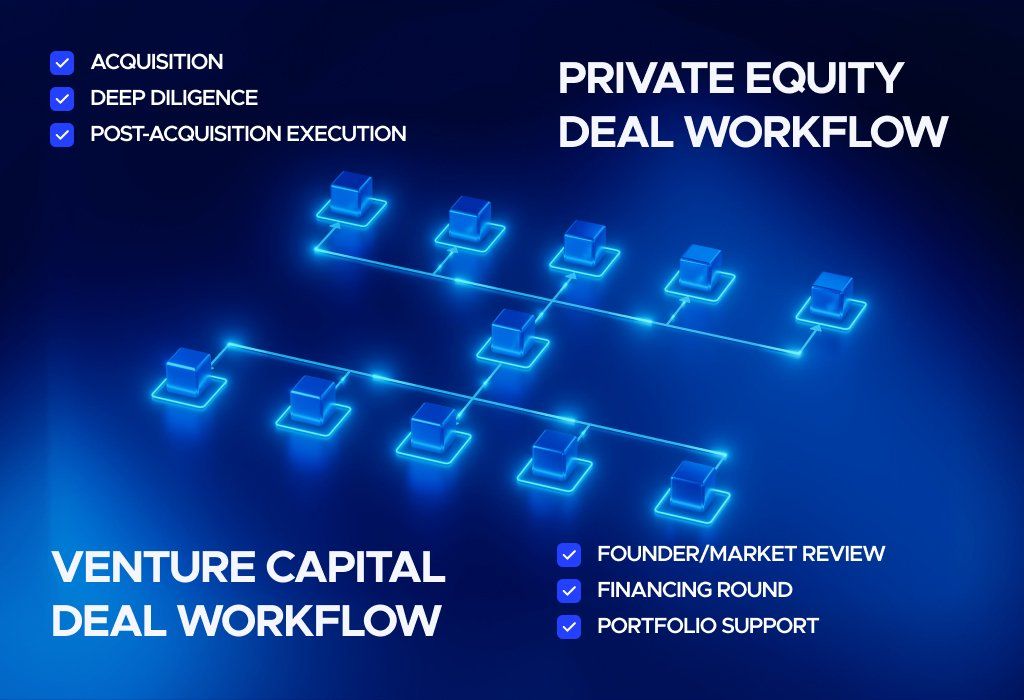
The investment workflow also reflects the different nature of the two models.
The Private Equity Deal Workflow
Sourcing and Screening: Identifying potential targets and assessing strategic and financial fit.
Initial Review: Reviewing teasers, CIMs and preliminary financial information.
Investment Committee Review: Assessing the opportunity and deciding whether to progress.
Due Diligence: Reviewing financial, legal, tax, commercial and operational information in detail.
Transaction Structuring: Negotiating financing arrangements and transaction documents.
Post-Acquisition Execution: Implementing the investment plan, including operational improvements or add-on acquisitions.
The Venture Capital Deal Workflow
Deal Flow and Pitch Review: Reviewing opportunities through founders, referrals and investor networks.
Founder and Market Review: Assessing the team, product, market and early traction.
Term Sheet: Agreeing the principal investment and governance terms.
Confirmatory Diligence: Reviewing the cap table, technology, IP, contracts and other key documents.
Syndicate and Closing: Finalising participating investors and transaction documentation.
Portfolio Support: Supporting growth, follow-on fundraising and strategic development.
Due Diligence in PE vs VC Deals
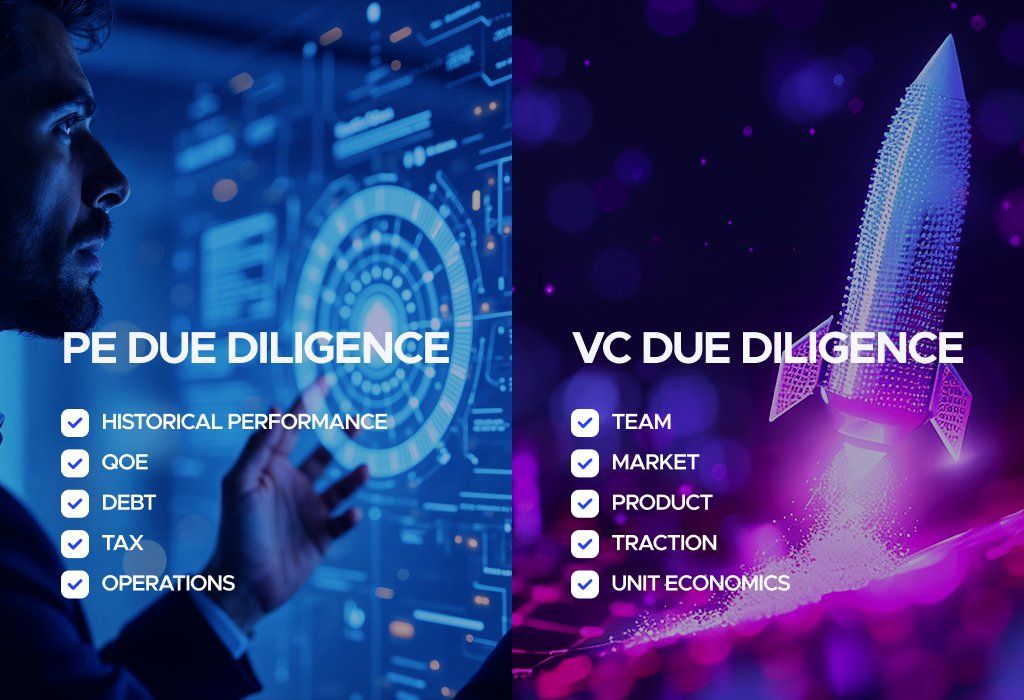
Both models require due diligence, but the focus changes according to company maturity and investment structure.
Private Equity Due Diligence
PE diligence often involves detailed analysis of:
Financial performance: Historical revenue, EBITDA, cash flow and Quality of Earnings.
Working capital and balance sheet: Receivables, payables, inventory and capital expenditure.
Legal, tax and compliance: Material contracts, litigation, employment matters and tax exposure.
Operations and systems: Business processes, technology infrastructure, supply chain and operational risks.
Venture Capital Due Diligence
VC diligence often focuses on:
Founder and team: Experience, capabilities and ability to execute.
Market opportunity: Market size, growth potential and competitive positioning.
Product and technology: Product development, technology, IP ownership and scalability.
Traction and unit economics: Revenue growth, retention, customer acquisition and pipeline.
Cap table: Existing investors, financing history, option pools and investor rights.
As investment processes become larger and involve more advisers, investors and internal teams, both models need a structured way to share and review sensitive information.
Why Data Rooms Matter in Private Equity and Venture Capital

PE and VC transactions involve confidential financial, legal, commercial and operational information. During diligence or fundraising, this information may need to be reviewed by investors, advisers, lawyers, analysts and internal teams.
Email attachments and generic file-sharing tools can make it harder to maintain a consistent document structure and control who has access to sensitive materials.
A Virtual Data Room provides a central environment where transaction or fundraising documents can be organised and shared with relevant participants.
This is particularly useful when:
multiple investors or advisers are involved;
different participants need different documents;
sensitive materials should be shared only at a later stage;
the team needs a clear structure for investor or buyer review.
How Boundeal VDR Fits PE and VC Workflows
Boundeal VDR provides tools that can support different private capital workflows, from fundraising and investor diligence to portfolio company transactions.
Documents
The Documents section provides a structured environment for organising financial, legal, commercial, IP and other transaction materials.
PE teams can use it for acquisition diligence or portfolio company sales, while VC-backed companies can organise fundraising materials for investor review.
Participants
Participants helps deal teams manage investors, advisers, founders and internal team members and organise access according to their role in the project.
Project Dashboard
The Project Dashboard provides a central overview of key project information and helps users navigate the main components of the VDR.
AI Deal Assistant
The AI Deal Assistant helps users navigate large document collections and find relevant information using natural-language queries, which can be particularly useful when diligence involves a large number of files.
Watermarking
Watermarking adds a deterrent and traceability layer to sensitive document previews, helping reduce the risk of uncontrolled document distribution.
Confidentiality Agreement
A Confidentiality Agreement can require participants to accept confidentiality terms before they begin working with project documents.
Which Model Fits Which Company?
There is no universal answer to whether a company should pursue VC, growth equity or PE. The appropriate model depends on factors such as company maturity, capital requirements, ownership objectives, risk profile and growth plans.
When Venture Capital May Be Relevant
VC may be relevant for companies with:
a scalable or technology-driven business model;
significant market growth potential;
early or expanding revenue;
a need for capital to develop products and accelerate growth;
founders prepared to share ownership and governance with investors.
When Private Equity May Be Relevant
PE may be relevant for companies with:
an established operating model and meaningful revenue;
opportunities for operational improvement or expansion;
potential for acquisitions or consolidation;
owners seeking partial liquidity, a full sale or recapitalisation;
a business model suitable for the investment structure being considered.
The Role of Growth Equity
Growth equity can sit between traditional early-stage VC and buyout PE. It generally targets companies with established business models that need capital to expand without following a traditional buyout structure.
Regardless of the investment model, clear documentation and organised investor communication become increasingly important as a transaction progresses.
FAQ
What is the main difference between private equity and venture capital?
Private equity often invests in more established businesses and may seek significant or controlling ownership. Venture capital primarily invests in earlier-stage, high-growth companies, usually through minority positions.
Is venture capital a type of private equity?
Yes. Venture capital is generally considered part of the broader private capital and private equity investment landscape, although the term “private equity” is commonly used to describe buyout and growth investment strategies.
Do PE firms invest in startups?
Some PE firms invest in younger or high-growth businesses through growth equity strategies. Traditional buyout PE, however, generally focuses on more established companies.
How do PE and VC due diligence differ?
PE diligence typically places greater emphasis on historical financial performance, Quality of Earnings, debt, tax, legal and operational matters. VC diligence focuses more on the founding team, market opportunity, product, technology, traction, unit economics and cap table.
Why do private equity and venture capital deals use data rooms?
Data rooms provide a structured environment for organising confidential documents and sharing them with investors, advisers and other participants during fundraising, acquisitions and due diligence.
When should a startup prepare an investor data room?
A startup should consider preparing an investor data room before serious institutional due diligence begins. Having key financial, legal, commercial and corporate materials organised can make the review process easier to manage.
Conclusion
Private equity and venture capital both invest in private companies, but they differ in company stage, ownership, risk, deal structure, value creation and due diligence.
As private capital transactions become more complex, organised and secure document sharing becomes increasingly important. Boundeal VDR provides a structured environment for private capital teams, portfolio companies, founders and advisers to organise documents, manage participants and support controlled information sharing.