Key takeaways:
Private market transactions depend on controlled exchange of non-public financial, legal, commercial, and operational information among multiple external parties.
VDRs help funds, investors, advisors, lenders, and portfolio companies organize confidential documents within a structured transaction workflow.
Participant access should reflect each party’s role and review stage, rather than providing identical document access to all stakeholders.
Confidentiality terms and watermarked view-only previews help reduce unnecessary exposure and unauthorized distribution of sensitive transaction materials.
Structured folders, document search, and clear project visibility can reduce friction when teams review large and complex document sets.
A VDR for private markets supports fundraising, due diligence, private credit reviews, M&A transactions, and other controlled document-sharing workflows.
Private markets rely heavily on the confidential exchange of information among funds, investors, advisors, portfolio companies, and transaction teams. Unlike public markets, where standardized regulatory disclosure rules structure the process, private market transactions depend on selective, direct information sharing. A virtual data room serves as a central platform for deal execution, enabling deal sponsors to control confidential documents, manage diverse participants, and streamline review workflows.
What Are Private Markets?
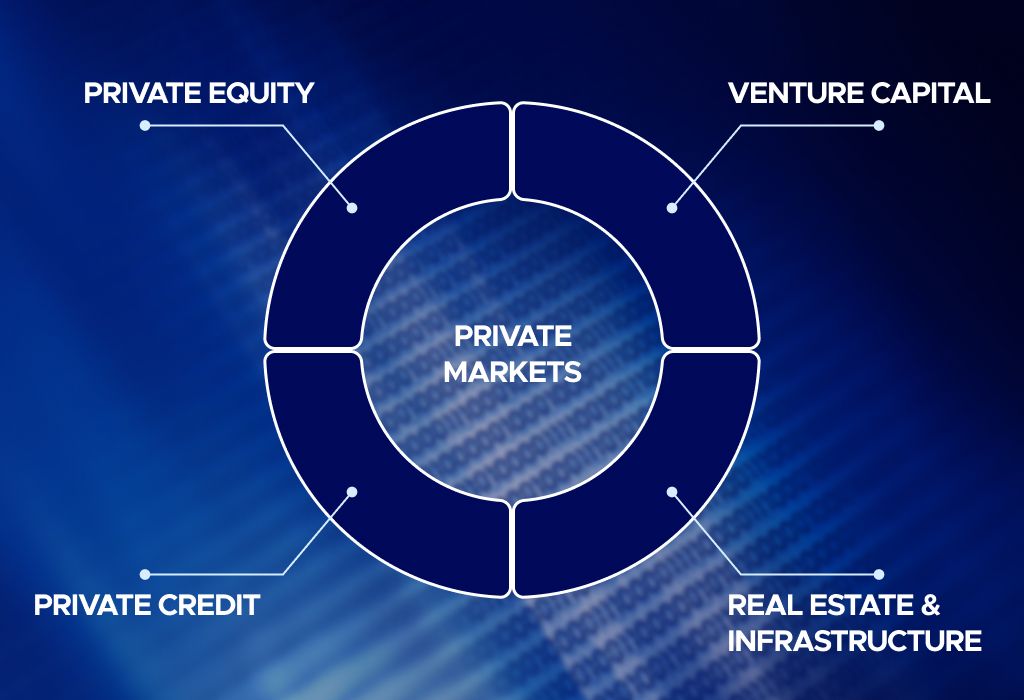
Private markets encompass investment activities occurring outside public stock exchanges. Unlike public entities publishing open quarterly filings, private market participants operate in a closed environment where non-public information is exchanged selectively.
This asset class spans several primary investment strategies:
Private Equity: Buyout and growth capital funds acquiring significant stakes in private operating entities.
Venture Capital: Early and late-stage investments funding high-growth startups and technological innovations.
Private Credit: Direct lending, mezzanine finance, and distressed debt financing provided by non-bank institutions.
Real Estate and Infrastructure: Investment funds financing commercial property, energy, and real infrastructure assets.
Private M&A Transactions: Mergers, acquisitions, and corporate divestitures involving privately held businesses.
In these segments, limited partners (LPs) commit capital to general partners (GPs), who deploy the capital to target portfolio companies. Because valuations, competitive positioning, and operational health are assessed through direct disclosure, private market transactions fundamentally depend on selective access to documents and controlled information flows.
Why Document Control Is Critical in Private Markets
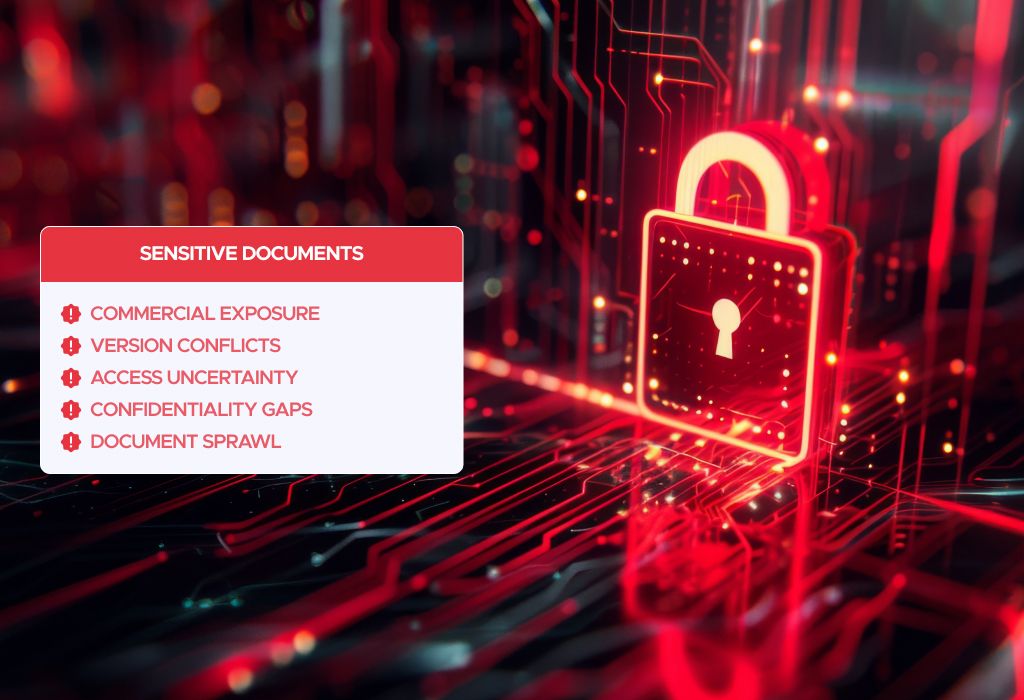
Private market transactions involve sensitive financial, legal, commercial, and operational information that is shared with multiple external parties. The challenge is not only storing these documents, but controlling who can access them and at what stage of the process.
Typical materials may include financial reports, tax documents, customer contracts, legal agreements, portfolio updates, investor materials, and intellectual property records. Many of these files contain information that should be available only to selected investors, lenders, advisors, or other transaction participants.
Poorly controlled sharing can create several risks:
Commercial exposure: Confidential pricing, customer information, business plans, or product strategies may be disclosed to parties who do not need access.
Version conflicts: Documents distributed through email attachments or separate folders can quickly become outdated or inconsistent.
Access uncertainty: Public links or loosely managed shared folders make it harder to maintain clear control over who can review sensitive materials.
Confidentiality gaps: Sensitive information may be shared before the appropriate confidentiality terms have been accepted.
Document sprawl: Files distributed across emails, cloud folders, and internal systems become harder to organize and review during diligence.
Private market teams, therefore, need a structured approach to document access. Access levels should reflect each participant’s role and stage in the transaction, while sensitive materials should remain available only to the parties that genuinely need them.
A VDR supports this approach by bringing document organization, participant access, confidentiality controls, and secure review into one managed environment. Its value is not simply storing files, but helping transaction teams maintain control over how non-public information is shared throughout the review process.
Where VDRs Are Used in Private Market Transactions
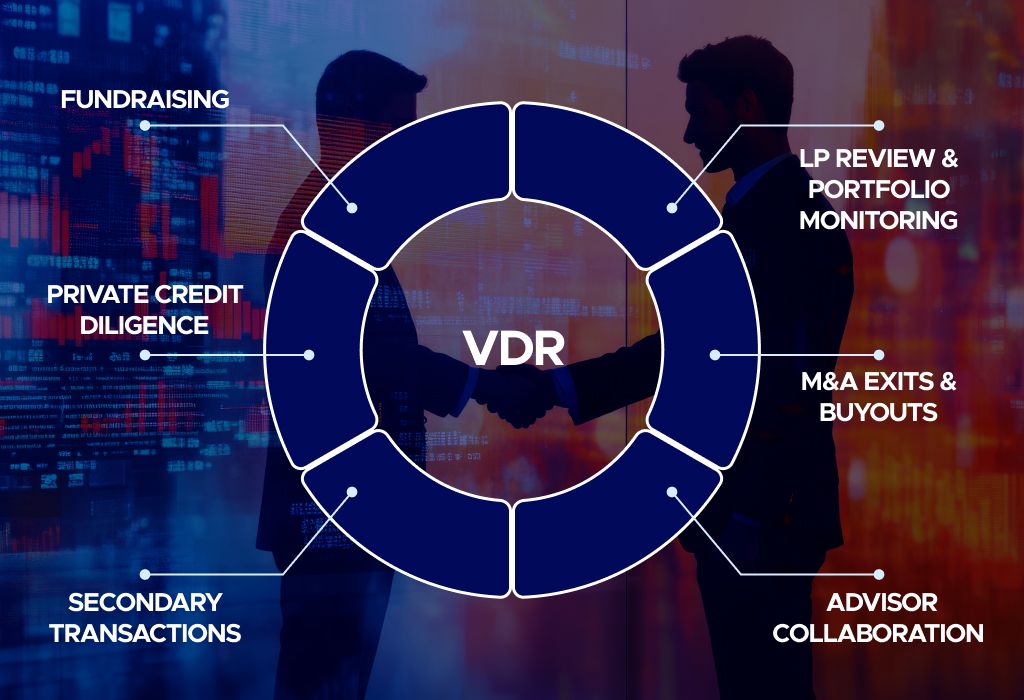
Virtual data rooms serve as essential infrastructure across the entire lifecycle of private market investments:
Fundraising: General partners set up data rooms to distribute offering memorandums, fund terms, historical performance metrics, and compliance records during LP review.
LP Review and Portfolio Monitoring: Funds maintain secure portals to share quarterly performance updates, audited financial statements, capital call notices, and tax documentation with LPs.
Private Credit Diligence: Lenders evaluate borrower financial statements, debt covenants, asset valuations, and collateral documentation during credit underwriting.
M&A Exits and Buyouts: Sell-side advisors organize financial, operational, and legal data rooms for potential buyers conducting investor due diligence.
Secondary Transactions: Sellers of private fund stakes or secondary portfolio holdings share fund financials and asset performance data with secondary buyers.
Advisor Collaboration: Investment bankers, legal counsel, tax accountants, and technical consultants collaborate within a single secure repository to audit deal records concurrently.
Why Generic File Sharing Is Not Enough
While standard cloud storage platforms and email suffice for everyday file sharing, they fail to meet the rigorous demands of private market transactions.
Key limitations of generic cloud drives include:
Access Confusion: Basic link sharing creates permission confusion across dozens of external investment firms and advisory teams.
Uncontrolled Sharing: Standard drives permit users to download, print, or forward proprietary files without restrictions or dynamic tracking.
Version Conflicts and Document Sprawl: Disorganized folder copies lead to outdated files circulating among participants, causing confusion when drafting agreements.
Absence of Confidentiality Gates: Generic tools cannot enforce non-disclosure agreements or clickwrap confidentiality terms prior to file access.
Poor Process Visibility: Deal managers cannot track which documents specific investors analyzed, how long they reviewed them, or whether buyer interest is waning.
A purpose-built private markets VDR replaces disorganized document sprawl with a controlled, auditable, and structured transaction environment.
How VDRs Improve Private Market Workflows
VDRs improve private market workflows by combining document organization, controlled access, confidentiality, and review tools within one transaction environment. This reduces reliance on scattered folders, email attachments, and separate sharing links.
Key workflow benefits include:
Structured document management: Financial, legal, tax, commercial, and operational materials can be organized into clear folders for easier review.
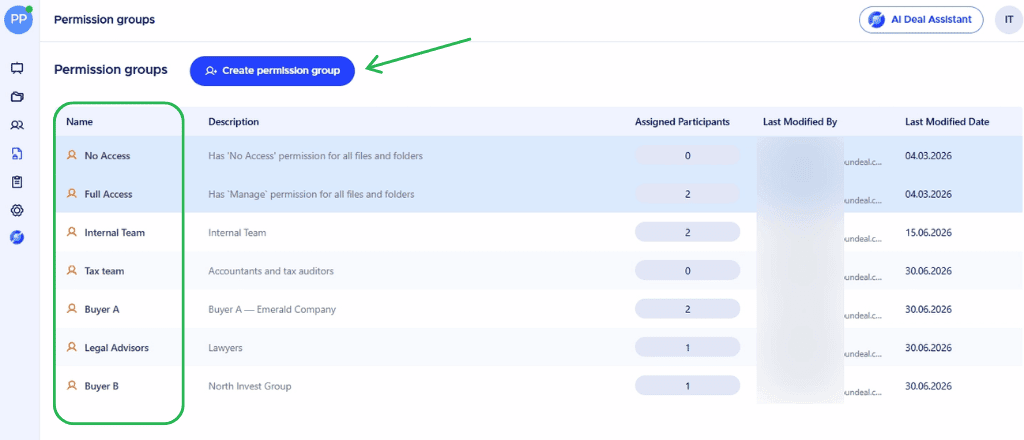
Participant access: Administrators can invite relevant parties and adjust access levels as the transaction progresses.
Confidentiality controls: Participants can be required to accept confidentiality terms before working with project documents.
Watermarked previews: Dynamic watermarks on view-only materials help reduce the risk of unauthorized sharing, copying, or distribution.
Document navigation: Search and AI-assisted document context can help teams find relevant files and work more efficiently with large document sets.
Project visibility: A central dashboard helps administrators track documents, participants, and the overall project status.
The main value of a VDR is not faster deal execution by itself. It is a more structured and controlled review process, with fewer avoidable problems around document access, organization, confidentiality, and navigation.
How Boundeal VDR Supports Private Market Teams
Private market teams need to organize large volumes of non-public information while controlling access for investors, lenders, advisors, lawyers, and portfolio company representatives. Boundeal VDR provides a structured environment for these document-heavy workflows without replacing the judgment of deal teams or professional advisors.
The Documents section helps administrators organize folders, documents, file types, and uploaded files in one project. Built-in search and secure document preview make it easier for participants to locate and review relevant materials without relying on scattered folders or email attachments.
As the participant group changes, the Participants section allows administrators to invite users, remove participants, and adjust access levels. This supports private market workflows in which different investors, advisors, or transaction parties may require varying levels of access as a review progresses.
For sensitive materials, a Confidentiality Agreement can require participants to accept confidentiality terms before they begin working with project documents. Watermarking adds dynamic watermarks to view-only previews, helping reduce the risk of unauthorized sharing, copying, or distribution.
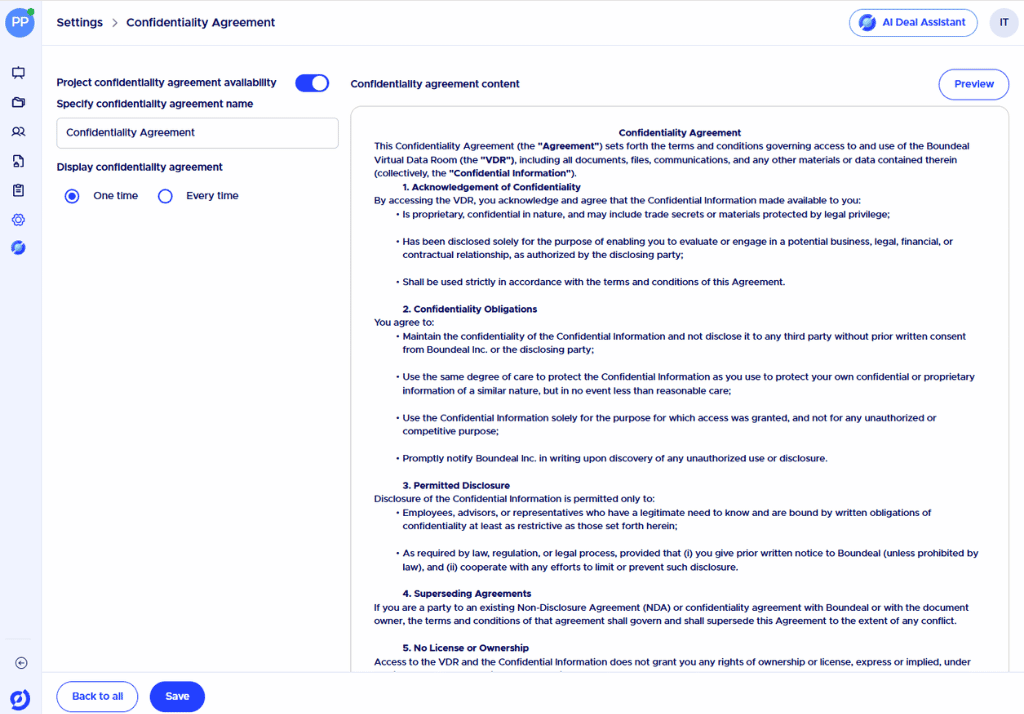
When projects contain large document sets, AI Deal Assistant helps teams work with document context, find relevant files, and obtain an overview of available materials. The Project Dashboard provides administrators with a central view of documents, participants, and the overall project status.
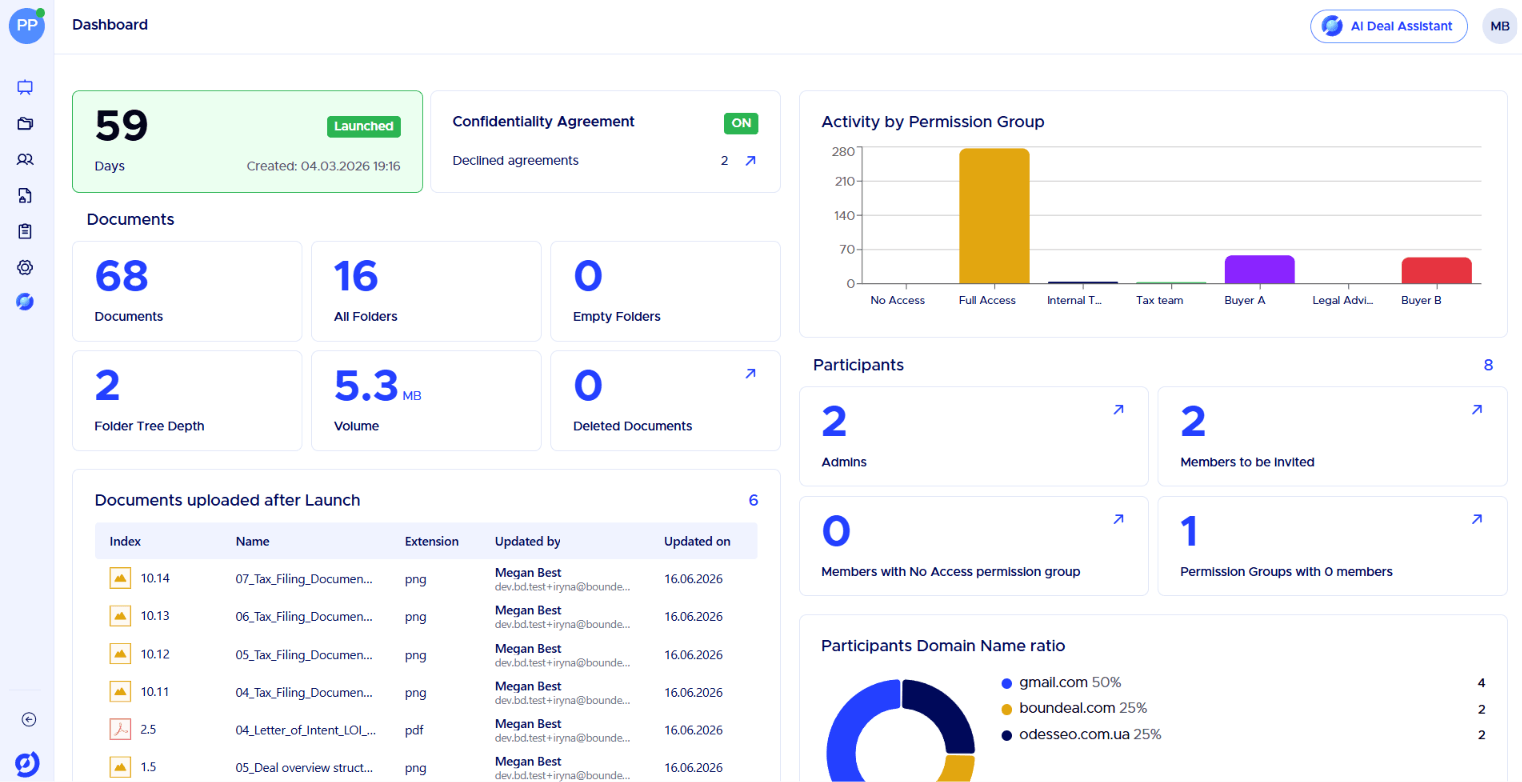
Together, these capabilities make Boundeal VDR relevant to fundraising, investor review, private market transactions, and other workflows that require structured document collaboration and controlled participant access.
Choosing a VDR for Private Markets
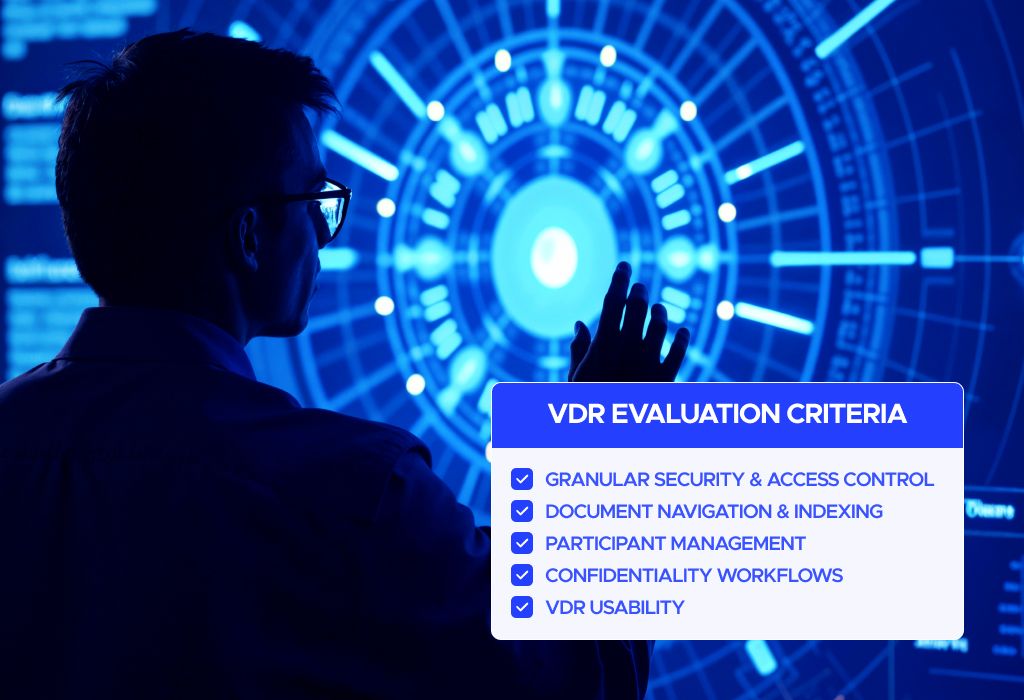
Selecting the right virtual data room requires evaluating how effectively the platform balances security, speed, and ease of deployment. Private market deal sponsors should assess several key evaluation criteria:
Granular Security and Access Control: Ensure the software allows folder-level permission settings, dynamic watermarking, and instant permission revocation.
Document Navigation and Indexing: Look for intuitive folder creation, bulk drag-and-drop capabilities, and robust search to minimize setup and review delays.
Participant Management: Verify that inviting external groups, updating access rights, and tracking user engagement can be handled effortlessly without administrative bottlenecks.
Confidentiality Workflows: Confirm the platform supports integrated NDA acceptance gates before granting user access to sensitive repositories.
VDR Usability: Prioritize clean user interfaces that require zero training for external investors, buyers, legal teams, and LPs.
For organizations seeking modern, reliable, and secure online data room software for startups, businesses, M&A, and corporate document management, Boundeal VDR offers an ideal balance of enterprise-grade security and user-friendly deal orchestration.
FAQ
Why do private market teams use VDRs?
Private market teams use VDRs to exchange non-public financial, legal, and operational documents securely during investment transactions. A VDR ensures strict confidentiality, controls user permissions, and provides complete auditability across all participant interactions.
How do VDRs help private equity firms?
VDRs help private equity firms streamline sell-side due diligence, fund deployment, and LP reporting. By centralizing confidential files and controlling access tiers, firms protect portfolio company metrics while accelerating transaction timelines.
Can VDRs support private credit diligence?
Yes, VDRs support private credit diligence by providing a secure repository for credit underwriting materials, debt agreements, and borrower financial audits. Lenders can evaluate loan terms and borrower risks within a strictly controlled environment.
Why is document access control important in private markets?
Document access control is vital in private markets because transactions involve non-public, commercially sensitive data that could harm company valuations if leaked. Controlling view, print, and download rights ensures that files are viewed strictly by authorized stakeholders at the appropriate deal stages.
What VDR features matter most for private market transactions?
The most critical VDR features for private market transactions include granular participant access management, dynamic document watermarking, integrated confidentiality agreements, AI search, and project dashboard analytics.
Conclusion
Virtual data rooms are essential infrastructure in private markets because they bring structure, security, and efficiency to confidential document exchanges involving multiple external stakeholders. Beyond simple file storage, the true value of a private market VDR lies in controlled participant access, dynamic confidentiality enforcement, and streamlined due diligence workflows. Platforms like Boundeal VDR provide the secure deal environment necessary for funds, advisors, and corporate dealmakers to execute high-stakes private market transactions with confidence.