Key Takeaways
A standard YC SAFE provides contractual rights to future equity without the interest or maturity date associated with debt.
Convertible notes are debt instruments, so repayment provisions, creditor rights and accrued interest can affect a startup's financing risk.
Valuation caps and discounts can increase investors' conversion shares, but neither instrument removes the possibility of founder dilution.
Post-money SAFEs and convertible notes use different capitalization and conversion rules; founders should model all outstanding instruments together.
A SAFE may suit standardized pre-seed financing, while a convertible note may accommodate investors seeking negotiated debt protections.
The best structure depends on the signed terms, investor expectations, local law and the startup's runway.
Introduction
Should an early-stage startup raise money through a SAFE or a convertible note? Both can defer the pricing of shares until a later financing, but they differ in legal status, repayment exposure and conversion economics. For founders, those differences influence dilution and fundraising flexibility; for investors, they affect protections and potential returns. The appropriate choice depends on the instrument's terms and the company's circumstances.
What Is a SAFE Note?
SAFE stands for Simple Agreement for Future Equity. The investor provides capital in exchange for contractual rights to receive shares upon a specified future event. A SAFE note investment does not issue shares immediately. In the standard Y Combinator (YC) post-money form, a SAFE is not a loan, bears no interest and has no maturity date.
Possible terms include a post-money valuation cap, which makes the ownership sold through a SAFE easier to estimate; a discount on the priced-round share price; and an MFN clause, allowing adoption of certain later terms. Pro rata rights may appear in a separate side letter. Earlier pre-money SAFEs use different capitalization calculations. Standard YC forms offer alternative cap, discount and MFN structures; customized documents may combine terms.
A SAFE generally converts in a defined equity financing; liquidity or dissolution events may trigger different contractual outcomes. Cash recovery is not guaranteed, and future equity rights can dilute founders.
What Is a Convertible Note?
A convertible promissory note is debt that may convert into equity under agreed conditions. Its principal is the amount borrowed; interest may accrue until repayment or conversion. This is the essential convertible note meaning: the investor is initially a creditor, not merely a future shareholder.
Key terms include interest (simple or compound if specified), maturity, a possible valuation cap or discount, and a qualified financing threshold for conversion. Change-of-control and default provisions govern additional outcomes. Caps and discounts are not mandatory in every note.
If maturity arrives first, repayment, extension or conversion depends on the signed terms; conversion is not automatic. A note may rank ahead of equity in insolvency, subject to creditor priority, subordination and local law. Repayment is not guaranteed if assets are insufficient.
SAFE vs Convertible Note: Main Differences
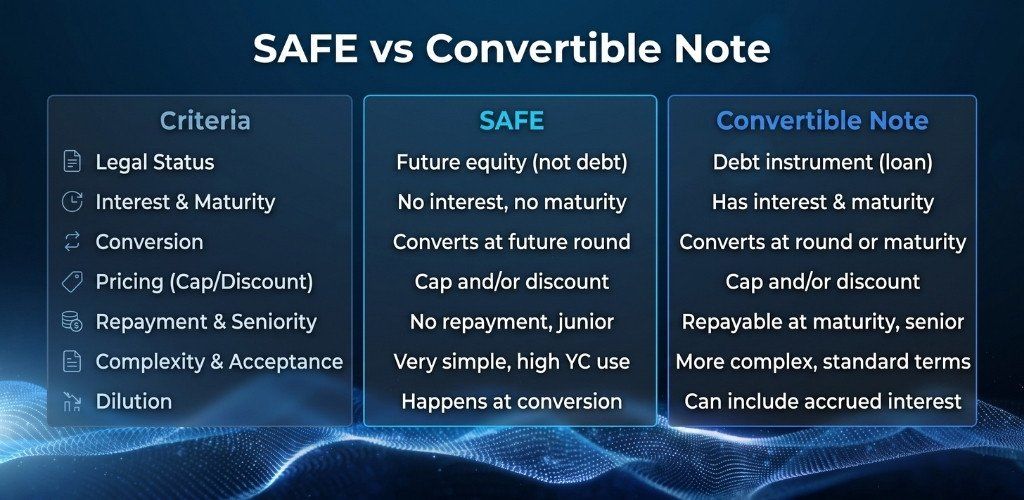
The main safe vs convertible note differences are:
Legal status: A standard YC SAFE is a future-equity contract; a convertible note is debt with potential creditor rights.
Interest and maturity: Standard SAFEs have neither; notes usually specify both.
Conversion: Standard post-money SAFEs generally convert in defined equity financings; notes may require a minimum qualified financing.
Pricing: Either may contain caps or discounts, but calculation rules differ.
Repayment and seniority: Notes may become repayable and rank ahead of equity; standard SAFEs lack maturity-based repayment.
Complexity and acceptance: Standard SAFEs may close faster, while investors seeking debt protections may prefer notes.
Dilution: Post-money SAFEs aid visibility; notes also require accrued-interest modeling.
Side letters, option pools and other convertibles still affect ownership. Executed terms and local law control.
How Valuation Caps and Discounts Work
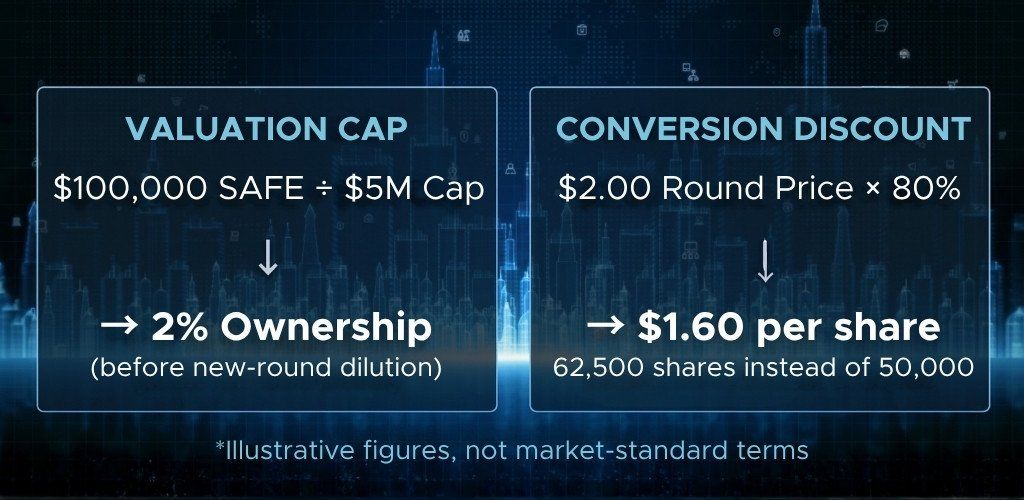
A valuation cap limits the valuation used to calculate a conversion price under the contract. It is not a promise that the next priced round will value the company at that amount. A conversion discount instead reduces a reference price per share in that round.
Illustrative cap example: An investor contributes $100,000 through a YC-style post-money SAFE with a $5 million cap. Under a simplified cap-based model, $100,000 ÷ $5,000,000 = 2% ownership attributable to that SAFE before dilution from new priced-round investment and any relevant new option pool. This percentage is not a complete conversion share count. The capitalization definition, other instruments and actual financing terms control the final result.
Illustrative discount example: New investors pay $2 per share in a qualifying priced round. A convertible note with a 20% discount and a $100,000 conversion amount converts at $2 × 80% = $1.60 per share, yielding 62,500 shares rather than 50,000 at the full round price. The example excludes accrued interest, any cap and transaction-specific adjustments. These figures illustrate mechanics, not market-standard terms.
If a contract contains both a cap and discount, its wording determines how the applicable price is selected; founders should not automatically apply both reductions cumulatively. Pre-money SAFEs, post-money SAFEs and notes use different conversion calculations. Model each agreement, including any option pool increase, before relying on a headline ownership estimate.
How Conversion, Interest, and Maturity Affect Investors and Founders
A priced equity round may trigger conversion, but only when the contractual conditions are met. For example, a note requiring a minimum qualified financing amount may remain debt after a smaller round, while a standard YC post-money SAFE generally converts in a defined equity financing without that threshold.
Interest can also change the number of shares issued. If a $100,000 note accrues $5,000 in interest and both amounts convert at $1 per share, the investor receives 105,000 shares rather than 100,000. Whether interest compounds, converts or is payable in cash depends on the document.
A SAFE has no maturity pressure but can provide exit rights. At note maturity, repayment, amendment or conversion depends on signed terms. Sale and dissolution outcomes, priorities and recoveries can differ.
Model all outstanding instruments, options and warrants in a fully diluted cap table before and after the next round.
When Should Startups Use a SAFE vs a Convertible Note?
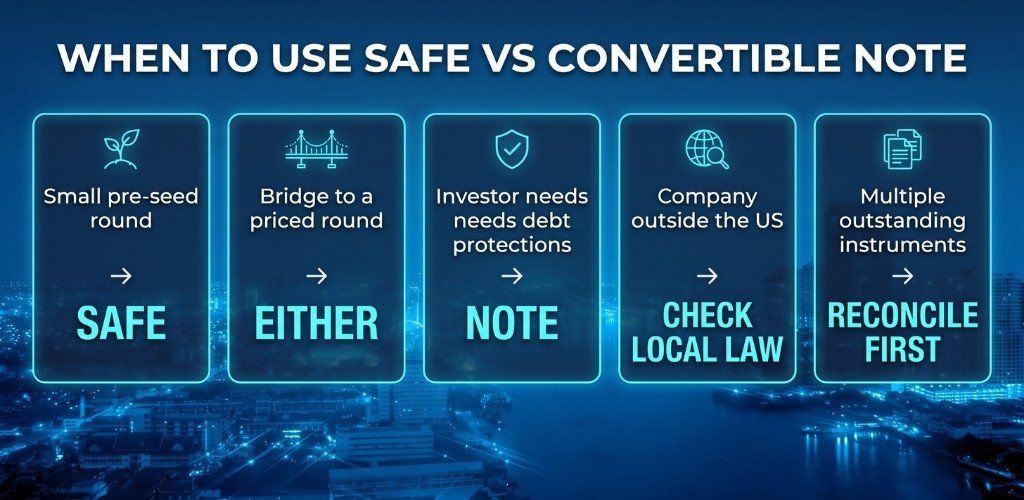
There is no universal winner: assess investor acceptance, governing law, costs, runway and the next financing milestone.
A SAFE may fit pre-seed rounds with angels familiar with standardized documents and no desired debt maturity. Different caps and side letters still create dilution.
A convertible note may fit bridge funding or investors requiring interest and creditor protections, although maturity can pressure runway.
Practical situations:
Small pre-seed round: A standardized SAFE may be efficient if investors accept it and conversion is modeled.
Bridge to a planned priced round: Either can work; compare note maturity against the company's realistic timeline.
Investor requires debt protections: A note may be necessary, subject to negotiated risk and cost.
Company outside the US: Review local corporate, securities and tax rules before using a US-style YC form.
Several outstanding instruments: Reconcile existing caps, discounts and side letters before issuing more securities.
Seek qualified local counsel for uncertain enforceability or conversion terms.
SAFE and Convertible Note Red Flags Founders Should Review
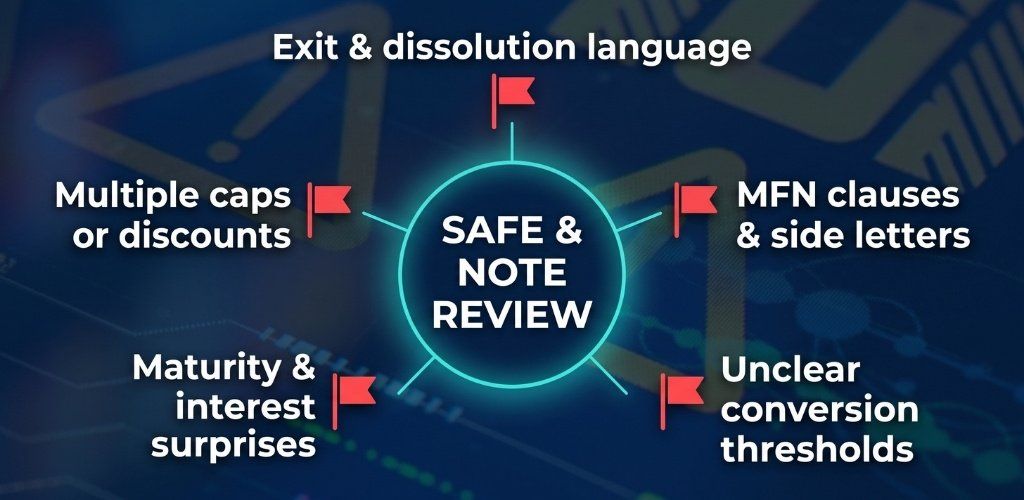
Multiple caps or discounts: Different SAFE and note series may convert at different prices; a single headline cap table can hide cumulative dilution.
Maturity and interest surprises: Check repayment dates, default provisions, accrued interest and extension procedures before relying on a future round.
MFN clauses and side letters: Later fundraising terms may affect earlier investors or create additional pro rata commitments.
Unclear conversion thresholds: A financing below the note's threshold may not discharge the debt.
Exit and dissolution language: A contractual payment formula does not ensure recovery when assets are insufficient.
Option pool assumptions: Pool expansion can change founder ownership and the economics of conversion.
Jurisdictional issues: A familiar US template may need material changes or may be unsuitable under local law.
Model instruments together.
Documents Needed Before Signing or Raising on a SAFE or Convertible Note
Before signing: Prepare the draft instrument and its schedules, current cap table, prior SAFEs and notes, side letters, investor identity and agreed financial terms. Obtain board and shareholder approvals where applicable. Check authority to sign and any relevant corporate restrictions.
During fundraising: Retain executed agreements, amendments, investor subscription and payment records, financial statements, forecasts and cash runway assumptions. Keep supporting IP and ownership documents available when requested for diligence. Record all additional rights agreed with investors.
Before the next priced round: Reconcile outstanding principal, interest, valuation caps, discounts, conversion events and maturity provisions. Prepare a conversion model and fully diluted cap table showing investor ownership before and after the proposed financing and option pool changes. Confirm the calculations against the executed documents with relevant advisers.
How a VDR Supports Convertible Financing Documentation
Separate email threads can make it difficult to distinguish signed financing agreements from drafts. Boundeal VDR offers a structured environment for fundraising document review. Its Documents area can hold SAFE and note agreements, cap tables, financial records and approvals; Participants helps manage access for investors and advisers. Confidentiality Agreement supports agreement-based access before sensitive material is reviewed, while Watermarking can protect view-only document previews.
The Project Dashboard provides an overview of project materials and participants. AI Deal Assistant may help users navigate document content, but it is not a legal opinion or an automatic conversion or valuation model. A VDR supports controlled investor review; it cannot validate the signed terms or guarantee a financing outcome.
Common Myths About SAFEs and Convertible Notes
“SAFE means the investment is guaranteed to be safe.” False. SAFE means Simple Agreement for Future Equity; investors can lose their capital.
“A SAFE is issued equity as soon as it is signed.” False for the standard YC form. It initially creates contractual rights, with shares typically issued following a defined conversion event.
“All convertible notes have the same terms.” False. Interest, maturity, repayment, caps, discounts and conversion thresholds are negotiated or set by the chosen form.
“No interest means no dilution.” False. A SAFE can convert into shares, diluting existing shareholders even without interest charges.
FAQ
What is a SAFE note?
A SAFE note is a commonly used name for a Simple Agreement for Future Equity, which gives an investor contractual rights to future shares or specified proceeds. It does not normally issue shares when signed.
Is a SAFE note debt or equity?
A standard YC SAFE is not debt or issued stock at signing. It represents contractual equity-related rights whose treatment depends on the triggering event and signed terms.
What is the difference between a SAFE and a convertible note?
A standard YC SAFE has no interest or maturity date, while a convertible note is debt that may accrue interest and require repayment. Both may convert into equity, but creditor rights and conversion terms differ.
Do SAFE notes have maturity dates or interest?
Standard YC SAFEs have neither. Other instruments described informally as SAFEs should be checked against their actual wording.
How does a valuation cap work in a SAFE?
It limits the valuation applied in the contract's relevant conversion pricing calculation. The resulting share count still depends on the SAFE version and capitalization assumptions.
What happens when a convertible note reaches maturity?
The contract determines whether repayment becomes due, conversion is available, or other steps apply. Investors and founders may negotiate an extension, but should not assume one will be granted.
Which is better for pre-seed fundraising: a SAFE or a convertible note?
A SAFE may be convenient when investors accept standardized terms and avoiding maturity pressure is important. A note may fit investors who require debt protections; local law, runway and dilution calculations should guide the choice.
Conclusion
SAFE notes and convertible notes both postpone some pricing decisions, but they differ in legal structure, conversion mechanics and repayment exposure. Neither instrument prevents dilution, and no choice is universally preferable. Founders should weigh investor preferences, negotiated terms, applicable law and cash runway while modeling the combined effects of existing securities. Well-organized documents support transparent investor review, but they do not replace sound financing terms or professional advice.