Key Takeaways
A term sheet sets out proposed financing economics, governance, and investor rights before definitive documents are negotiated and signed.
Founder dilution depends on valuation, option pools and convertible securities, not merely the investment amount quoted in an offer.
Liquidation preferences and participation rights may change exit proceeds even when shareholders' ownership percentages stay the same.
Board seats and protective provisions can limit founder control independently of the percentage of shares investors own.
Some clauses, including confidentiality, no-shop, and expenses, may bind parties before the financing itself becomes legally committed.
Founders should model outcomes and review restrictive or binding terms with counsel before signing.
Introduction
How does a venture capital term sheet affect ownership, control, and exit proceeds? Valuation alone cannot answer. Option pools, investor preferences, veto rights, and binding clauses can alter economics and obligations. Founders who understand these terms can compare offers, negotiate with investors, and prepare for closing without overlooking immediate commitments.
What Is a Term Sheet?
A term sheet outlines financing terms before definitive agreements: valuation, investment, securities, governance, investor rights, and closing conditions. Used in priced seed, Series A, and later rounds, it differs from a SAFE or convertible note, which can itself be an investment instrument.
Founders, lead investors, and counsel negotiate it. While commercial terms are often non-binding, confidentiality, exclusivity, or expenses may be binding, depending on drafting and jurisdiction.
What Is Included in a Startup Term Sheet?
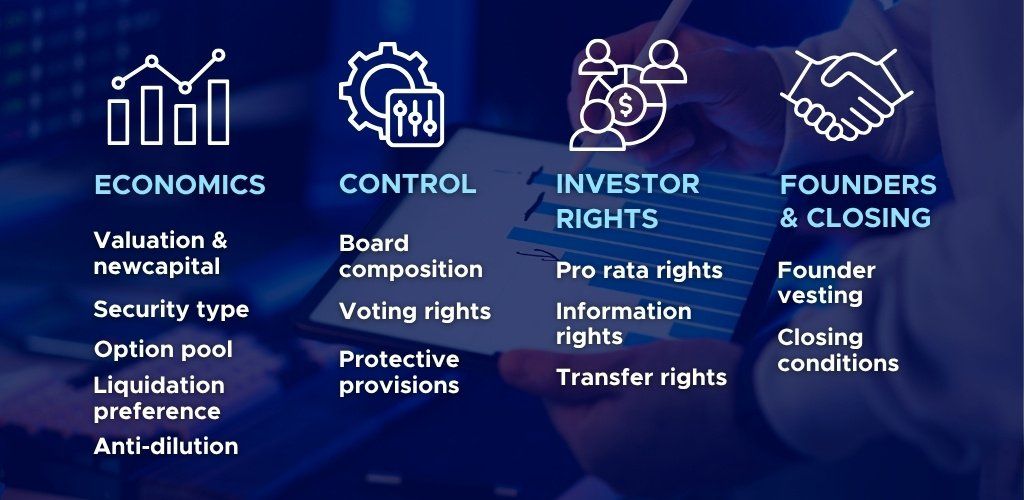
Key clauses affect economics and control:
Pre-money valuation and new capital: Set the basic ownership calculation. What is included in fully diluted capitalization?
Security type: Often preferred shares. What economic and voting rights differ from common shares?
Option pool: Shares reserved for employees. Is a top-up required before closing?
Liquidation preference and participation: Determine priority and sharing of sale proceeds. What happens at a modest exit?
Board composition: Allocates director appointments. Who selects independent directors?
Voting and protective provisions: Reserve certain decisions for investor consent. Which transactions need approval?
Anti-dilution: Adjusts conversion pricing in specified down rounds. Is it weighted-average or full ratchet?
Pro rata and information rights: Address later-round participation and reporting. What limits and deadlines apply?
Transfer rights: May include ROFR, co-sale, and restrictions on founder sales. Which transfers are exempt?
Founder vesting: May change when founder equity vests. Is prior service credited?
Closing conditions: Specify approvals, documents, and diligence requirements. Are they achievable?
High valuations cannot offset every restrictive term.
Valuation, Investment Amount, and Founder Dilution
In a simple priced equity round, post-money valuation = pre-money valuation + new primary investment.
For example, an illustrative:
$8 million pre-money valuation + $2 million of new equity equals = $10 million post-money valuation.
The new investor receives 20% ($2 million ÷ $10 million), while existing shareholders collectively retain 80%, assuming no other capitalization adjustments.
A pre-money option pool top-up generally dilutes existing holders. Outstanding SAFEs and notes may convert at different prices. Model a fully diluted cap table including each instrument.
For further funding math, see Pre-Money vs Post-Money Valuation: What Founders Need to Know.
Liquidation Preference and Participation Rights
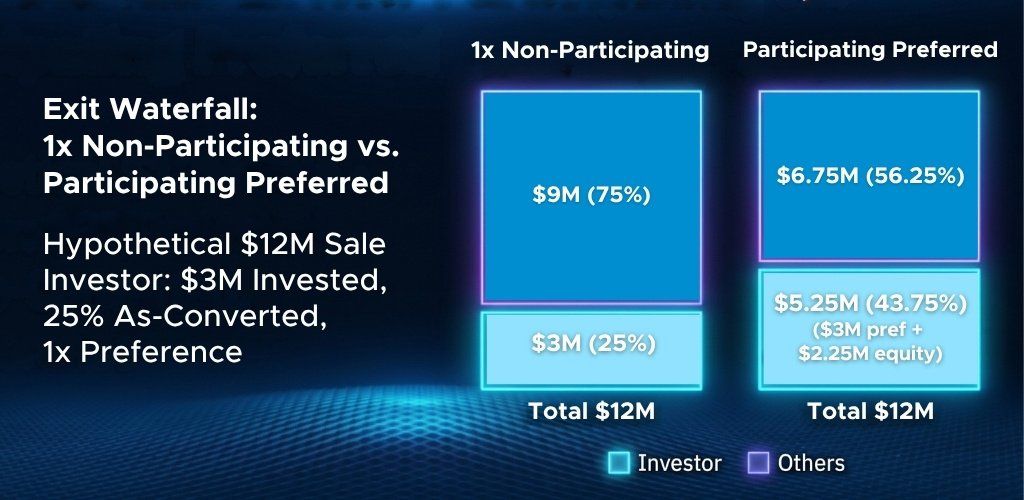
A liquidation preference gives preferred investors priority over common shareholders in specified exits; it does not guarantee recovery. Under 1x non-participating preferred, an investor generally chooses its preference amount or the proceeds from conversion to common shares. Participating preferred may receive the preference and then share in remaining proceeds.
Consider a hypothetical $12 million sale. One investor contributed $3 million, owns 25% as converted, and has a 1x preference. Assume no debt, expenses, other preferences, or participation cap:
Non-participating: The investor compares the $3 million liquidation preference with 25% of the $12 million exit proceeds ($3 million). Both alternatives produce $3 million for the investor, leaving $9 million for other shareholders.
Participating: The investor receives the $3 million preference, then 25% of the remaining $9 million ($2.25 million). The investor receives $5.25 million in total, leaving $6.75 million for other shareholders.
Other preferred rounds may form a liquidation stack, with senior classes paid first. Check priority and participation caps.
Board Seats, Voting Rights, and Protective Provisions
A round may give investors board seats; quorum and deadlock rules matter too. Ownership is not the same as control.
Protective provisions may require preferred-holder consent to issue senior securities, amend the charter, incur significant debt, sell major assets, or approve a company sale. Broad vetoes can delay operations and future funding. Negotiate clear thresholds and exceptions.
Anti-Dilution, Pro Rata, and Other Investor Rights
Anti-dilution adjusts conversion price after qualifying lower-priced issuances. Broad-based weighted-average protection accounts for both issuance price and share quantities; full ratchet resets the relevant conversion price to the qualifying lower price regardless of the number issued and can be more dilutive.
Pro rata rights let eligible investors participate in future rounds, subject to contractual notice and allocation limits. Information rights can require statements and budgets. Registration, ROFR, co-sale and transfer restrictions may constrain later transactions. Assess how rights interact in later rounds.
Which Term Sheet Clauses May Be Legally Binding?
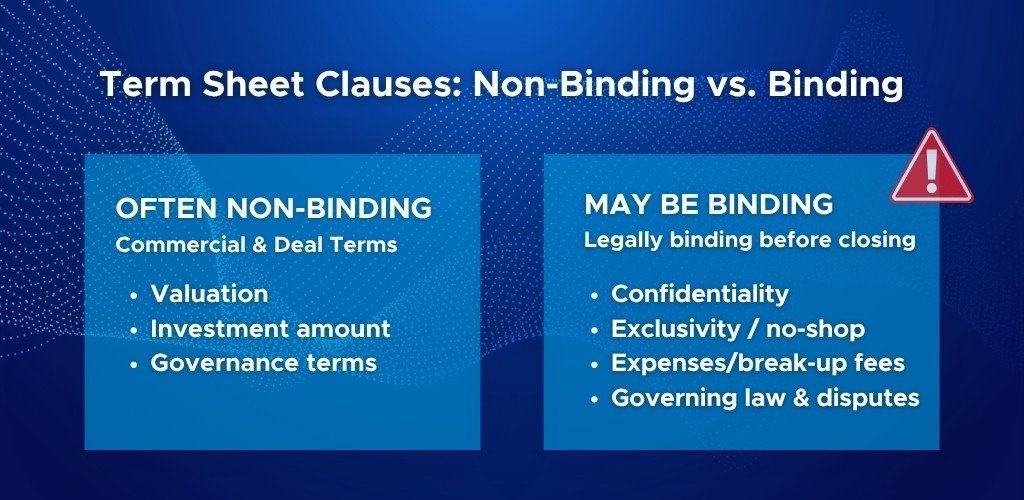
A term sheet is not necessarily wholly non-binding. The document may make these provisions enforceable before closing:
Confidentiality: Limits disclosure of negotiations and sensitive information.
Exclusivity/no-shop: Restricts competing fundraising discussions for a stated period.
Expenses or break-up fees: May allocate costs or specified termination payments.
Governing law and disputes: Set rules for interpreting and enforcing obligations.
No-shop can block competing offers without guaranteeing closing. Check duration and exceptions. Counsel should review enforceability under local law.
Term Sheet Negotiation Checklist for Founders
Before signing:
Model the fully diluted cap table after new shares, option pool changes, and outstanding convertibles.
Compare liquidation preferences, participation, anti-dilution, and exit waterfall scenarios.
Review board appointments, veto rights, founder vesting, drag-along, and transfer restrictions.
Check pro rata, information rights, expenses, and exclusivity deadlines.
Confirm closing conditions and identify any legally binding provisions.
Record unresolved issues with the lead investor and counsel; ensure the proposed terms can carry into definitive documents.
Sample Term Sheet Template: How to Read a Typical Example
This hypothetical educational example is not a ready-to-sign agreement. A sample term sheet template might show:
Investment: $2m. Is all funding committed at closing or conditional on milestones?
Pre-money valuation: $8m. What fully diluted share count and convertibles are assumed?
Option pool: 10% post-closing. Must founders fund the top-up through pre-money dilution?
Security: Series A preferred. What rights attach to the shares?
Preference: 1x non-participating. Are other classes senior, and what events trigger payment?
Board: three seats (common, preferred, and mutually selected independent). Who approves the independent appointee?
Pro rata rights: Eligible investors may join later rounds. What limits apply?
Confidentiality and 30-day no-shop: Which clauses bind immediately, and when does exclusivity expire?
Figures are hypothetical. NVCA model documents are US reference forms, not mandatory templates.
What Happens After a Term Sheet Is Signed?
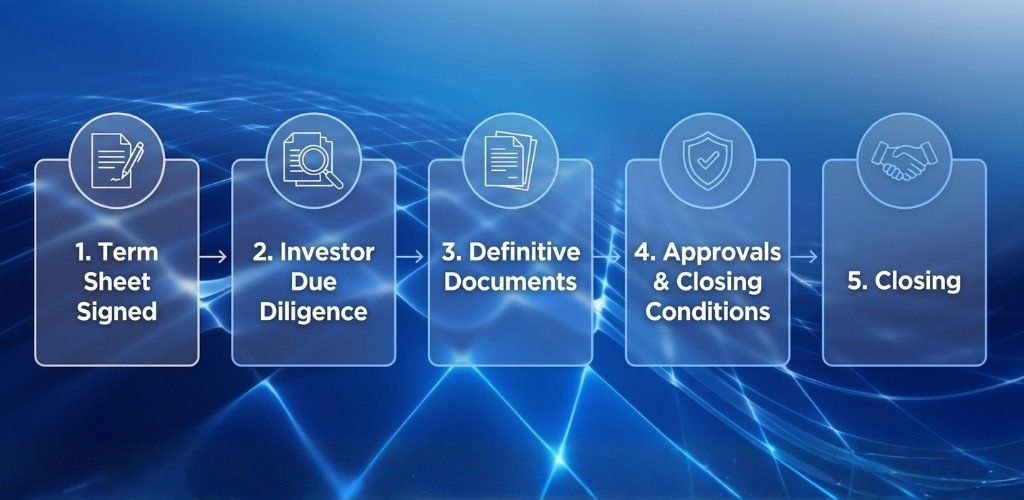
Investors review financial statements, forecasts, the cap table, corporate approvals, material contracts, IP ownership, and relevant tax or compliance records. Lawyers negotiate definitive documentation; a US-style priced round may include an amended charter, a stock purchase agreement, an investors' rights agreement, and a voting agreement.
After approvals and closing conditions are met, shares are issued, funds are transferred, and the cap table is updated. Timing varies; signing does not guarantee closing.
How a VDR Helps Manage Term Sheet Due Diligence and Closing
Diligence requires controlled document access. Boundeal VDR provides Documents for term sheet versions, financials, cap tables, and approvals; Participants to manage investors' and advisers' access; and a confidentiality agreement for accepting terms before reviewing sensitive material.
Watermarking can identify recipients on view-only previews, while Project Dashboard summarizes project information and participants. AI Deal Assistant can assist navigation through materials, but it does not provide legal approval or automatically negotiate or sign financing documents. It does not guarantee funding.
Common Mistakes Founders Make When Signing Term Sheets
Chasing valuation alone: Ignoring option pool dilution or unfavorable liquidation economics.
Overlooking control: Accepting vetoes or board rights that disrupt future decisions.
Signing a broad no-shop: Losing competing options without a committed closing.
Confusing stages: Assuming a negotiated outline equals final financing documents.
Ignoring convertibles: Underestimating ownership changes when SAFEs or notes convert.
Disorganized diligence: Delaying closing with inconsistent cap tables or missing approvals.
FAQ
What is a term sheet in startup fundraising?
It is a summary of the proposed financing economics, legal terms, and governance prior to definitive agreements. It helps parties agree on a negotiating framework.
Is a venture capital term sheet legally binding?
Some clauses can be binding even when commercial terms are not. The signed wording and applicable law determine enforceability.
What is included in a startup term sheet?
It typically covers valuation, investment, security type, option pool, investor preferences, board rights, and closing conditions. The precise terms vary by round.
How does a liquidation preference affect founders?
It can give preferred investors priority over common shareholders in specified exits. Participation and seniority can further reduce founder proceeds.
What is a no-shop clause in a term sheet?
It limits the company's ability to pursue competing financing for an agreed period. Its scope and consequences depend on drafting and law.
Can founders negotiate a term sheet?
Yes, founders can negotiate economics, governance, and investor protections before signing. Qualified counsel can help evaluate trade-offs and binding clauses.
What happens after a term sheet is signed?
The parties conduct diligence, draft definitive documents, obtain approvals, and work toward closing. Funds arrive only if closing conditions are satisfied.
Conclusion
A term sheet defines the initial architecture of a priced funding deal, not just its headline valuation. Founders should test ownership and exit outcomes alongside governance rights and potentially binding clauses. Qualified legal review helps translate negotiated terms into appropriate definitive agreements. Secure document preparation and controlled investor access can then support diligence without guaranteeing a transaction.