Key Takeaways
Buy-side due diligence evaluates a target company’s financial, legal, commercial, and operational risks before an M&A transaction moves forward.
Fragmented deal files across local drives and email threads slow buyer review and increase the risk of missing critical liabilities.
Coordinating legal, tax, financial, commercial, and operational advisers requires clear document organization and controlled participant access.
Generic file-sharing workflows can create uncontrolled copies, version confusion, and confidentiality risks during time-sensitive acquisition due diligence.
AI-powered document search can help buyer teams navigate large diligence repositories and locate relevant information faster.
Virtual data rooms provide structured infrastructure for documents, participants, confidentiality controls, and project-level visibility.
Introduction
Buy-side due diligence is where a buyer tests the business behind the deal story. The challenge is not only obtaining documents, but also identifying risks, gaps, liabilities, and potential deal-breakers before a transaction progresses. When information is fragmented across different channels, review becomes slower and harder to coordinate. A controlled document environment helps buyer teams and advisers evaluate information more efficiently while protecting confidential materials.
What Is Buy-Side M&A Due Diligence?
Buy-side due diligence is the review conducted by an acquiring company to assess the commercial, financial, legal, tax, and operational position of a target business. It usually begins once the seller provides access to confidential information.
In practical terms, buy side due diligence tests assumptions behind valuation, transaction structure, future performance, and identified risks. From the buyer side, the objective is to verify information rather than simply review materials prepared by the seller.
Due diligence in finance can cover financial statements, management accounts, debt, cash flow, forecasts, and quality of earnings. Finance due diligence forms part of a broader review that may also include legal, tax, HR, IT, commercial, regulatory, and operational matters.
The process may involve the buyer’s M&A team, finance and legal teams, tax specialists, HR and IT, commercial advisers, investment bankers, and external consultants.
Unlike sell-side preparation, buy-side review tests the seller’s assumptions and supporting evidence. Findings can influence pricing, deal terms, warranties, indemnities, integration planning, and the decision to proceed.
The phrase “due diligence acquisitions” may also be used in the context of company acquisitions. In practice, acquisition due diligence depends heavily on how clearly information is structured and shared with reviewers.
Common Challenges in Buy-Side Due Diligence
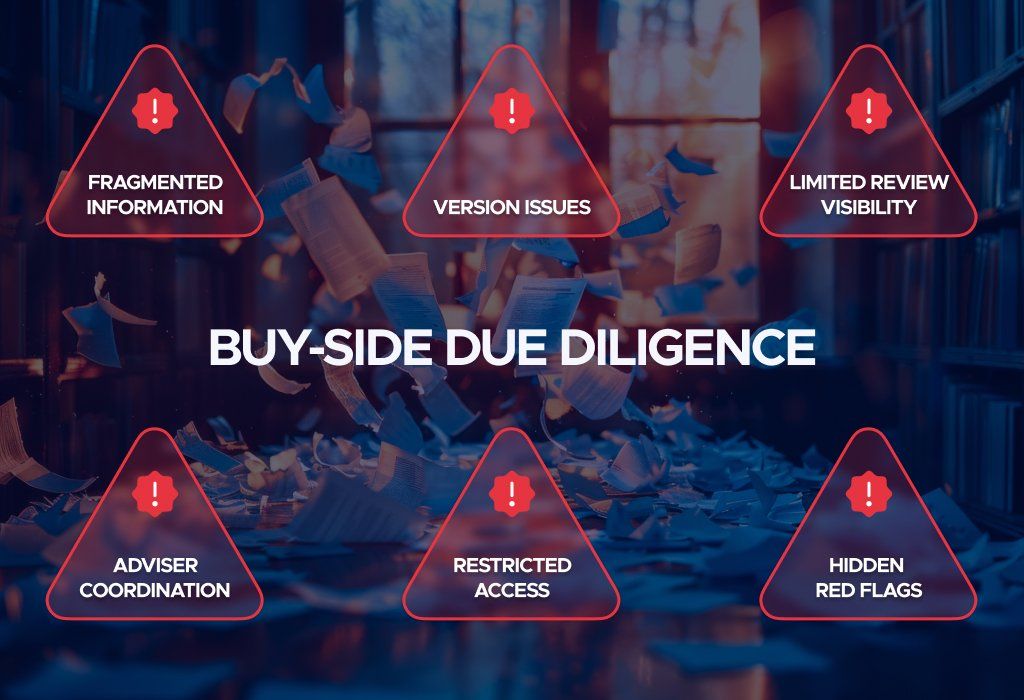
Buy-side teams face operational friction when evaluating target companies under strict deadlines. Large document volumes, restricted materials, and parallel reviews across multiple disciplines make document control a significant part of the diligence process.
Fragmented Information and Delayed Uploads
Sellers may provide files gradually or across different channels, including shared folders and email attachments. This makes it harder for the buyer team to understand whether the available document set is complete or whether important information is still outstanding.
Version and Document Ownership Issues
When naming conventions and folder structures are inconsistent, reviewers may spend unnecessary time determining which document is current and who is responsible for providing updates. Duplicate or outdated files can also lead different advisers to work from different information.
Limited Review Visibility
When several teams review documents simultaneously, it can become difficult to understand what has already been examined, which areas still require attention, and where additional information may be needed. Weak project visibility increases coordination work for the buyer and its advisers.
Adviser Coordination Breakdown
Lawyers, finance teams, tax specialists, commercial advisers, and operational experts frequently review information in parallel. Without a structured document environment, teams may duplicate work or miss dependencies between findings in different diligence areas.
Confidentiality and Restricted Access
Certain documents may contain commercially sensitive information that should only be available to specific participants or at particular stages of the transaction. Weak access management increases the risk of unnecessary exposure or uncontrolled distribution.
Hidden Red Flags Under Time Pressure
When bid or transaction deadlines approach, reviewers must identify relevant risks within large document sets. Restrictive covenants, change-of-control provisions, unresolved litigation, tax issues, or unusual financial arrangements can be difficult to locate when information is poorly organized.
Why Email and Generic File Sharing Are Not Enough
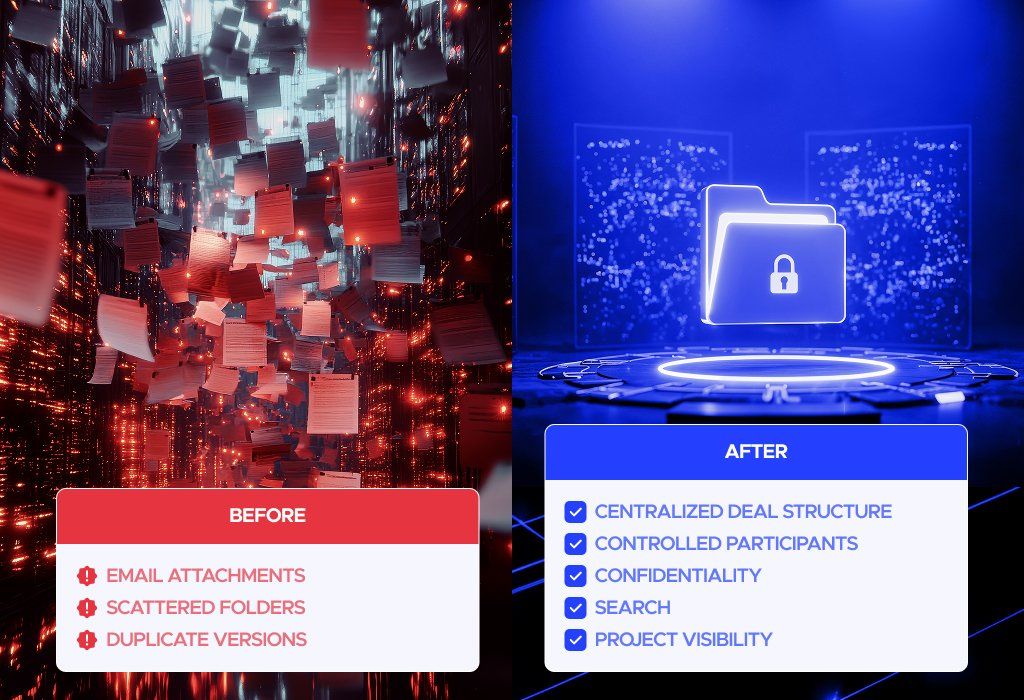
General-purpose cloud storage and email can support basic document sharing, but they become harder to manage when acquisition due diligence involves multiple advisers, confidential information, changing document sets, and tight deadlines.
Generic File-Sharing Workflow: Files may be distributed across links, folders, and attachments. Purpose-Built M&A VDR: Centralized deal document structure.
Generic File-Sharing Workflow: Access depends on general folder and sharing settings. Purpose-Built M&A VDR: Participant access managed within the deal workspace.
Generic File-Sharing Workflow: Confidentiality terms may be handled separately. Purpose-Built M&A VDR: Confidentiality Agreement integrated into project access.
Generic File-Sharing Workflow: Standard file and keyword search. Purpose-Built M&A VDR: AI-assisted navigation across large document sets.
Generic File-Sharing Workflow: Limited deal-level visibility. Purpose-Built M&A VDR: Central Project Dashboard.
Generic File-Sharing Workflow: Sensitive files may circulate outside the main workspace. Purpose-Built M&A VDR: Watermarked view-only previews for selected materials.
Email attachments are particularly difficult to control because every message can create another local copy of a confidential file. Generic shared folders can also become difficult to navigate as document volumes, participants, and revisions increase.
The result may be slower adviser coordination, outdated documents being reviewed, confidential information circulating outside the intended workflow, and additional transaction friction before signing or closing.
How a VDR Solves Buy-Side Due Diligence Challenges
A virtual data room creates a structured environment for document review, participant management, and confidential information sharing during an M&A process.
Documents: Centralized Deal Structure
The Documents area helps organize diligence materials within a searchable folder structure. Keeping financial, legal, commercial, tax, HR, and operational files in one workspace reduces the need to search across disconnected folders and email threads.
For buyer advisers, clearer document organization means less time locating relevant materials and more time analysing their substance.
Participants: Buyer Team and Adviser Access Management
The Participants area helps administrators manage who is involved in the project and adjust access levels as the review progresses.
This is particularly useful when internal teams and external advisers participate in the same transaction but do not necessarily require the same level of access throughout the process.
Project Dashboard: Quick Project Visibility
The Project Dashboard gives administrators a central view of documents, participants, and key project information.
During a time-sensitive review, this helps deal teams understand the overall workspace without relying entirely on separate status emails or disconnected file-sharing tools.
AI Deal Assistant: Faster Navigation Across Large Document Sets
The AI Deal Assistant helps reviewers navigate large collections of documents and find relevant information faster.
It can support document research when a buyer or adviser needs to locate information across a large repository. It should be treated as an information-navigation tool rather than a replacement for professional legal, financial, tax, or commercial judgement.
Watermarking: Protection for Sensitive Previews
Watermarking helps protect view-only document previews by placing identifying information on materials displayed within the workspace.
It can discourage uncontrolled sharing of sensitive documents, although watermarking should not be treated as a guarantee that information cannot be copied or disclosed.
Confidentiality Agreement: Controlled Access Before Review
The Confidentiality Agreement helps ensure that participants accept the relevant terms before starting work within the project.
This provides a more structured confidentiality workflow than handling agreements separately from the document-review environment.
What Buyers Should Look For in a Due Diligence Data Room
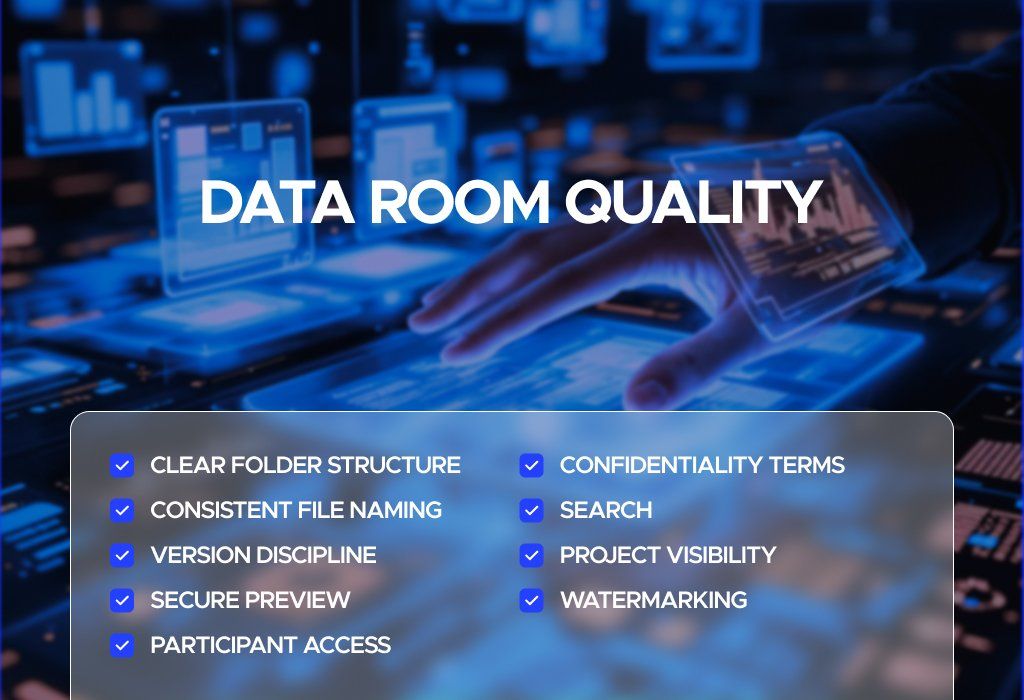
Buyer teams should evaluate not only the target company, but also the quality of the information environment used during the review. Poor organization can slow decision-making and make important information harder to identify.
A practical due diligence data room checklist should include:
Clear Folder Structure: Documents organized by financial, legal, commercial, tax, HR, operational, and other diligence areas.
Consistent File Naming: Naming conventions that help reviewers understand document purpose and avoid confusion between similar files.
Version Discipline: A clear process for replacing or identifying updated materials so advisers know which information should be reviewed.
Secure Document Preview: Sensitive materials should be available through a controlled viewing environment when wider file circulation is unnecessary.
Participant Access Management: Administrators should be able to manage project participants and adjust access levels.
Confidentiality Terms: Participants should accept applicable confidentiality terms before accessing project materials.
Search Across Large Document Sets: Reviewers should be able to locate relevant information without manually navigating every folder.
Project-Level Visibility: Administrators should have a central overview of key project information, documents, and participants.
Watermarking: Sensitive view-only previews can be watermarked to discourage uncontrolled sharing.
Typical Documents Reviewed by Buy-Side Teams
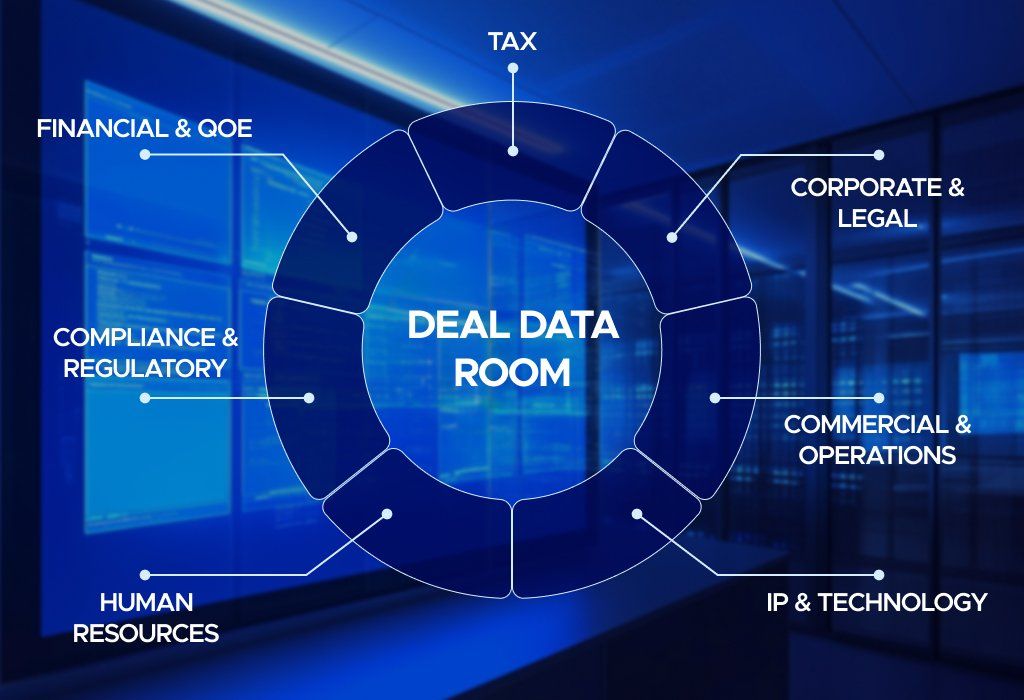
Buy-side teams review different document categories to test historical performance, identify liabilities, and assess assumptions behind the transaction.
Financial & Quality of Earnings. Typical Documents: Financial statements, management accounts, budgets, quality of earnings materials, debt schedules, financing documents.
Tax. Typical Documents: Tax filings, tax correspondence, tax risk documentation.
Corporate & Legal. Typical Documents: Constitutional documents, board materials, shareholder agreements, shareholder approvals, material contracts, litigation records.
Commercial & Operations. Typical Documents: Customer contracts, revenue concentration reports, supplier agreements, operational documents, pricing information.
Intellectual Property & Technology. Typical Documents: IP registrations, licences, product documentation, technology documentation, relevant security materials.
Human Resources. Typical Documents: Employment agreements, HR policies, executive compensation documents, organisational information.
Compliance & Regulatory. Typical Documents: Regulatory correspondence, compliance documentation, licences and other relevant regulatory files.
The exact document set depends on the target company, transaction structure, sector, and scope of the buyer’s review.
How Boundeal VDR Fits Buy-Side M&A Workflows
Boundeal VDR provides a secure workspace for managing confidential documents during acquisition due diligence. It supports professional review without replacing the judgement of buyers and advisers.
Documents helps organize deal files, file types, uploaded users, and searchable folders, while Participants helps manage project members and access levels.
The Project Dashboard gives a quick view of documents, participants, and key project information. The AI Deal Assistant helps reviewers navigate large document sets and find relevant information faster.
Watermarking helps protect view-only previews from uncontrolled sharing, while the Confidentiality Agreement helps ensure participants accept terms before starting work.
FAQ
What is buy-side due diligence in M&A?
Buy-side due diligence is the verification process conducted by an acquirer to assess a target company before completing a transaction. It can cover financial, legal, tax, commercial, operational, HR, technology, and other areas depending on the deal.
What are the biggest challenges in buy-side due diligence?
Common challenges include fragmented information, incomplete document uploads, version confusion, parallel adviser reviews, restricted access, and tight transaction deadlines. These issues become harder to manage as the number of documents and participants increases.
How does a VDR help during buy-side due diligence?
A VDR centralizes deal documents within a controlled workspace and helps teams manage participants, confidentiality, and document navigation. This can reduce friction when several buyer advisers review confidential information at the same time.
What documents do buyers review in an M&A data room?
Buyers may review financial statements, quality of earnings materials, tax records, customer and supplier contracts, corporate documents, employment information, IP records, and litigation files. The exact scope depends on the company, sector, and transaction.
Why is email not enough for M&A due diligence?
Email creates separate copies of documents and makes version and access management more difficult as a review expands. A structured data room keeps sensitive materials within a central deal workflow and gives teams a clearer information environment.
How can AI search help buyers review deal documents faster?
AI-assisted search can help reviewers locate relevant information across large document repositories without manually opening every file. It can improve navigation and information discovery, but it does not replace professional analysis or due diligence judgement.
Conclusion
Buy-side M&A due diligence is both an analytical exercise and a document workflow challenge. Buyers need to identify material risks while coordinating advisers, controlling access, and reviewing large volumes of confidential information.
A structured VDR environment can make that process easier to manage by centralizing documents, participants, confidentiality controls, and information discovery. Boundeal VDR provides a secure workspace designed to support professional M&A due diligence without replacing the expertise of the teams conducting the review.