Main takeaways
Many M&A deals fail because buyers pay for expected synergies before proving they can be delivered after closing.
The main acquisition challenges are overvaluation, weak due diligence, poor integration planning, hidden liabilities, and cultural conflicts.
Financial issues in mergers and acquisitions damage deal economics through debt pressure, weak forecasts, working capital disputes, and unexpected costs.
Integration issues in mergers and acquisitions are often the most costly stage because companies must combine systems, teams, contracts, and operations.
Regulatory approval can delay or halt a deal, even when the strategic rationale appears strong.
Cultural integration affects retention, decision speed, and alignment with leadership.
Even large acquisitions can fail after signing because ownership transfer is only the legal part of the deal. Real value depends on execution: integrating teams, systems, data, suppliers, contracts, customers, and governance. When integration risks are underestimated, a strong business case can turn into cost overruns, litigation, talent loss, and missed synergies.
Why M&A deals fail
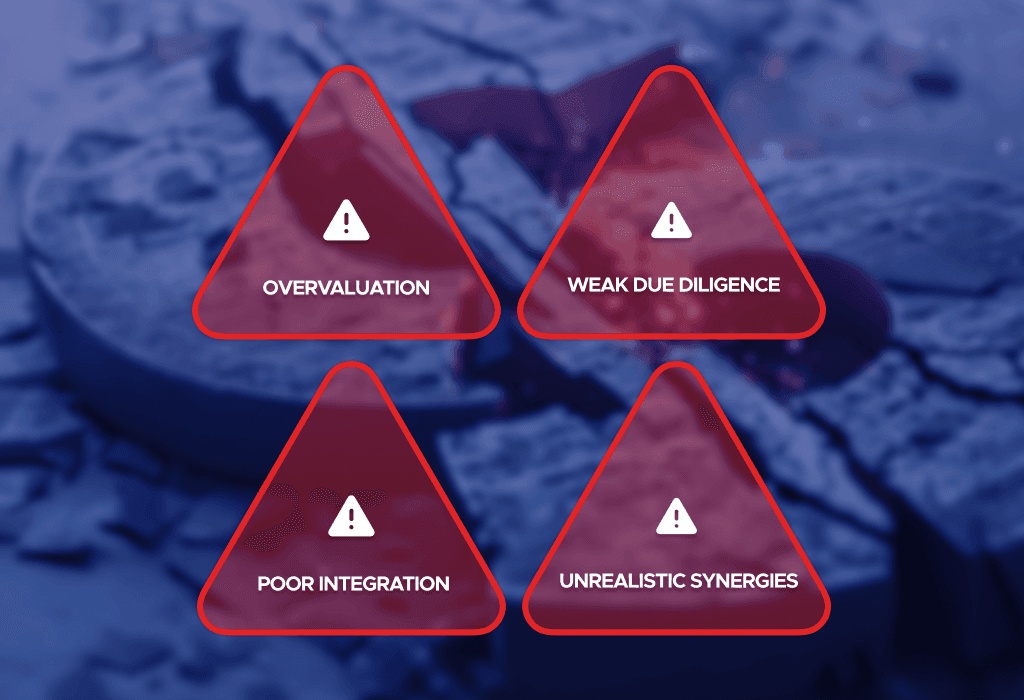
The problems with mergers and acquisitions often start before closing. A buyer may overpay because the target has fast growth, a strong brand, unique technology, or access to a new market. Valuation then depends on optimistic revenue growth, cost savings, and cross-selling. If these assumptions are not tested against operational reality, the buyer pays for value that still has to be created after closing.
HP’s acquisition of Autonomy shows how overvaluation and weak diligence can damage a deal after closing. HP bought the UK software company for about $11 billion and later took an $8.8 billion writedown, alleging serious accounting improprieties at the acquired business. The case became a warning for buyers that financial due diligence should go beyond headline revenue, growth story, and strategic fit. If the buyer does not test the quality of earnings, revenue recognition, customer contracts, and management assumptions, acquisition challenges can turn into a major impairment soon after closing.
Unrealistic synergy expectations create the same risk. Synergies are often presented as automatic: shared procurement, lower overhead, stronger distribution, combined customers, or better technology. In practice, each synergy requires a plan, budget, accountable owners, and time. Cost synergies may require layoffs, supplier renegotiations, ERP migrations, or office consolidations. Revenue synergies are less predictable because customers may resist the new offer, and sales teams may lose focus.
Poor integration planning is another common reason why deals fail. A signed purchase agreement does not merge reporting systems, customer data, IT architecture, or corporate cultures. Sprint and Nextel show how damaging this can be: incompatible networks, billing issues, and cultural friction contributed to a major writedown and years of underperformance.
Financial challenges in M&A transactions
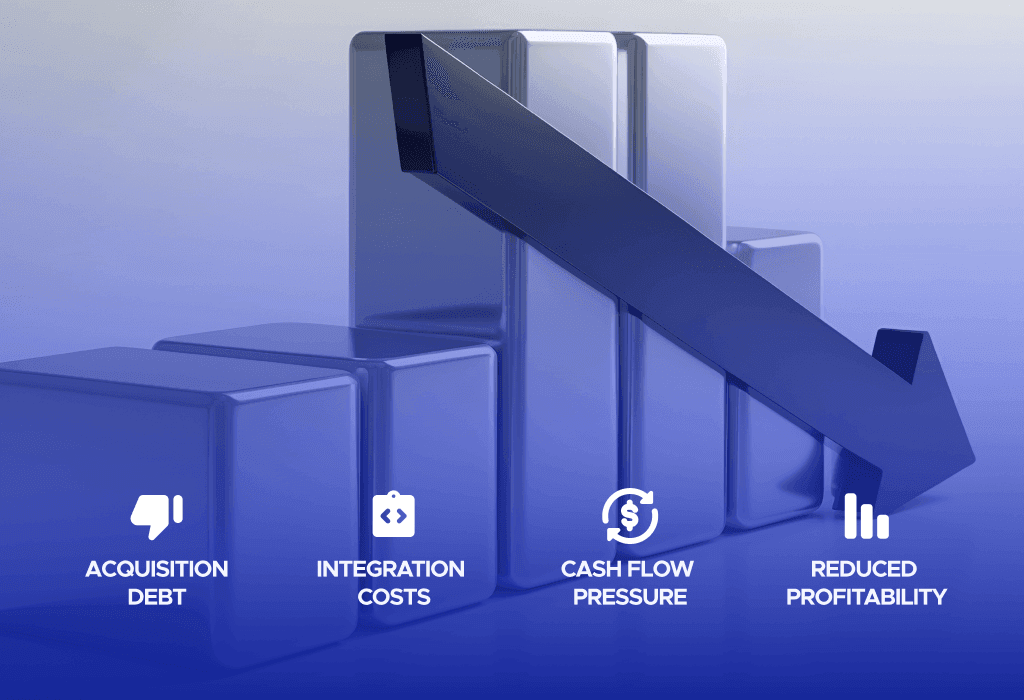
Financial risks in acquisitions extend beyond the purchase price. If the buyer uses debt, the combined company must service that debt even when synergies take longer than expected. A deal that appears accretive in a spreadsheet can become restrictive if cash flow weakens, interest rates change, or restructuring absorbs more capital than planned.
Inaccurate forecasting is one of the most common issues in mergers and acquisitions. Forecasts may rely on stable demand, loyal customers, smooth system migration, no regulatory delay, and no talent loss. The model may ignore dis-synergies such as customer churn, duplicate work during transition, lower productivity, or supplier disruption. Conservative models should include downside scenarios and realistic timelines.
Working capital disputes often appear after closing. The final price may depend on receivables, inventory, accrued expenses, deferred revenue, and debt-like items. If definitions are unclear, a technical accounting issue can become a post-closing conflict.
Unexpected integration costs are another financial risk. EY-Parthenon research shows that one-time M&A integration costs depend on changes in the operating model, workforce, technology, and infrastructure. Transaction costs can range from 1% to 4% of deal value, while complex integrations may cost more.
Operational and integration challenges
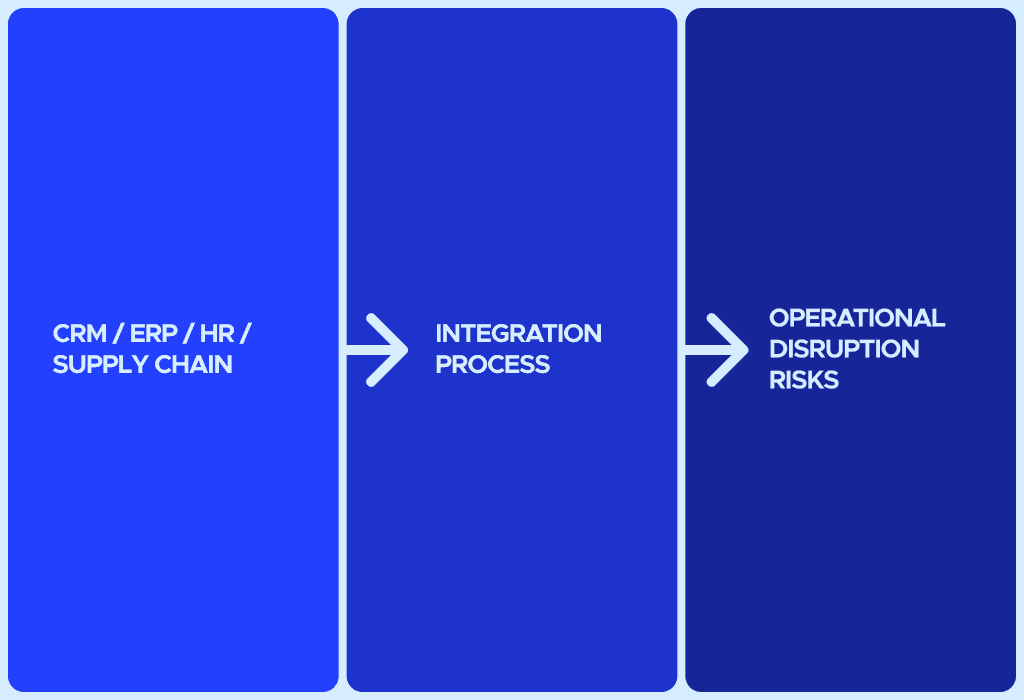
The integration phase often becomes the most expensive part of an acquisition. IT integration is usually one of the first obstacles. Companies may have different CRM systems, ERP platforms, cybersecurity policies, cloud environments, data structures, and reporting standards. Running parallel systems may be necessary for a period, but it increases cost, slows reporting, and expands cyber risk.
ERP migration is especially complex because it affects finance, procurement, inventory, payroll, tax reporting, and internal controls. A rushed migration can disrupt operations. A slow migration can keep the combined company dependent on duplicated systems for too long. In both cases, integration costs must be planned before closing.
Operational alignment also means removing duplicated offices, warehouses, suppliers, support functions, and management layers. These overlaps are often the source of expected cost synergies, but removing them can affect service quality, morale, and customer retention. Supply chain integration adds risk because vendor consolidation, logistics changes, and contract renegotiation can disrupt production or delivery.
Workforce restructuring is equally sensitive. Severance, retention bonuses, new roles, changed reporting lines, and leadership appointments can affect employee engagement. Exxon’s Pioneer acquisition shows that even well-planned production synergies may take 18–24 months to fully appear.
Legal and regulatory challenges
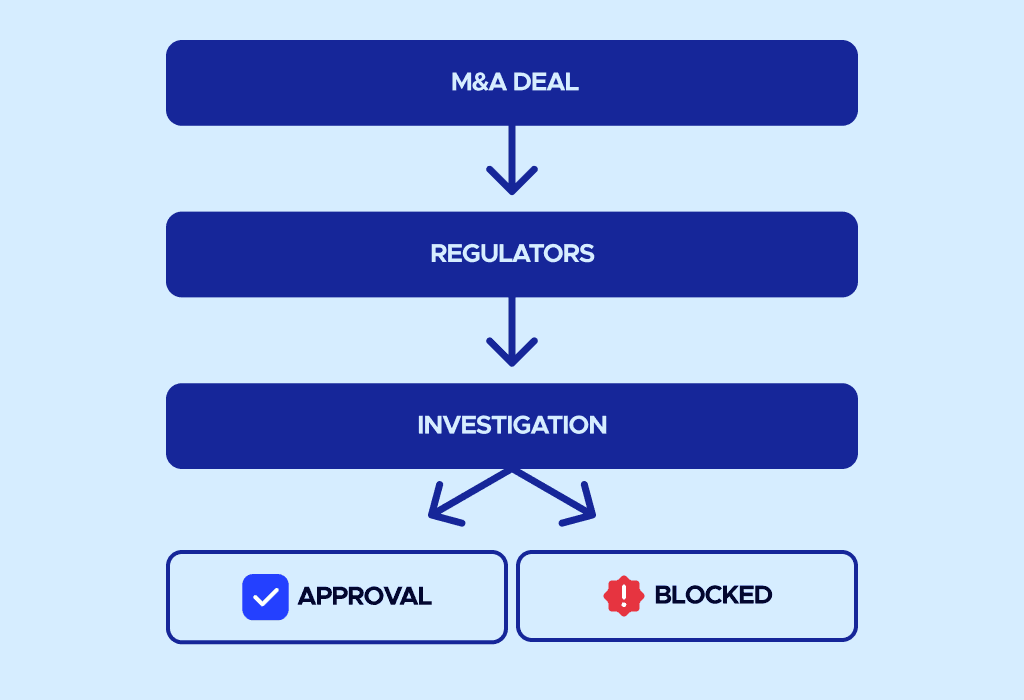
Legal and regulatory risk can delay closing, force remedies, or stop a transaction entirely. Adobe abandoned its $20 billion acquisition of Figma following scrutiny from the UK and the EU. JetBlue and Spirit canceled their $3.8 billion merger after a U.S. judge blocked the deal. Kroger’s planned $25 billion acquisition of Albertsons was also blocked on competition grounds.
Regulatory approval is not a formality. Authorities can challenge a deal if they believe it may raise prices, reduce choice, harm workers, restrict innovation, or weaken competition. Buyers must assess antitrust risk early, especially when the target is a direct competitor or when the combined company would control important data, distribution channels, or infrastructure.
Compliance risks can be just as damaging. A buyer may inherit sanctions exposure, anti-bribery issues, labor claims, tax problems, environmental obligations, or sector-specific licensing failures. In cross-border deals, companies may also need foreign investment approvals, national security reviews, and compliance with data transfer requirements.
Contract transfer issues add complexity because supplier, customer, lease, financing, or IP agreements may require consent before assignment. Data privacy and cybersecurity also matter: a target’s customer database, vendor access, source code, cloud controls, and breach history can affect valuation, closing, and post-deal liability.
Human and cultural challenges

Human risk is often treated as a soft issue, but it has a direct financial impact. Culture shapes decisions, communication, risk tolerance, and change readiness. Mercer research on more than 4,000 deals found that cultural issues often delay synergies and prevent transactions from meeting financial targets.
Employee retention is one of the first tests after the announcement. People want to know whether their roles will change, who they will report to, whether compensation will be affected, and what the new company expects from them. If leadership does not communicate clearly, uncertainty fills the gap. Strong employees may leave before the integration team understands which skills are most important.
Management conflicts can also slow integration. If both legacy companies keep parallel decision structures, teams may wait for direction or compete for influence. If the buyer imposes its approach too quickly, it may damage the target’s strengths. Cultural mismatch was evident at DaimlerChrysler, and AOL-Time Warner became another classic case of cultural and strategic misalignment.
How companies reduce M&A risks
Companies reduce transaction risks by treating M&A as a full-cycle process rather than a signing event. Due diligence should cover financial, legal, tax, operational, commercial, HR, IT, cybersecurity, ESG, and regulatory issues. It should also test the deal thesis: why this company, why now, why an acquisition instead of a partnership or an internal build, and what must be true for value to appear.
Integration planning should start before signing whenever the deal probability is high. The buyer needs a Day 1 plan, a 100-day plan, a target operating model, workstream owners, synergy tracking, and escalation rules. An Integration Management Office can coordinate finance, HR, IT, legal, commercial, and operations teams so that decisions are not delayed.
A virtual data room supports this process by giving approved parties controlled access to documents, Q&A, contracts, financial records, and diligence materials. A well-structured VDR reduces confusion, supports audit trails, and helps teams find issues before they become post-closing disputes.
Risk analysis should be connected to the deal structure. If a risk is material, it should affect price, escrow, indemnities, earnouts, warranties, closing conditions, or termination rights. Synergies should be probability-weighted and adjusted for customer churn, employee attrition, productivity loss, and integration cost. Post-merger governance should then track whether the promised value is actually delivered.
FAQ
What are the biggest challenges in mergers and acquisitions?
The biggest challenges are overvaluation, weak due diligence, poor integration planning, hidden liabilities, regulatory approval, IT migration, cultural integration, employee retention, and unexpected integration costs.
Why do M&A deals fail?
M&A deals fail when buyers pay too much, overestimate synergies, underestimate integration complexity, miss hidden liabilities, or fail to align leadership, culture, systems, and operations after closing.
How long does post-merger integration take?
Post-merger integration can take from several months to several years. Large IT, ERP, operational, and cultural integrations often take 18–36 months.
What is the most expensive part of M&A integration?
The most expensive parts are often IT and ERP migration, workforce restructuring, duplicated operations, compliance remediation, and supply chain alignment.
How can companies reduce M&A risks?
Companies reduce M&A risks through deeper due diligence, conservative valuation, early integration planning, a structured VDR, realistic synergy models, clear governance, and post-closing performance tracking.
Conclusion
M&A risks affect finance, operations, legal, people, and technology simultaneously. A weak forecast can increase debt pressure. Poor IT integration can disrupt reporting and customer service. Cultural mismatch can cause talent loss. Regulatory delays can change the economics before closing. Hidden liabilities can drain value years after the deal. Successful acquisitions are built on discipline: careful due diligence, a realistic acquisition strategy, detailed integration planning, strong governance, and accountability for realizing synergies. Signing completes the transaction, but integration determines whether it creates value.