Key Takeaways
Multiple bidders increase access complexity because strategic buyers, financial sponsors, lenders, advisors, and clean teams require different information.
Sensitive financial and commercial data should be disclosed in stages rather than made equally visible to every participant.
Permission Groups structure the process by bidder or workstream, while Granular Permissions limit access to individual folders and documents.
Confidentiality acceptance should form part of participant onboarding before document review begins.
Audit trails and activity reports support governance, but bidder activity should be treated as an engagement signal rather than proof of intent.
During PE or financial sell-side M&A, the main challenge is controlling who accesses what data, when, and under what conditions. This pressure peaks when divesting portfolio companies, regulated entities, or asset portfolios. Sellers must keep multiple bidder and adviser teams moving without exposing sensitive financial, legal, or HR files. A specialist VDR acts as a transaction-governance layer, combining structured document organization with precise, auditable disclosure controls.
Why Sell-Side M&A Creates Specific Pressure for PE and Financial Companies
Sell-side M&A creates unique operational pressure for private equity and financial companies because they must coordinate disclosures across multiple independent organizational tiers. Information is rarely held in one place; it is scattered across the sponsor, the operating management of the portfolio company, internal compliance departments, and various external advisory teams.
In a portfolio company sale, the PE sponsor typically controls the transaction, yet management and portfolio-company employees hold the underlying operational details. This structure creates a practical governance issue: who prepares, approves, uploads, updates, and releases each document?
These processes combine highly sensitive commercial records with personal, regulatory, client, fund, financing, and portfolio-level information, meaning the consequences of excessive access can affect several stakeholders simultaneously. The table below outlines the diverse document categories that must be carefully managed:
Financial: Audited accounts, budgets, forecasts, working-capital data, debt schedules, covenant information.
Commercial: Customer concentration, pricing models, margins, pipeline, churn, sales contracts.
Legal: Corporate records, material contracts, disputes, claims, intellectual-property documents.
HR: Organisation charts, employment agreements, compensation, benefits, personal information.
Operational: Supplier contracts, facilities, operating KPIs, inventory, IT and technology systems.
Regulatory: Licences, risk reports, compliance assessments, regulatory correspondence, internal policies.
Portfolio/Investment: Asset-level valuations, portfolio performance, remaining commitments, investment memoranda.
Cyber & Data: Security reports, incident logs, system architecture, customer data, third-party risks.
For financial companies, the exact material depends on whether the subject is a regulated entity, lending portfolio, customer book, or payment operation. Using an M&A data room for financial companies allows the deal team to coordinate these complex data sets without compromising security or compliance.
Multiple Bidders and Advisor Teams: Why Access Becomes Harder to Control
Managing buyer access control in M&A becomes increasingly difficult because strategic buyers, financial sponsors, lenders, lawyers, and clean teams all require entirely different depths of information. Providing a single, uniform level of access to this diverse matrix of participants creates unacceptable confidentiality and competitive risks.
To manage this complex environment, sellers must move away from flat folder structures. The solution lies in structured, staged disclosure in M&A, allowing access to expand gradually as bidders progress through the transaction stages:
Stage 1 — Initial review: Teasers, high-level historical headline financials, market overviews, and limited management information.
Stage 2 — Active diligence: Detailed financials, key contracts, tax records, legal information, and core operational materials.
Stage 3 — Shortlisted bidders: Customer-level or contract-level data, detailed pricing and margin information, deeper technology materials, and lender diligence.
Stage 4 — Exclusivity or confirmatory diligence: Remaining highly sensitive items, updated documents, separation materials, and final agreements.
This model preserves competitive tension by ensuring bidders receive enough information to conduct their current stage of diligence, while the seller avoids exposing late-stage or highly sensitive material earlier than necessary. Through a centralized VDR, these buyer groups can be securely managed under one project without overlapping visibility.
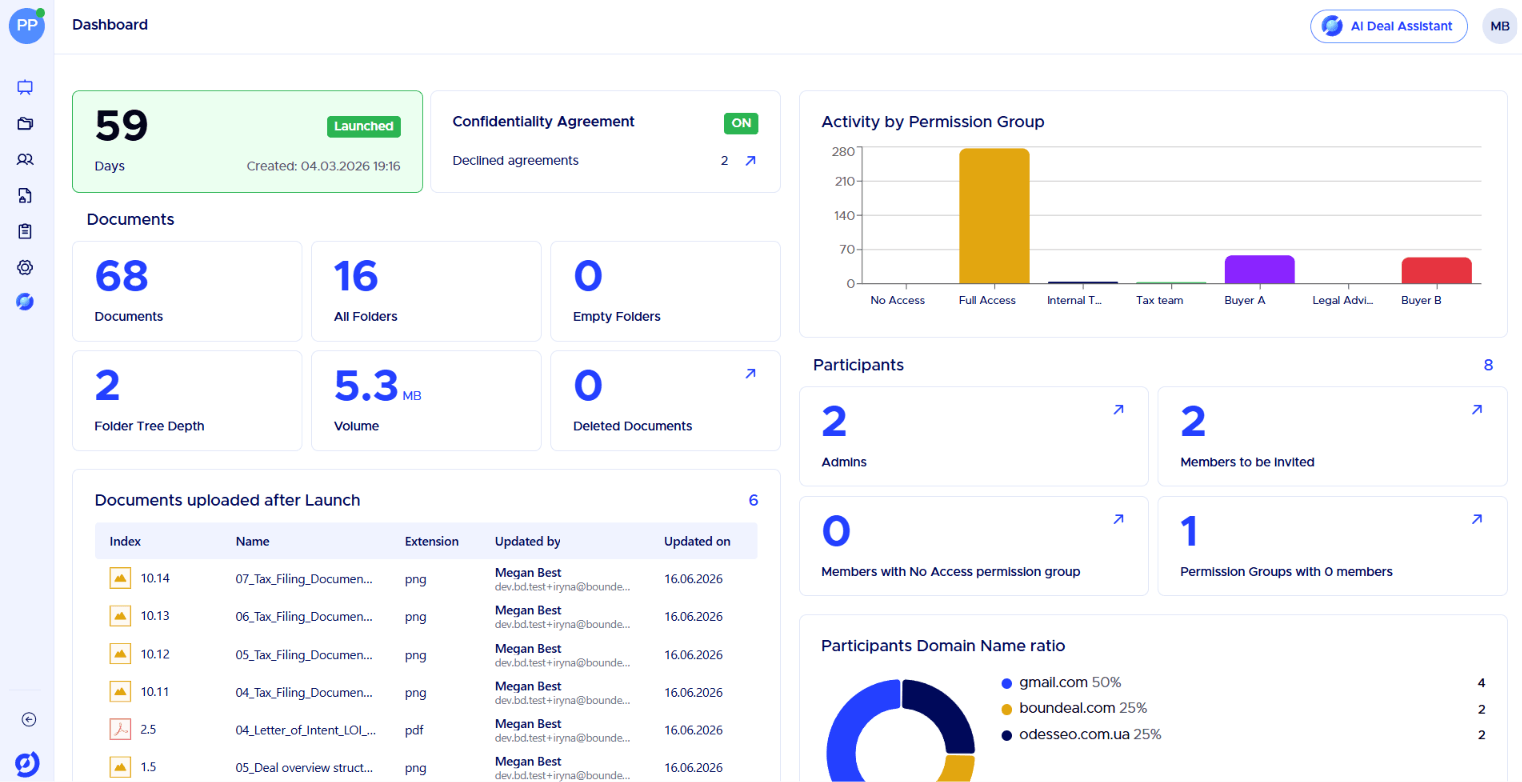
The Boundeal VDR platform ensures strict separation of visibility and operational control between the administrator and participant roles. Members have access only to the Documents and Reports & Insights sections.
Administrators have access to powerful management features, including a dashboard, setting up permission groups, participants,and an AI-powered assistant, providing centralized project management.
Sensitive Financial and Commercial Information: What Can Go Wrong
Exposing sensitive commercial or financial information prematurely can damage negotiations, reduce confidence in the sale process, and cause avoidable internal or external concern. Without controlled disclosure, high-value corporate data can easily fall into the wrong hands.
The practical risks of uncontrolled disclosure include:
Customer lists and customer-level revenue: Direct competitors could exploit client lists, identify customer dependencies, expose contract economics, or cause a loss of customer confidence.
Pricing and margins: Detailed unit economics and procurement costs reveal exactly how the business competes. Broad early access can destroy the target's market advantage if the bidder withdraws.
Forecasts and business plans: Early access exposes management assumptions, planned market entries, product roadmaps, hiring plans, and expected customer wins before bidder seriousness is verified.
Debt schedules and financing information: Exposing covenants, maturity dates, and liquidity constraints can weaken the seller's negotiating leverage, particularly with multiple lenders involved.
Legal claims and compliance matters: Uncontrolled access can expose privileged legal strategies, regulatory communications, and internal investigations. Note: VDR permissions do not preserve legal privilege automatically; access procedures must always be coordinated with legal counsel.
HR and management information: Exposing compensation, retention agreements, and incentive plans can disrupt target management, cause personnel anxiety, and lead to employee attrition.
Appropriate security depends heavily on the sensitivity, context, scale, and risks of the processing, making precise sell-side data room control an absolute necessity.
How Permission Groups Help Structure Access
Permission Groups allow administrators to organize VDR users by their functional role in the transaction rather than managing individual, unrelated permission profiles for dozens of different users. Standardizing access through defined groups ensures that participants performing the same function start from the exact same security baseline.
For example, a seller can establish separate groups for the PE sponsor deal team, portfolio-company management, investment-bank advisors, external legal teams, and individual bidding entities (e.g., Strategic Buyer A, Financial Buyer B, and Buyer A Clean Team). As NIST’s Role-Based Access Control (RBAC) guidance explains, individual access-control lists can be costly and prone to error, whereas role-based access assigns users to roles and privileges that reflect their specific organizational responsibilities.
How Granular Permissions Reduce Unnecessary Exposure
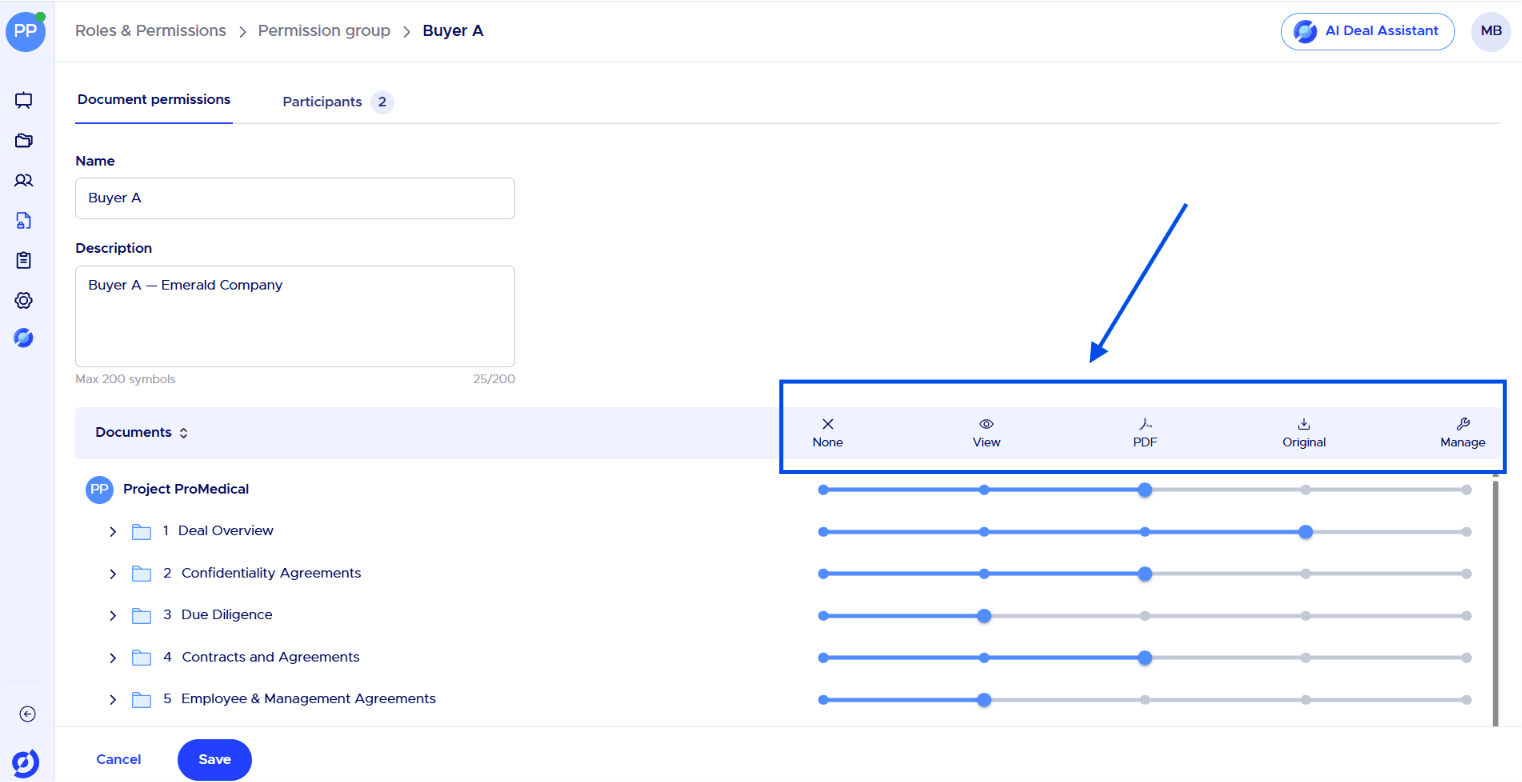
Granular Permissions enforce the security principle of "least privilege" by limiting each participant’s actions to the minimum access required to perform their assigned due diligence task. This prevents unnecessary exposure of highly sensitive files while keeping the process practical and efficient.
NIST defines the principle of least privilege as limiting users or processes to the minimum privileges and resources necessary to complete their assigned functions. In a sophisticated M&A data room, this access is defined across three distinct layers:
Permission Groups answer: "Which transaction team does this participant belong to?"
Roles & Permissions answer: "What can this participant do in the project?" (e.g., administrator, contributor, uploader, or reviewer).
Granular Permissions answer: "What can the participant do with this particular folder or document?"
These layers allow for precise operational control. For instance, while all approved bidders can preview historical financial statements, only shortlisted bidders can access detailed forecasts. Similarly, lenders can be restricted to debt and cash-flow folders, while legal advisors are limited to litigation and corporate folders.
Confidentiality Agreement and Access Discipline
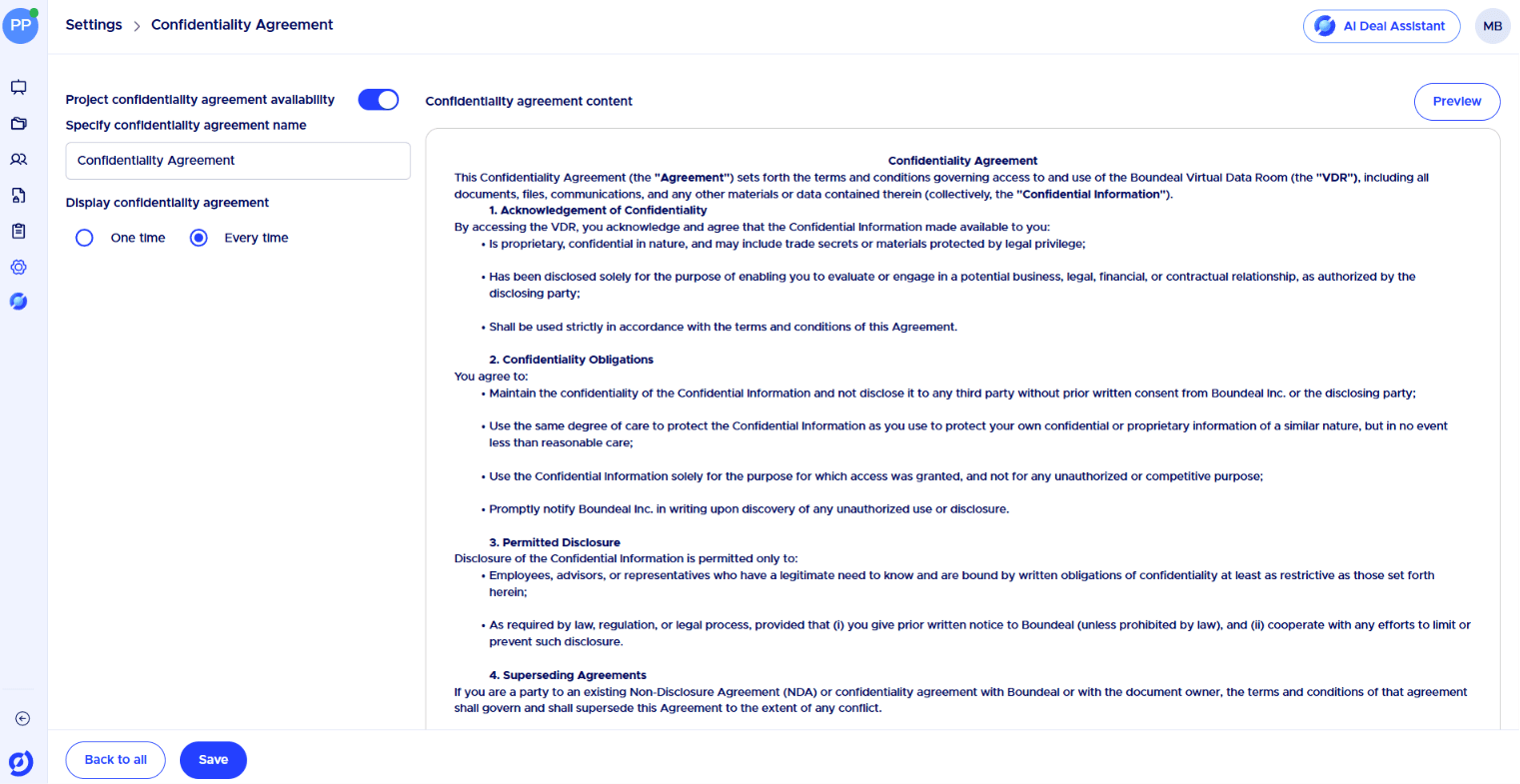
An upfront Confidentiality Agreement serves as a mandatory, system-enforced entry point that requires participants to accept your transaction terms before viewing any data room files. This feature establishes strict compliance discipline from the very beginning of the process.
Managing non-disclosure agreements (NDAs) manually via email before granting data room access is slow and introduces administrative risk. If an administrator accidentally sends a VDR invitation before an NDA is executed, confidential data can be exposed instantly.
A professional VDR automates this workflow. The participant receives an email invitation, reviews the customized confidentiality terms upon their first login, and must click to accept them before access to the project begins. This automated process ensures that:
Onboarding is completely standardized for all global participants.
The risk of granting access before required legal steps are completed is eliminated.
Deal teams can easily document and prove their compliant access procedures.
Every user's entry is directly bound to the accepted project terms.
It is important to note that this platform acceptance is an operational control designed to complement the transaction's primary NDA and legal process. It does not replace professional legal advice, negotiated NDAs, antitrust protocols, or data-protection analysis.
Audit Trails, Reports & Insights, and Export Index
Audit trails, real-time Reports & insights, and the Export Index function as separate, critical governance tools that provide sellers with a complete record of data room structure and participant activity. These features help investment teams monitor bidder engagement and maintain process control.
To manage a sale effectively, PE teams and financial sellers require distinct tracking capabilities:
Audit Trails: The Activity Record
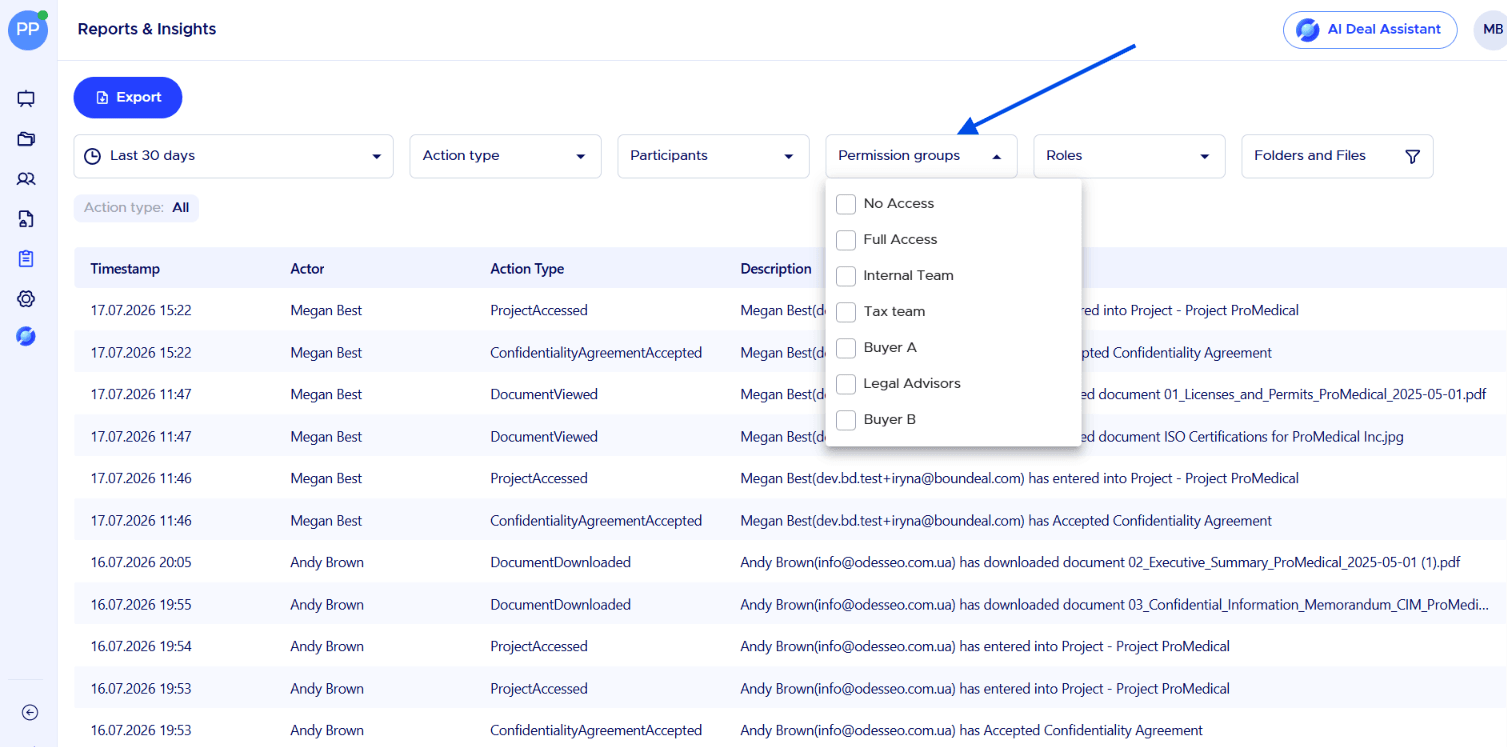
Audit trails create a permanent, time-stamped log of every action within the VDR. They record the specific participant, their Permission Group, the document or folder accessed, the action taken (view, download, or modify), and the exact timestamp.
Reports & Insights: Process Visibility
Real-time reports help investment bankers and PE sponsors identify which bidders are actively reviewing materials, which folders (such as transfer pricing or intellectual property) are attracting sustained attention, and where review activity has stalled. This bidder engagement data provides valuable signals for prioritizing follow-ups, preparing management Q&A sessions, and identifying incomplete workstreams.
Export Index: The Structural Record
While audit trails record participant actions, the Export Index records the room’s physical structure. It allows the deal team to download the complete data room hierarchy as an Excel table. This sheet is invaluable for reconciling the VDR against diligence checklists, securing internal approvals, and maintaining a structured, reviewable record for the transaction file.
FAQ
What are the most common sell-side M&A pain points for private equity firms?
Private equity firms must coordinate disclosures across the sponsor, portfolio company management, advisors, and lenders while managing multiple parallel bidding groups. They must protect sensitive financial and operational data, adapt user permissions as the deal progresses through different stages, and maintain an unalterable, auditable record of all participant activity for compliance and reporting.
Why do financial companies need controlled M&A data rooms?
Financial companies handle highly sensitive information, including client records, proprietary financial models, tax structures, compliance audits, and regulatory correspondence. Controlled access ensures that strategic buyers, financial sponsors, lenders, and advisors only view the specific documents relevant to their role, preventing accidental data leaks and preserving competitive tension.
How do Permission Groups help in sell-side M&A?
Permission Groups allow sellers to organize users by their functional role or bidder group (such as Strategic Buyer A, Financial Sponsor B, or Lender Team). Administrators can assign specific folder visibility and document-action settings to the entire group at once, ensuring consistency, saving time, and reducing the risk of human error.
What is the difference between Permission Groups and Granular Permissions?
Permission Groups organize VDR users into functional teams to simplify administration. Granular Permissions define the exact actions those users can perform on specific folders or documents (such as view-only access, folder restrictions, or disabling original-file downloads). Together, they enforce the principle of least privilege.
Why is bidder activity tracking important?
Tracking bidder activity provides investment bankers and sellers with real-time visibility into how diligence is progressing. It helps identify active buyers, spot potential transaction bottlenecks, and prepare for Q&A sessions. However, activity metrics should be treated as engagement signals, not as definitive proof of a bidder's valuation or willingness to close.
Conclusion
A virtual data room is a vital tool for transaction control, not just a basic document storage space. For private equity and financial sellers, maintaining control over information exposure is essential to protect deal value. By using Permission Groups, Granular Permissions, and upfront Confidentiality Agreements, sellers can manage complex transactions securely. With the addition of real-time Reports & Insights and the Export Index tool, deal teams can ensure their sell-side processes remain organized, auditable, and highly successful.