Key takeaways of the article
A structured startup due diligence process reduces investment risk by systematically verifying financial, legal, and operational assumptions before closing a deal.
A complete financial due diligence checklist focuses on revenue quality, burn rate, and unit economics, as flawed projections often lead to capital losses.
Legal due diligence for startups ensures proper ownership, enforceable contracts, and compliance, with CB Insights linking 18% of failures to legal issues.
Market analysis validates real demand and competitive positioning, helping investors determine whether growth assumptions are realistic and scalable.
Operational due diligence evaluates execution capability, as weak processes and team gaps remain leading causes of startup underperformance.
Startup investments offer high return potential but carry significant uncertainty. A structured startup due diligence process allows investors to validate assumptions, assess risks, and build a clear understanding of the business before committing capital.
Why due diligence is crucial for startup investments
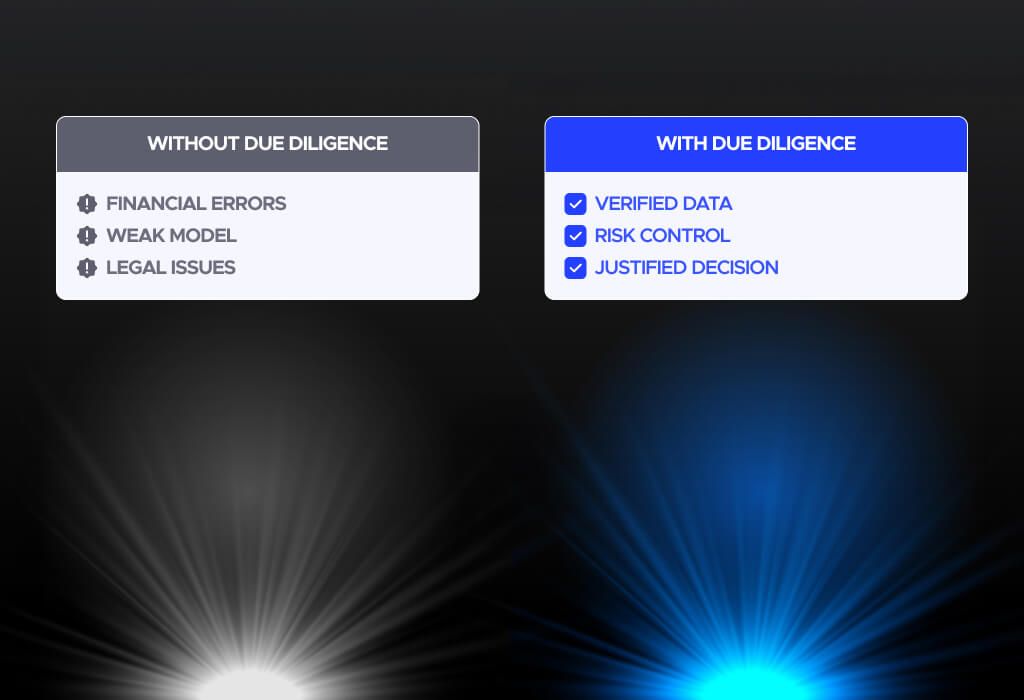
Startup due diligence gives investors a structured way to verify data instead of relying on founder's narrative alone. In early-stage deals, where transparency is limited and internal controls are still developing, diligence becomes the primary decision-making tool. It allows investors to move from assumptions to verifiable evidence across financial, legal, market, and operational dimensions.
Without proper investor due diligence, critical risks often remain hidden until late stages or even after closing. These may include inaccurate financial reporting, unclear ownership structures, weak governance, hidden liabilities, or fragile revenue models. According to research by CB Insights, most startup failures are linked to fundamental business issues such as poor product-market fit(43%) and wrong market timing (29%), but legal and compliance problems still appear as recurring risk factors that can delay or completely block deals.
Additional studies support this. Harvard Business School highlights that information asymmetry and lack of proper verification significantly increase investment risk in early-stage ventures, while McKinsey & Company notes that structured due diligence improves decision quality and reduces downside exposure in high-uncertainty investments.
In practice, due diligence is not only about identifying risks. It also supports valuation, validates growth assumptions, and helps investors assess whether the team can execute. A well-structured review provides clarity on both downside scenarios and real upside potential, turning uncertainty.
Financial due diligence checklist
Financial review forms the backbone of any startup due diligence process. The goal is to understand how the business generates revenue, uses capital, and manages financial risks.
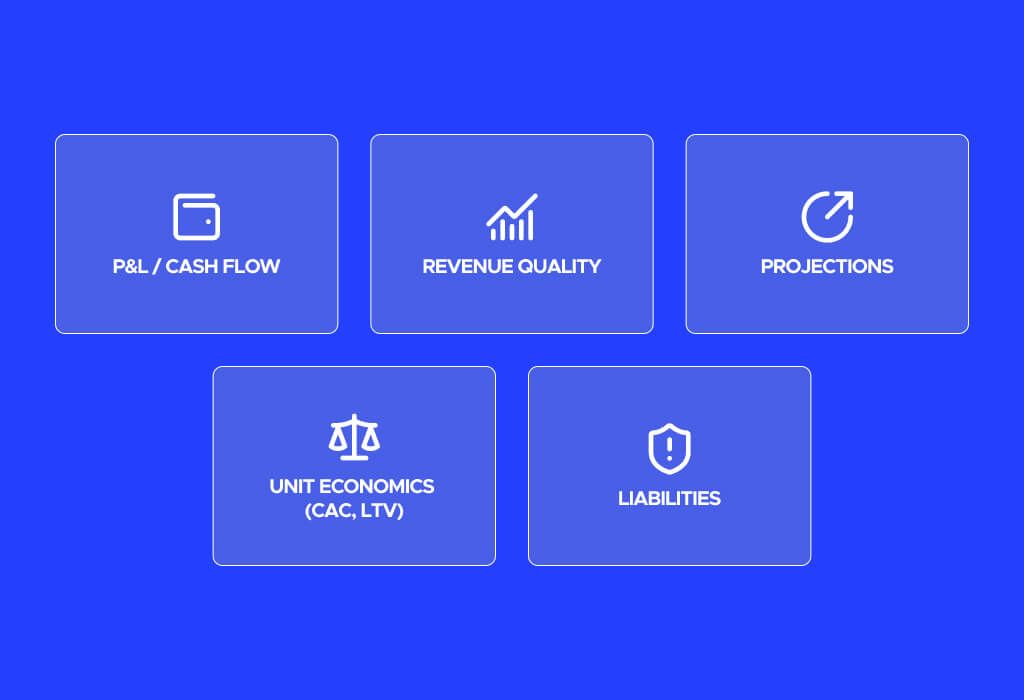
1. Review core financial statements
Start with the income statement, balance sheet, and cash flow statement. Together, they show revenue growth, margin trends, cost structure, asset quality, liabilities, working capital, burn rate, and overall liquidity. This step helps investors understand the company’s current financial position and whether the numbers reflect a stable operating reality.
2. Assess revenue quality
Investors need to look beyond topline growth and evaluate how reliable that revenue actually is. This includes reviewing the share of recurring versus one-time revenue, exposure to customer concentration risk, consistency of revenue recognition practices, and margin stability over time. Strong growth is less convincing when revenue is volatile or heavily dependent on a small number of clients.
3. Validate financial projections
Forecasts should be tested through the assumptions behind them rather than accepted at face value. Investors typically review expected growth rates, pricing logic, hiring plans, cost structure expansion, and scenario analysis across base, downside, and upside cases. The purpose is to determine whether projected performance is realistic and supported by operational logic.
4. Analyze unit economics
This step focuses on whether the business model can scale efficiently. Key metrics include customer acquisition cost (CAC), lifetime value (LTV), payback period, contribution margin, and the overall LTV: CAC ratio, with a benchmark of around 3:1 often used as a healthy signal. Weak unit economics may indicate that growth is expensive and difficult to sustain.
5. Review risks and liabilities
The final step is to identify financial exposures that may reduce the attractiveness of the investment. This includes debt obligations, tax exposure, contingent liabilities, internal controls, and the overall quality of financial reporting. Even a fast-growing startup can become a weak investment case if hidden risks or poor controls create uncertainty around future performance.
Legal due diligence checklist
Legal review is a core part of startup due diligence because even a promising business can become uninvestable if its legal foundation is weak. The purpose of this stage is to confirm that the company is properly formed, owns its key assets, complies with relevant laws, and is not carrying legal risks that could damage value after the investment.
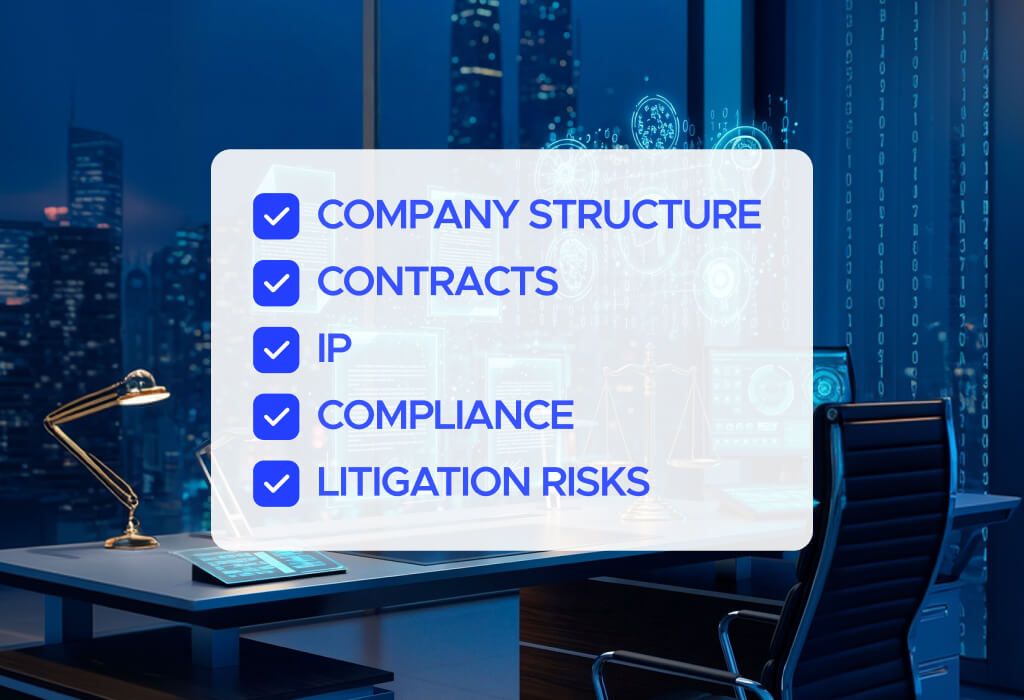
1. Verify corporate structure
Start by reviewing the company’s formation documents, bylaws, shareholder agreements, board resolutions, and cap table. This step helps investors confirm that ownership is accurate, approvals were properly documented, and the company is structured in a way that can support future fundraising, M&A transactions, and eventual exit planning.
2. Review contracts and commercial obligations
Investors should then examine key agreements with customers, suppliers, partners, employees, and contractors. The goal is to identify problematic terms such as unfavorable liabilities, change-of-control clauses, exclusivity restrictions, weak termination terms, or obligations that could become a barrier after closing.
3. Confirm intellectual property ownership
In many startups, intellectual property is one of the main sources of value, so investors need to verify ownership of patents, trademarks, copyrights, code, proprietary processes, and related assets. This also includes checking IP assignment agreements and making sure no former founder, employee, or contractor retains unresolved rights or claims.
4. Check compliance and regulatory exposure
This stage focuses on whether the startup complies with applicable tax, labor, privacy, licensing, and industry-specific requirements. Investors need to understand whether the company has any gaps in regulatory compliance that could lead to fines, restrictions, operational disruption, or reputational damage.
5. Review litigation risks and legal red flags
The final step is to assess ongoing, past, or threatened disputes, along with broader warning signs such as weak governance, incomplete records, inconsistent disclosures, or sloppy compliance practices. These issues may not always appear serious at first, but they can materially affect valuation, delay funding, or stop a deal entirely.
Market and competitive analysis
Market review helps investors determine whether a startup operates in an environment that can support scalable growth. Even a strong product will struggle without sufficient demand or a clear competitive position. The goal of this stage is to validate market size, confirm real customer demand, and assess whether the company can capture and defend its share.
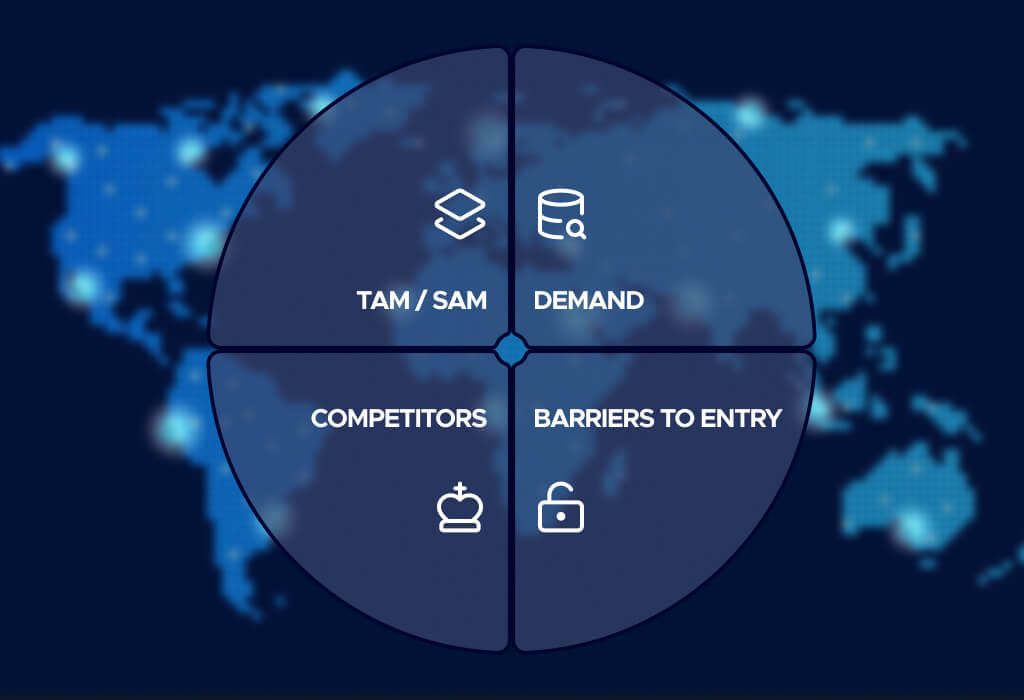
1. Gauge the overall market opportunity and expansion trajectory
Venture capitalists kick off their assessment by examining the total addressable market (TAM), the serviceable addressable market (SAM), and broader industry forces. They dig into projected compound annual growth rates, prevailing macroeconomic shifts, regulatory influences, and technological tailwinds that could accelerate (or hinder) uptake. Size alone isn't enough—an expansive market only becomes attractive when it's realistically reachable and demonstrates momentum consistent with the startup's projected scaling path.
2. Confirm genuine customer interest and traction
Investors then shift focus to verifying whether demand is authentic rather than speculative. They scrutinize key indicators such as customer retention/churn levels, engagement and usage patterns, funnel conversion percentages, and evidence of price sensitivity or actual payment behavior. Insights drawn from direct user conversations, surveys, cohort analyses, and real-world behavioral signals help determine if the company has truly nailed product-market fit or remains anchored in unproven early hypotheses.
3. Map out the rivalry and protective edges
Next comes a thorough scan of both direct rivals and substitute solutions, weighing how the startup stacks up across dimensions like cost structure, feature depth, brand perception, switching costs, and user stickiness. This evaluation also uncovers potential entry barriers (technological, network-based, regulatory, etc.) and tests whether the business possesses a durable edge—such as proprietary tech, data advantages, or exclusive partnerships—or risks being quickly overtaken or commoditized.
4. Scrutinize the customer acquisition and revenue execution plan
In the final core review, investors dissect the startup's go-to-market playbook and its ability to translate interest into sustainable income. They examine channel effectiveness (organic, paid, partnerships, viral), typical sales cycle lengths, customer acquisition costs relative to lifetime value, payback periods, and the potential to scale distribution without proportional cost explosions. Ultimately, even the most promising market remains worthless unless the company can penetrate and monetize it efficiently, predictably, and at a growing scale.
Operational due diligence
Operational review determines whether a startup can execute on its strategy and scale without breaking. Even with strong financials and a validated market, weak execution can undermine the entire investment case. The goal of this stage is to assess team capability, internal processes, scalability, and risk management.

1. Evaluate the founding team and key employees
Investors review the background, experience, and track record of founders and core team members to assess execution capability. This includes leadership quality, functional expertise, hiring decisions, and team dynamics. Reference checks are often used to validate credibility, decision-making, and the ability to operate under pressure.
2. Review internal processes and execution discipline
The next step is to understand how the business actually operates day-to-day. Investors examine workflows, reporting systems, KPIs, decision-making structures, and documentation quality. The goal is to determine whether the company has enough structure to manage growth or relies too heavily on ad hoc processes.
3. Assess the scalability of operations
Investors analyze whether the startup can handle growth without major disruptions. This includes reviewing infrastructure, product delivery processes, onboarding systems, supply chains, and operational dependencies. A business that works at a small scale may fail if its systems cannot support expansion.
4. Identify operational risks and bottlenecks
This step focuses on detecting vulnerabilities such as dependence on key individuals, single suppliers, limited distribution channels, or manual processes that do not scale. A proper risk assessment helps investors understand where growth may create stress or failure points.
5. Review culture, HR practices, and control systems
Finally, investors evaluate how the organization functions internally. This includes employee retention, hiring practices, compensation structures, and performance management. They also review basic controls such as data protection, compliance processes, and risk management systems to ensure the company can scale without losing operational control.
Conclusion
A strong startup due diligence process helps investors move beyond founder narratives and evaluate what is actually true, scalable, and defensible inside the business. The most effective investor due diligence checklist does not stop at financial statements or legal files. It connects financial analysis, market demand, team strength, operational readiness, and intellectual property review into one decision framework. When investors approach due diligence for startups with that level of discipline, they improve valuation judgment, reduce downside risk, and make better long-term bets.
FAQ
What is startup due diligence?
Startup due diligence is an investor’s deep check of a company before funding it. It is used to test the business, verify claims, and spot risks before money is committed.
What should a financial due diligence checklist include?
It should cover the main financial statements, revenue stability, cash burn, runway, debt, taxes, and core metrics like CAC, LTV, and payback period. Investors also review forecasts to see whether growth assumptions make sense.
Why is legal due diligence for startups important?
Legal problems can weaken valuation, slow the round, or stop the deal. Investors need to confirm proper company structure, clear IP ownership, legal compliance, and the absence of major disputes.
How do investors assess market opportunity during due diligence?
They review market size, customer demand, competition, and the go-to-market model. The goal is to understand whether the startup can win real customers in a market that is large enough to matter.
How long does due diligence for startups usually take?
Usually from a few weeks to about two months. Timing depends on the stage of the startup, the size of the deal, and how much detail investors need to review.