Key Takeaways
Pre-money valuation represents a company’s agreed value before new investment, while post-money valuation includes the new capital.
In a simple priced equity round, investor ownership equals the investment divided by post-money valuation.
Option pools, SAFEs, and convertible notes can affect founder dilution beyond the headline valuation.
Founders should review the fully diluted capitalization table and investor rights before accepting a term sheet.
A virtual data room helps organize documents for fundraising and investor due diligence.
Introduction
When raising capital, founders need to understand how valuation affects ownership. The difference between pre-money and post-money figures determines how much equity an investor receives for a given investment. Understanding the calculation and the terms behind it helps founders compare offers, assess dilution, and negotiate a financing round with greater confidence.
What Is Pre-Money Valuation?
Pre-money valuation is the agreed value of a company immediately before it receives new investment in a priced equity round. It provides the basis for determining the share price and the ownership allocated to a new investor.
A negotiated valuation is not the same as a company’s book value or cash balance. It reflects the terms accepted by the company and investors, considering factors such as financial performance, growth prospects, business risks, and negotiating conditions. It also does not guarantee the company’s value in a future financing round or sale.
Pre-money valuation is closely connected to the capitalization table, or cap table, which records the company’s shares and other equity interests. Founders should understand which shares, options, warrants, and convertible securities are included in the calculation. These assumptions can affect the share price and each shareholder’s resulting ownership.
For founders, the key question is not simply whether the valuation looks high. It is how the proposed terms affect ownership after the financing and whether additional requirements create further dilution.
What Is Post-Money Valuation?
Post-money valuation is the company’s implied value immediately after a financing round. In a straightforward priced equity round, it equals the pre-money valuation plus the new primary investment.
Post-money valuation = Pre-money valuation + New investment
For example, an $8 million pre-money valuation and a $2 million investment produce a $10 million post-money valuation.
Post-money valuation is not the same as the company’s cash balance. In this example, the company receives $2 million in new capital, not $10 million. The post-money figure represents an implied equity valuation after the investment; it does not guarantee what shareholders will receive in a future sale.
The basic formula also does not capture every financing detail. Option pool changes, SAFEs, convertible notes, and other transaction terms can affect ownership calculations. Founders should confirm how these items are treated in the financing documents.
How to Calculate Pre-Money and Post-Money Valuation
The two basic formulas are:
Post-money valuation = Pre-money valuation + New investment
Pre-money valuation = Post-money valuation − New investment
In a simple priced equity round, investor ownership is calculated by dividing the new investment by the post-money valuation.
Investor ownership = New investment ÷ Post-money valuation
The price per share is also based on the company's capitalization before financing:
Price per share = Pre-money valuation ÷ Pre-money fully diluted shares
For example, if a company has an $8 million pre-money valuation and 10 million fully diluted shares, the implied price is $0.80 per share. A $2 million investment at this price would purchase 2.5 million new shares, bringing the total to 12.5 million shares. The investor would own 20% of the company, assuming no additional capitalization adjustments.
Existing shareholders’ combined ownership is the remaining percentage, assuming no additional capitalization adjustments.
Example: Calculating Ownership
Suppose a company has an $8 million pre-money valuation and receives $2 million in new investment.
Post-money valuation: $8 million + $2 million = $10 million.
Investor ownership: $2 million ÷ $10 million = 20%.
Existing holders’ combined ownership: 100% − 20% = 80%.
If the post-money valuation is known, subtract the investment to calculate the pre-money figure. For example, a $10 million post-money valuation and a $2.5 million investment imply a $7.5 million pre-money valuation. The investor receives 25% under the same simplified assumptions.
Ownership Distribution Scenarios
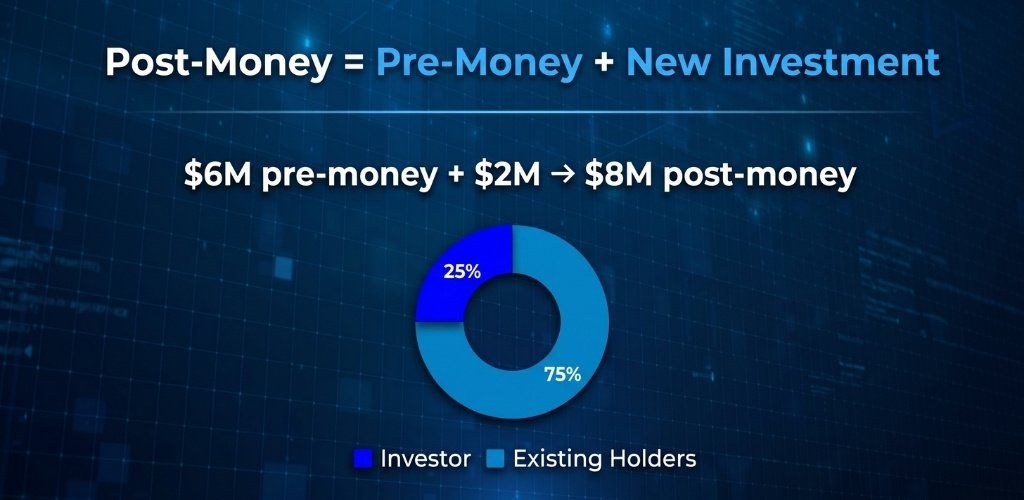
These examples assume a straightforward priced equity round without additional adjustments for convertible securities or option pool changes.
Scenario 1: $6 million pre-money valuation
New capital: $2,000,000
Post-money valuation: $8,000,000
Investor ownership: 25%
Existing holders’ combined ownership: 75%
Scenario 2: $8 million pre-money valuation
New capital: $2,000,000
Post-money valuation: $10,000,000
Investor ownership: 20%
Existing holders’ combined ownership: 80%
Scenario 3: $10 million pre-money valuation
New capital: $2,000,000
Post-money valuation: $12,000,000
Investor ownership: 16.67%
Existing holders’ combined ownership: 83.33%
Scenario 4: $15 million pre-money valuation
New capital: $5,000,000
Post-money valuation: $20,000,000
Investor ownership: 25%
Existing holders’ combined ownership: 75%
These scenarios show that investor ownership depends on the investment relative to the post-money valuation, not on the investment amount alone. Founders should also confirm that competing offers use the same capitalization assumptions.
How Pre-Money and Post-Money Valuation Affect Founder Dilution
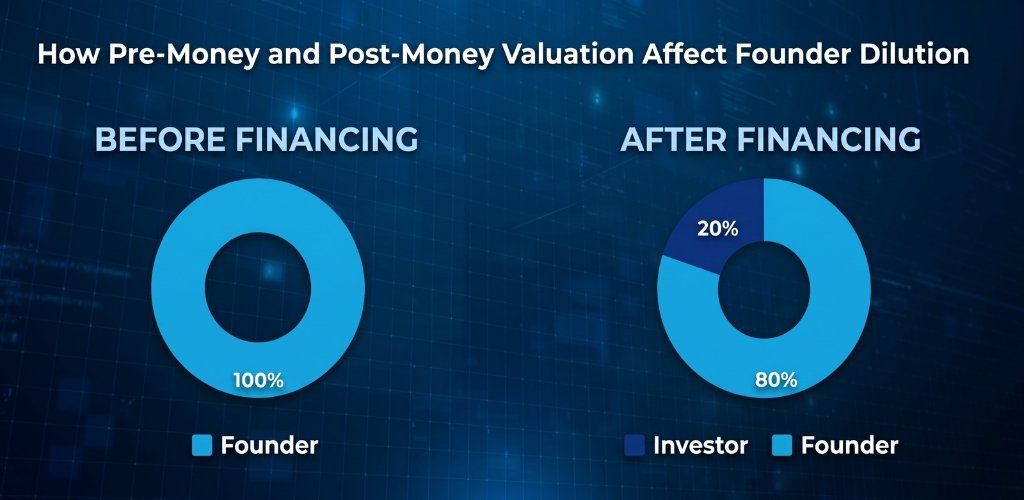
Equity dilution occurs when a company issues new shares, reducing an existing shareholder’s percentage ownership. A founder may retain the same number of shares while owning a smaller proportion of the company.
Consider a founder who owns 100% of a company before it raises $2 million at an $8 million pre-money valuation.
Before financing:
Founder ownership: 100%
Investor ownership: 0%
After financing:
Founder ownership: 80%
Investor ownership: 20%
The post-money valuation is $10 million. Based on that figure, the founder’s 80% stake has an implied value of $8 million. This is a paper valuation, not a guarantee of future sale proceeds. Actual returns can depend on the exit price, liquidation preferences, shareholder rights, and transaction costs.
A simplified share-count example illustrates the change:
Founder’s existing shares: 10,000,000
New shares issued to the investor: 2,500,000
Total shares after financing: 12,500,000
Founder’s ownership: 80%
Investor’s ownership: 20%
This example assumes a consistent share price and capitalization basis. In an actual round, options, warrants, and convertible securities may change the fully diluted ownership calculation.
Founders should therefore evaluate the full financing terms, not just the headline valuation. Investor rights and option pool requirements can affect the economic outcome even when the initial ownership calculation looks straightforward.
How Employee Option Pools and SAFEs Change the Calculation
Employee Option Pools
Companies often establish an employee option pool to attract and retain talent. Investors may require a new pool or an increase to an existing pool before a financing round closes.
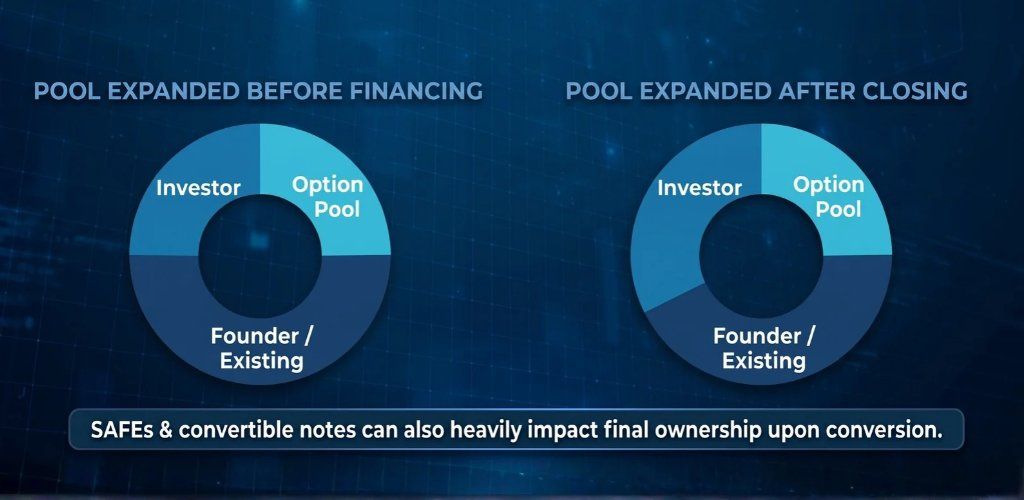
If the expanded pool is included in the pre-money capitalization, existing shareholders may bear much of the additional dilution. The result depends on the term sheet, the pool’s size, the capitalization definition, and when the options are included in the calculation.
If the option pool is expanded before the financing and included in the pre-money capitalization, the additional dilution generally falls on existing shareholders rather than the new investor. If the pool is expanded after closing, both existing shareholders and the new investor typically share the dilution. As a result, two financing offers with the same headline valuation may leave founders with different ownership percentages depending on how the option pool is structured.
Founders should check:
The target option pool percentage.
Whether existing grants count toward the target.
How many additional options the company expects to need.
How the pool affects founder ownership after financing.
The pool should reflect a realistic hiring plan rather than being assessed as an isolated percentage.
SAFEs and Convertible Notes
SAFEs and convertible notes can convert into equity during a later financing or under other contractual conditions. Their conversion affects the number of shares issued and can change founder and investor ownership.
A post-money SAFE valuation cap is a contractual mechanism used to determine the SAFE’s conversion price under its terms. It is not automatically equivalent to the company’s negotiated post-money valuation in a priced equity round.
Founders should review the valuation cap, any discount, interest where applicable, and other conversion provisions. When several instruments are outstanding, they should be modeled together with the new financing and option pool. The result depends on the actual documents, so legal and financial advisers may be needed to assess the full effect.
What Founders Should Check Before Agreeing to a Valuation
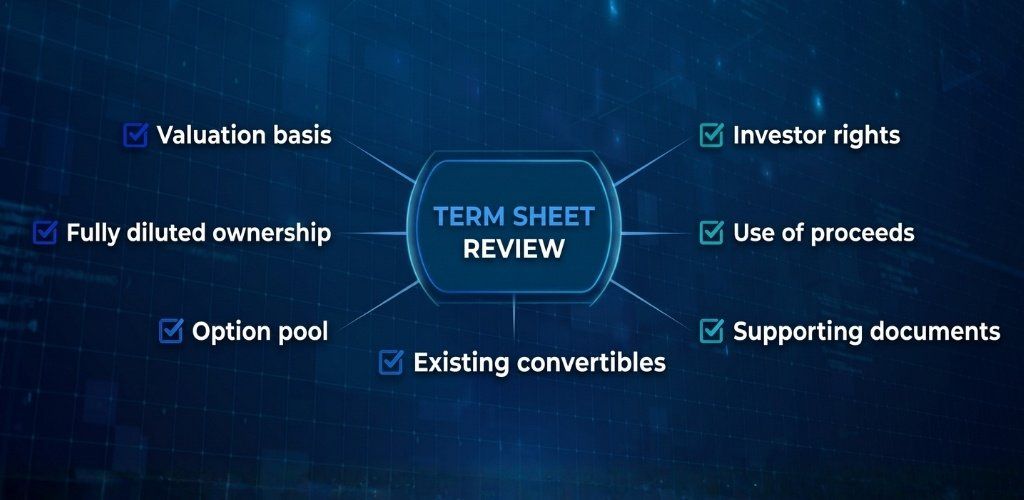
A term sheet should be evaluated as a complete financing proposal. Before agreeing to a valuation, founders should check:
Valuation basis: Is the figure pre-money or post-money? Is the investment new primary capital or does the deal also involve secondary share sales?
Fully diluted ownership: Which shares, options, warrants, and convertible securities are included?
Option pool: Must the company create or expand a pool before closing, and who bears the resulting dilution?
Existing convertibles: How will SAFEs and notes convert? Do caps, discounts, or interest affect the share count?
Investor rights: Could liquidation preferences or anti-dilution provisions affect future proceeds?
Use of proceeds: How much new capital will the company receive, and what business needs will it fund?
Supporting documents: Do the cap table, financial records, prior financing documents, and approvals support the assumptions?
When comparing post money vs pre money, founders should confirm which valuation basis appears in each term sheet before calculating investor ownership. Two offers with the same investment amount can produce different outcomes if their capitalization assumptions or option pool requirements differ.
A pro forma capitalization table should show ownership before and after financing and explain the assumptions used. Founders can then compare offers on a consistent basis and discuss unresolved issues with their advisers before signing definitive agreements.
How a VDR Helps Organize Valuation and Fundraising Due Diligence
During fundraising, investors and their advisers may review financial statements, forecasts, capitalization records, financing agreements, SAFE documents, option records, and corporate approvals. A virtual data room (VDR) provides a structured place to organize and share these materials with authorized participants.
Boundeal VDR offers features that can support the due diligence process:
Documents: Organize financial, legal, and corporate records in a central folder structure.
Participants: Invite project participants and manage their access levels.
Confidentiality Agreement: Require participants to accept standard or customized confidentiality terms before starting work in the project.
Watermarking: Apply dynamic watermarks to document previews for view-only users.
Project Dashboard: Give administrators an overview of key project information, documents, and participants.
AI Deal Assistant: Help users work with document content. It does not replace professional valuation, financial modeling, or legal review.
A VDR does not determine a company’s valuation or guarantee a successful fundraising outcome. Its role is to help organize documents and manage access during investor review. Founders can learn more about Boundeal VDR and assess whether its features fit their due diligence needs.
Common Pre-Money vs Post-Money Valuation Mistakes
Using the Wrong Formula
Dividing the investment by the pre-money valuation instead of the post-money valuation overstates investor ownership in a simple round. With an $8 million pre-money valuation and $2 million in new capital, the investor receives 20%, not 25%.
Ignoring the Option Pool
An option pool expansion can dilute existing shareholders. Founders should include the pool assumptions in their ownership model before comparing financing offers.
Treating Valuation as Guaranteed Value
A negotiated valuation does not guarantee the price of a future round or the proceeds from an exit. Business performance, market conditions, and investor rights can all affect the outcome.
Confusing a SAFE Cap With a Priced-Round Valuation
A post-money SAFE cap is part of the instrument’s conversion mechanics. It should not be treated as a guaranteed valuation for a later priced equity round.
Comparing Headline Numbers Alone
Offers with the same valuation can have different economic consequences because of option pool requirements, convertible securities, and investor rights. Compare the complete terms and resulting ownership, not just the headline figures.
FAQ
What is the difference between pre-money and post-money valuation?
Pre-money valuation is the agreed company value before new primary investment in a priced equity round. Post-money valuation includes that investment, so it equals pre-money valuation plus new capital in a simple round.
How do you calculate post-money valuation?
Add the new primary investment to the agreed pre-money valuation. An $8 million pre-money valuation plus $2 million in new capital gives a $10 million post-money valuation.
How much equity does a $2 million investment buy at a $10 million post-money valuation?
In a simple priced equity round, it buys 20% of the company. This assumes the investment and valuation use a consistent basis and that no additional capitalization adjustments are required.
Does an option pool increase affect founder dilution?
Yes. Creating or expanding an option pool can reduce existing shareholders’ percentage ownership. The effect depends on the pool’s size and how it is treated in the financing terms.
Is a post-money SAFE valuation cap the same as a priced-round valuation?
No. A post-money SAFE cap is used to determine the conversion price under the SAFE’s terms. A priced-round valuation is negotiated for an equity financing, and the two figures are not interchangeable.
Can two term sheets with the same valuation produce different founder ownership?
Yes. Two term sheets with the same headline valuation may result in different founder ownership percentages because of option pool requirements, outstanding convertible securities, or capitalization assumptions. Founders should compare the fully diluted ownership structure under each offer rather than relying on valuation figures alone.
Conclusion
Pre-money and post-money valuation describe different stages of a financing calculation and directly affect investor ownership. Founders should review the fully diluted cap table, option pool assumptions, convertible instruments, and investor rights before agreeing to a term sheet. Organizing supporting documents in a controlled due diligence workspace can make the review process more efficient.