Key takeaways
Cross-border sell-side M&A adds jurisdiction-specific legal, tax, regulatory, and operational workstreams to an already complex transaction process.
Centralized M&A document management reduces duplicate files, outdated versions, and inconsistent disclosure across international buyer and adviser teams.
Permission Groups help separate bidders, legal advisers, tax specialists, clean teams, management, and internal sell-side participants.
Granular Permissions limit access by role, folder, or document, reducing unnecessary exposure of confidential and commercially sensitive information.
AI-assisted document search helps international teams navigate large due diligence structures without relying on disconnected folders or email chains.
Reports, audit trails, and the Export Index provide a reviewable record of participant activity and the data room structure.
Cross-border sell-side M&A can expand the potential buyer pool, but it also increases the number of jurisdictions, advisers, document requests, and access decisions involved. The seller must support efficient cross-border due diligence while maintaining control over confidential information, document versions, and buyer access. A structured VDR helps centralize disclosure without giving every participant the same level of visibility.
What Makes Cross-Border Sell-Side M&A More Complex

Cross-border sell-side M&A is highly complex because the seller must simultaneously coordinate multiple international buyer groups, navigate local legal frameworks, and undergo regulatory reviews. This environment requires managing diverse workflows across different time zones, languages, and professional standards.
In a domestic transaction, parties usually operate under one legal system. In a cross-border deal, you must manage international buyers, local counsel, foreign tax specialists, and domestic management. Each group requires different information at different stages.
Operational friction often arises from time-zone gaps and varied regulatory obligations. Without a centralized system, document requests quickly overlap. Advisors from different regions might follow conflicting workflows and deadlines.
These overlaps can lead to serious operational bottlenecks. The same file might be uploaded multiple times, or advisors might review outdated versions. These mistakes slow down the deal and damage buyer confidence.
Therefore, the seller must design the data room structure and access logic before starting due diligence. Organizing files by jurisdiction and workstream keeps the process efficient. It allows the sell-side team to respond quickly and maintain control across borders.
Main Document and Access Risks in Cross-Border Due Diligence
The primary risk in cross-border due diligence is the unauthorized exposure or leakage of sensitive corporate data across foreign jurisdictions. When multiple global teams access files simultaneously, tracking who viewed what becomes extremely difficult.
The most common document and access risks include:
Uncontrolled sharing: Documents sent via email can be downloaded, forwarded, or stored on unsecured personal devices.
Outdated files: Different international teams may analyze conflicting versions of financial models or contracts.
Excessive access: Global bidders might view sensitive files unrelated to their roles, increasing their exposure.
Unclear buyer activity: Sellers cannot easily identify which bidders are active or where the review has stalled.
No auditable history: Disconnected sharing tools make it impossible to prove exactly when a file was accessed or replaced.
Certain information categories require rigorous protection. These include detailed financial statements, tax records, material customer contracts, intellectual property, and HR files. Exposure of these files can breach regional data laws, such as GDPR.
Not every foreign bidder should receive immediate access to highly confidential materials. Sellers must separate document visibility based on the buyer's actual progress in the deal. This phased disclosure strategy protects sensitive assets while keeping the transaction moving.
Why Email, Generic Folders, and Scattered File-Sharing Tools Are Not Enough
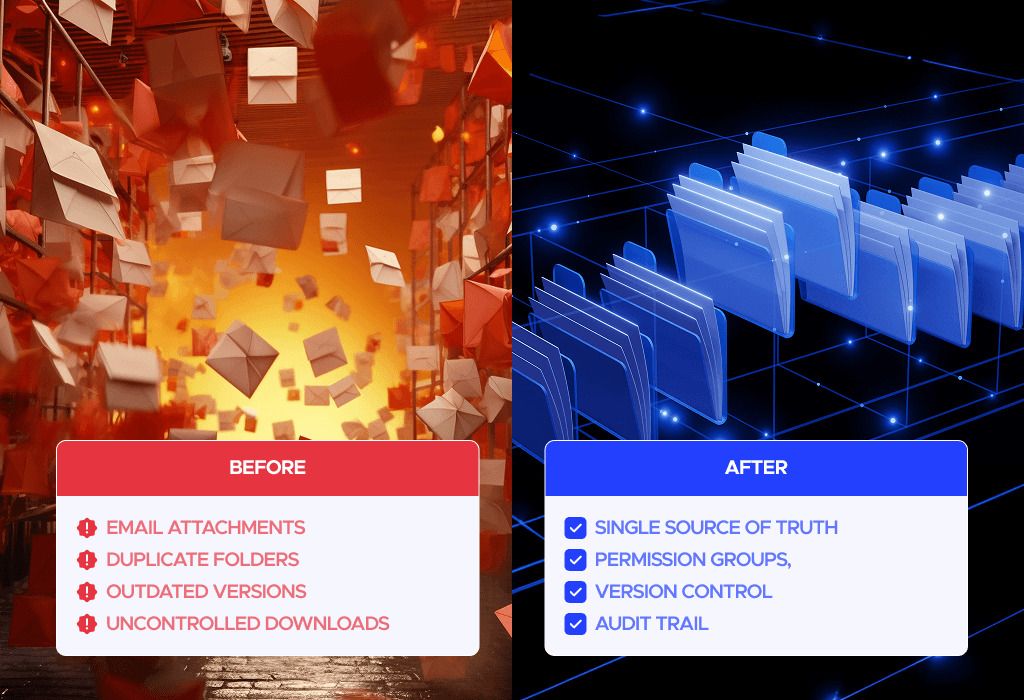
Standard email and generic cloud storage lack the security controls, granular permissions, and detailed audit trails required for M&A. They may not provide transaction-specific controls over downloading, printing, forwarding, and subsequent file distribution.
Email attachments create permanent, uncontrolled copies of your corporate data. Once an email is sent, the seller loses all control over that file. You cannot revoke access or verify if the recipient shared it with unauthorized third parties.
Generic cloud folders also present major risks. They often lead to messy, duplicate directory structures. Permissions are difficult to manage when multiple international advisors create their own subfolders.
These consumer-grade tools do not offer a single, transaction-focused dashboard. You cannot easily see who is active, which files are prioritized, or when files were modified. This lack of transparency slows down deal coordination.
A VDR for private equity sell-side M&A resolves these critical issues. It centralizes all communication, document storage, and access rules. It replaces risky, scattered tools with one secure, auditable workspace.
How a VDR Centralizes Cross-Border Due Diligence

A virtual data room centralizes cross-border due diligence by keeping all buyers, advisors, and files inside a single, highly secure digital environment. This setup eliminates the need for separate file-sharing links and chaotic email threads.
With a cloud-based VDR, approved global users work within the exact same folder structure. When you update a financial file or contract, the system updates it for everyone instantly. This ensures all parties analyze the latest information.
A clean VDR layout organizes documents by country, legal entity, or specific workstream. This structure helps international buyers locate relevant documents quickly. It dramatically reduces repetitive requests and administrative delays.
Boundeal provides this secure infrastructure for document control and buyer access. It helps sellers apply their disclosure decisions consistently across global markets. The platform keeps the entire transaction organized, auditable, and secure.
Permission Groups for Different Buyer and Adviser Teams
Permission Groups allow sellers to organize VDR users into functional teams and control exactly which folders each group can see. This ensures that sensitive files remain hidden from users who do not need them for their specific tasks.
A typical cross-border deal involves various teams. Strategic buyers, financial sponsors, local lawyers, and tax experts all need different access. Using Permission Groups prevents a "one-size-fits-all" access model that threatens confidentiality.
In Boundeal, you can configure these Permission Groups once and instantly apply them to new users. This saves valuable administrative time during busy transactions. It ensures that no buyer or advisor accidentally receives incorrect permissions.
Granular Permissions for Role-Based Disclosure
Granular Permissions restrict specific actions, such as downloading or printing, on individual folders or documents within the VDR. This feature allows sellers to share highly sensitive files without losing physical control over them.
These detailed settings allow you to customize permissions for specific high-value assets. You can protect your business while still providing enough data for proper due diligence.
Key granular settings include:
View-only access: Users can read files in their web browser but cannot download, print, or copy the text.
Folder-level access: You can restrict entire directories, like HR or intellectual property, to specific professional roles.
Document-level restrictions: This lets you apply strict rules to individual high-risk files within an otherwise open folder.
Staged disclosure: Access can expand as the bidder advances through the transaction phases.
These controls keep your sell-side M&A due diligence highly practical and secure.
The system operates on two key user roles: Admin and Member. Within this framework, you can assign customized access levels to every individual document and folder.
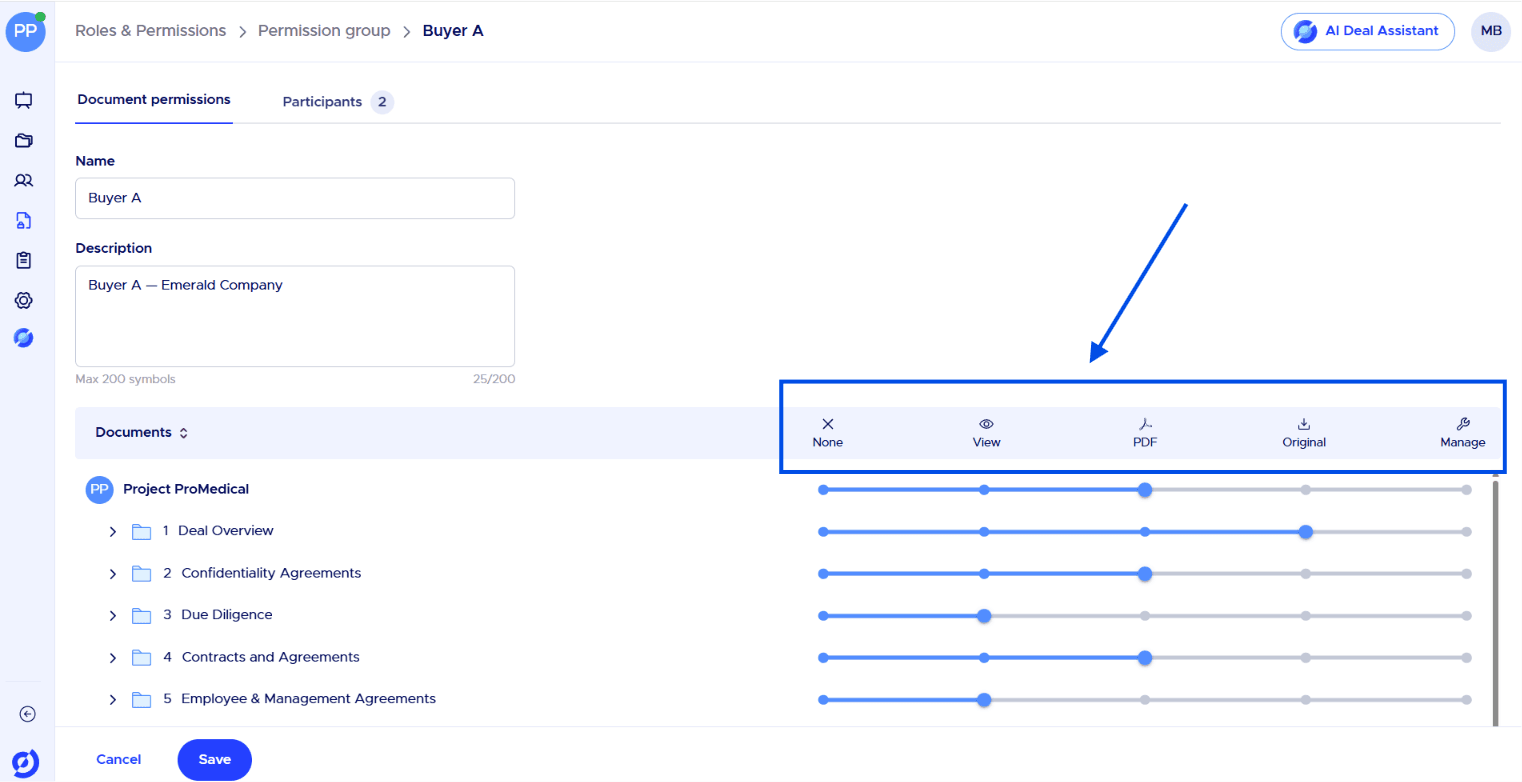
This granular permission structure ensures you share intellectual property or employee records only when a bidder is highly committed, minimizing data exposure throughout the deal lifecycle.
AI Deal Assistant, Document Search, Reports & Insights
AI tools, advanced search, and real-time reporting help sellers manage massive document sets and monitor buyer interest across global time zones. These features provide deep visibility into how different bidder groups interact with your data.
Faster navigation through large document sets
Document search allows users to locate files, clauses, and references without having to manually open every folder. This is particularly useful when the data room contains documents from several entities, jurisdictions, or business units.
Boundeal’s AI Deal Assistant can help users review project content, identify relevant information, and generate document overviews. It supports navigation and initial analysis but does not replace legal, financial, or tax judgment.
Visibility into buyer activity
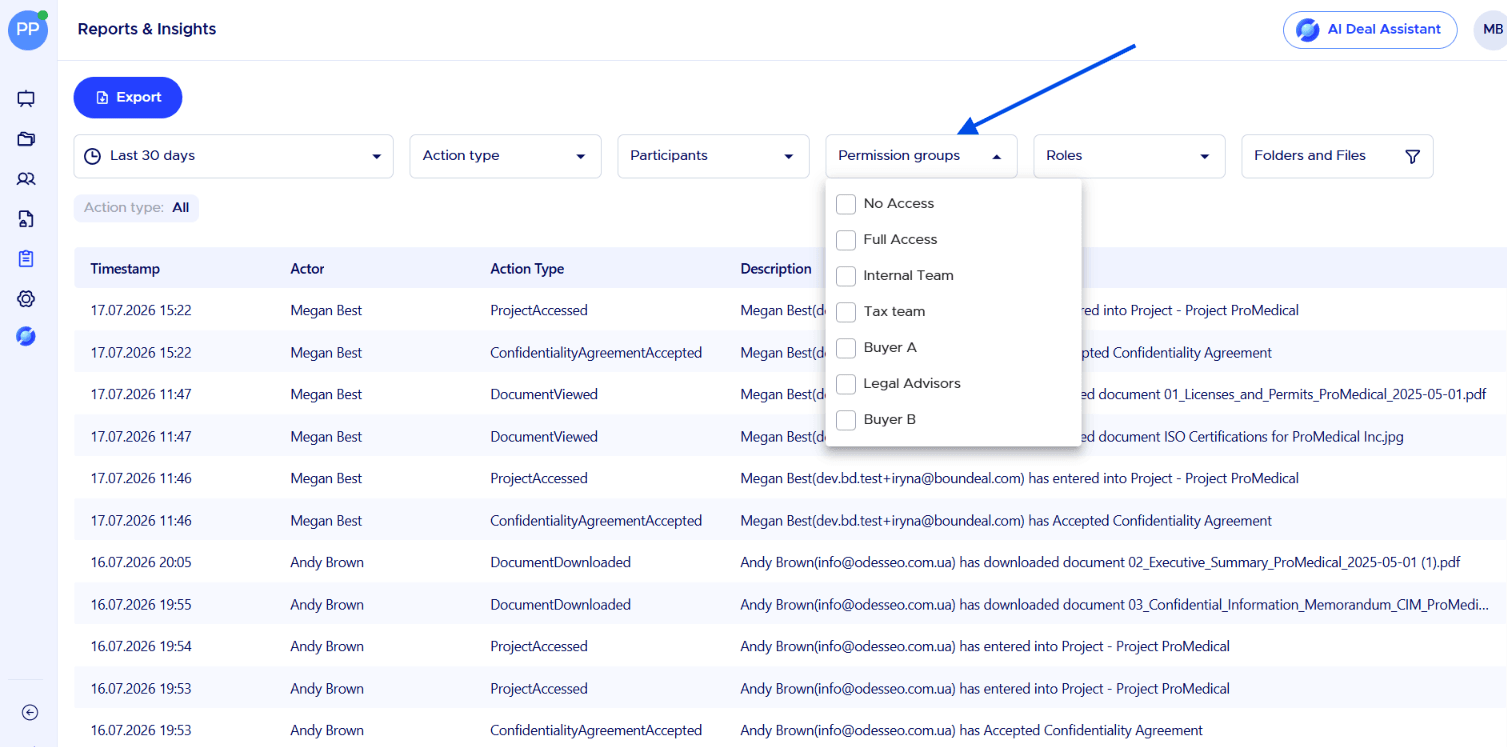
Reports & Insights help the sell-side team review activity by participant, Permission Group, document, and action. This can show which teams are actively reviewing materials, which folders attract attention, and where additional clarification may be required.
Audit trails create a time-stamped record of access and document actions. They support internal control and auditability, although activity alone does not prove that a bidder will submit an offer.
A documented data room structure
The Export Index allows the project structure to be exported as an Excel table. The sell-side team can use it for internal review, adviser coordination, and documentation of the folders and files included in the VDR.
FAQ
Why is cross-border sell-side M&A harder to manage?
Cross-border transactions involve more jurisdictions, adviser teams, and review workstreams than a domestic sale. The seller may need to coordinate local and international counsel, tax specialists, management, and multiple bidders while controlling access to different levels of documents.
What documents are shared in cross-border due diligence?
Typical materials include financial statements, tax records, forecasts, corporate documents, contracts, licenses, HR information, intellectual property files, and compliance records. The exact scope depends on the business, buyer requests, jurisdictions, and current disclosure stage.
How do VDR Permission Groups work?
Permission Groups organize participants by bidder, adviser function, or internal role. Each group can receive its own document visibility and allowed actions. This makes it possible to separate strategic buyers, financial buyers, legal advisers, tax teams, and clean teams within a single project.
What is the difference between Permission Groups and Granular Permissions?
Permission Groups define access for a team of participants. Granular Permissions apply more specific controls to individual folders or documents. Together, they help the seller align disclosure with each participant’s role and actual information needs.
Why are audit trails important in sell-side M&A?
Audit trails provide a time-stamped record of participant and document activity. They help the seller review who accessed information, when actions occurred, and how the data room was used. They support accountability but do not automatically demonstrate buyer intent.
Can a VDR support advisers in different countries?
Yes. A cloud-based VDR gives approved advisers access to a single structured project across different locations and time zones. The seller can separate teams and update permissions centrally. Applicable legal, privacy, and regulatory requirements must still be assessed independently.
Conclusion
Cross-border buyer interest should not result in weaker document control or broader disclosure than the transaction requires. A centralized VDR helps the seller organize documents, separate buyer and adviser teams, apply granular permissions, and maintain a reviewable activity record. Search, AI-assisted navigation, reporting, and Export Index further support an efficient and auditable sell-side process across markets.