Key takeaways from the article
AI M&A and generative models support the entire lifecycle, reducing analysis time and speeding up decision-making.
Intelligent platforms identify acquisition targets more precisely by analyzing market news and patent filings.
AI in due diligence speeds up the review of financial and IT data, detecting risks automatically.
Machine learning models improve financial modeling while tracking post-close performance.
Artificial intelligence is revolutionizing M&A by enabling faster identification of acquisition targets, more accurate risk assessments, and stronger investment hypotheses. According to research, AI can shorten the due diligence cycle by weeks, reduce human error, and improve valuation accuracy. In modern transactions, this is no longer just a passing trend but a necessary tool for faster decisions and lower uncertainty.

AI Across the M&A Deal Lifecycle
The traditional deal lifecycle includes several stages:
Deal Sourcing
Target Screening
Due Diligence
Deal Execution
Post-Deal Integration
AI is already helping at each of these stages. Machine learning models provide smarter market analysis by ranking companies based on strategic attractiveness. This enables moving from opportunistic deal sourcing to a more systematic approach.
At the screening stage, AI scans millions of companies and identifies connections that traditional databases often miss.
During due diligence, intelligent agents highlight key contract provisions, such as change-of-control clauses, flag anomalies, and compare data against regulatory requirements and historical benchmarks.
At the execution stage, AI builds financial models that account for multiple scenarios and currency risks.
After closing, ongoing KPI monitoring helps identify deviations from the original deal thesis and adjust strategy before value is lost.
As a result, AI speeds up, improves accuracy, and makes the M&A process more transparent, turning complex data into decision-ready insights.
Widespread Adoption of AI in M&A
AI adoption in M&A has become widespread. In a 2025 study by Deloitte, 1,000 corporate and private equity (PE) executives were surveyed, and 86% of them reported integrating generative AI into their M&A processes, with 65% doing so in the past year. Nearly 40% of companies now use AI in over half of their deals, and 83% are investing more than $1 million in AI tools. The most common uses of AI are in the early stages of deals—such as strategy development and market analysis (40% of respondents), screening, and due diligence (35%). However, the main barriers to full AI adoption remain data security (67%), the quality of input data (65%), and the reliability of models (64%).
Moreover, AI is helping companies save both time and money. According to McKinsey and Bain, the use of generative AI reduces deal durations by 10-30% and cuts costs by approximately 20%. A 2026 study by McKinsey found that 40% of companies actively using generative AI are reducing deal cycles by 30-50%, while 42% believe the technology is transforming M&A. Bain's survey revealed that only 20% of companies are currently using generative AI in deals, but over half plan to adopt it by 2027.
AI in Target Identification and Market Intelligence
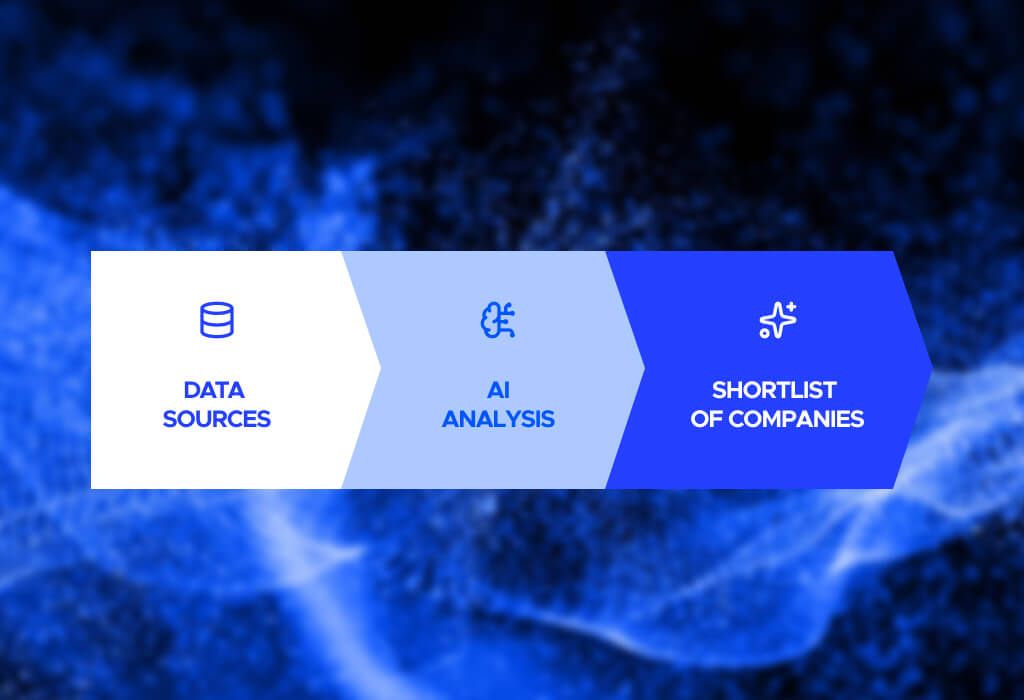
AI platforms scan hundreds of thousands of companies, industry trends, and news, analyzing websites, financial reports, and patents to identify promising targets. Unlike traditional databases, these platforms consider business models, growth rates, and technological competencies, allowing them to find growth opportunities in adjacent markets. The systems update data in real time and track market trends, helping evaluate revenue dynamics and adjust the buyer's strategy accordingly.
AI-Driven Due Diligence
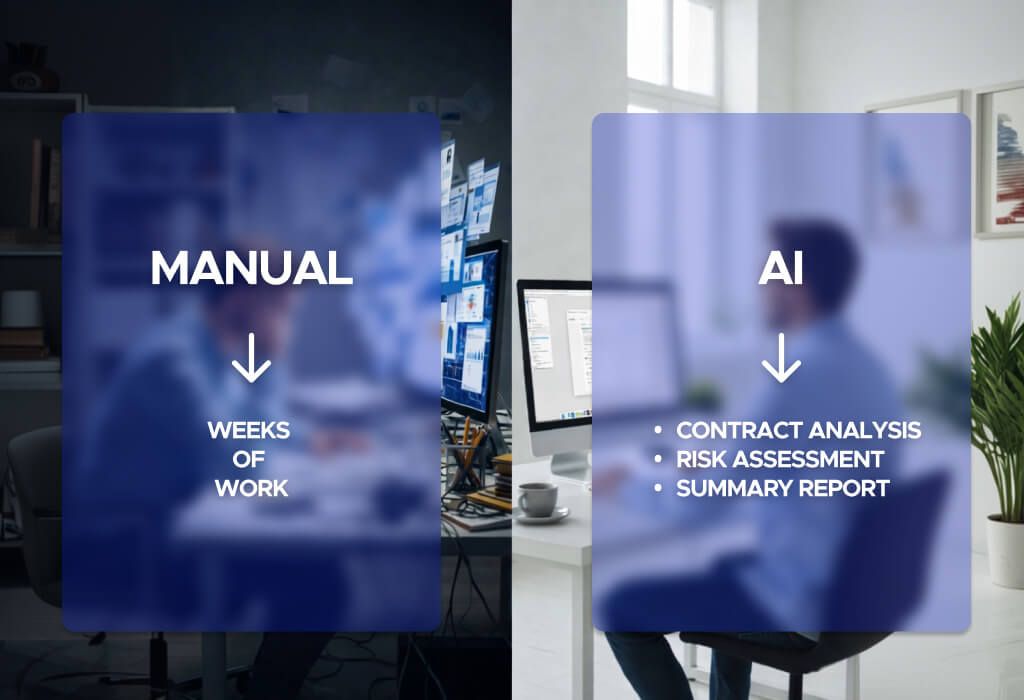
Due diligence is the most labor-intensive stage of a deal. Virtual data rooms contain thousands of documents, including financial reports, contracts, operational data, and legal files. AI systems take over the mechanical work, sorting files, extracting key dates, amounts, and terms, and comparing them to regulatory requirements and historical benchmarks.
Algorithms identify hidden risks and automatically generate brief reports highlighting problem areas. This improves the quality of the review, reduces the likelihood of missing important details, cuts costs, and shortens analysis time from weeks to days.
The application of AI in due diligence improves the quality of the review, reduces the likelihood of missing important details, and cuts costs significantly. These solutions help lawyers and analysts focus on material issues rather than manual data entry.
Navigating Large Data Rooms and Transaction Files with AI
In M&A deals, the volume of data is enormous: internal teams spend weeks reviewing thousands of financial reports, contracts, and legal files, while external due diligence costs can reach tens of thousands of dollars. AI platforms turn such data rooms from "digital filing cabinets" into interactive knowledge centers that analyze documents, summarize lengthy reports, and extract key points. The system automatically flags unusual provisions and financial discrepancies, supports natural language search, and answers questions such as "Which contracts contain change-of-control provisions?" Additional features include automatic redaction of personal data and file classification, reducing risks and saving time so the team can focus on the deal's strategy.
AI in Deal Analysis and Value Creation
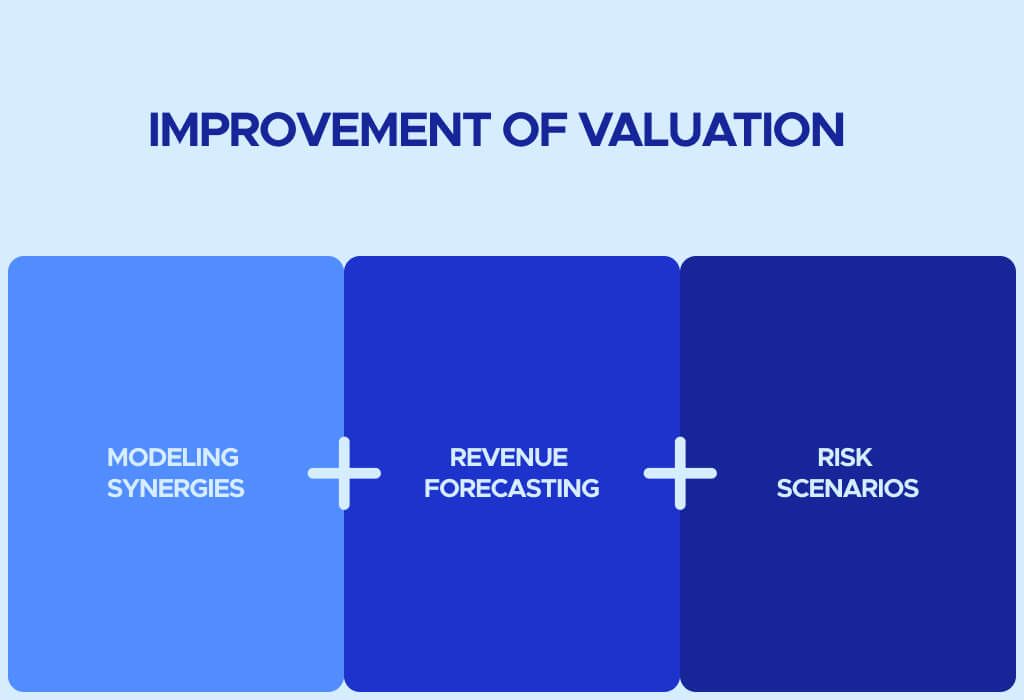
Beyond the review stage, M&A artificial intelligence serves as a tool for value creation. AI integrates market and client data, runs thousands of stress tests, and uncovers hidden connections. This leads to more accurate forecasts and strengthens negotiation positions.
AI solutions help model synergies by analyzing service costs, price elasticity, and distribution network optimization to determine where changes in product range or geography will yield the greatest impact.
After the deal closes, AI systems monitor key performance indicators (revenue, margins, customer churn) in real time and signal deviations before value is lost. Predictive models allow for testing scenarios in advance, such as working capital volatility, and account for risks when making decisions.
Ultimately, AI tools help identify profit sources, analyze product assortment and customer bases, and create deeper value plans. These systems turn post-deal processes from a "black box" into a managed value-creation mechanism.
Conclusion
Artificial intelligence has already become an integral part of modern M&A. It accelerates target identification, improves market analysis, automates due diligence, and helps create and realize value post-deal. However, successful AI implementation requires proper configuration: a clear understanding of goals (buy-side and sell-side), data security, model transparency, and human involvement in reviewing and interpreting results. Companies that implement AI in a timely manner gain a significant advantage in the speed, accuracy, and resilience of their deals. In the future, the combination of human expertise and AI tools will define success in the market, with the role of artificial intelligence for M&A due diligence.
FAQ
How does AI speed up due diligence and reduce its cost?
AI tools automate routine tasks: sorting and indexing documents, extracting key data (amounts, dates, terms), and comparing it to historical examples. This enables faster identification of anomalies and risks than manual analysis, reducing the review cycle from weeks to days and saving external costs by tens of thousands of dollars. Experts focus on interpreting results, not searching for information.
Do AI platforms help identify new acquisition targets?
Yes. AI platforms analyze millions of companies, market news, and patent data to uncover potential targets that traditional searches may miss. Machine learning considers nuances such as business models, growth rates, and technological competencies, regularly updating data to find hidden, promising companies.
Will AI replace consultants and lawyers in M&A?
No. AI enhances experts' work but does not replace them. Algorithms automate data collection and analysis, but interpreting data, making decisions, and conducting negotiations remain the role of humans. Research highlights that successful AI programs require a clear human role in controlling outcomes and verifying model accuracy. AI is considered a partner, not a replacement.
What security measures do AI data rooms provide?
Modern VDRs with AI use bank-level encryption, two-factor authentication, role-based access control, and activity audit logs. This ensures that only authorized users see documents and that every action is recorded. Intelligent automation also enables automated redaction of personal data, protecting confidentiality.
How does AI improve valuation and synergy planning?
AI integrates data on the market, competitors, and clients, runs thousands of scenarios, and identifies sensitive assumptions, thereby improving valuation accuracy and making models more resilient to market volatility. In synergy planning, AI analyzes service costs, network structure, and price elasticity to help identify where the business combination will have the greatest impact.