Get access
  1. Home
  2. Blog

What You Need to Know About Company Constitution

2025-11-19

A company constitution defines the internal governance framework of a business. It outlines how decisions are made, how power is distributed among directors and shareholders, and how conflicts are resolved. For any incorporated entity, this document acts as a foundational rulebook that ensures stability and transparency.

Understanding the corporate constitution is essential for founders, boards, and investors. It governs how a company operates beyond what is prescribed by general corporate law, helping prevent disputes and align stakeholder interests.

Company constitution at a glance

A company constitution is a legally binding document that sets out the principles, rights, and procedures guiding how a company is managed. It serves as the highest internal authority for decision-making, complementing national legislation and regulatory standards.

In simple terms, the constitution of the firm defines the relationship between shareholders, directors, and officers. It covers voting rights, director appointments, dividend policies, and procedures for altering share capital. Without this framework, key governance issues would remain undefined or be left to default statutory rules.

While every jurisdiction has its own terminology and format, the goal remains consistent: to establish clarity, accountability, and predictability within the organization.

Core components you’ll typically see


constitution-1.jpg

Though the exact structure varies by country and company type, most constitutions include several essential sections.

1. Company objects and powers. This section outlines the business purpose and scope of operations. It defines what activities the company can undertake and sets boundaries that protect shareholders from unauthorized decisions.

2. Share structure and rights. Here, the constitution details types of shares, voting privileges, dividend entitlements, and transfer restrictions. It ensures that ownership and control are clearly understood by all parties.

3. Board composition and authority. This part describes how directors are appointed, removed, and remunerated. It also specifies the limits of their powers and how board meetings are conducted.

4. Meetings and resolutions. Rules for convening annual or extraordinary meetings are outlined here, including notice periods, quorum requirements, and voting procedures.

5. Dividend policy and capital maintenance. The constitution sets guidelines for profit distribution and capital management to maintain solvency and comply with financial laws.

6. Dispute resolution and amendment procedures. It defines how disagreements are settled—whether through arbitration, mediation, or court—and how the constitution itself can be updated.

Together, these components provide a governance framework that minimizes ambiguity and ensures legal compliance across all corporate actions.


constitution-2.jpg

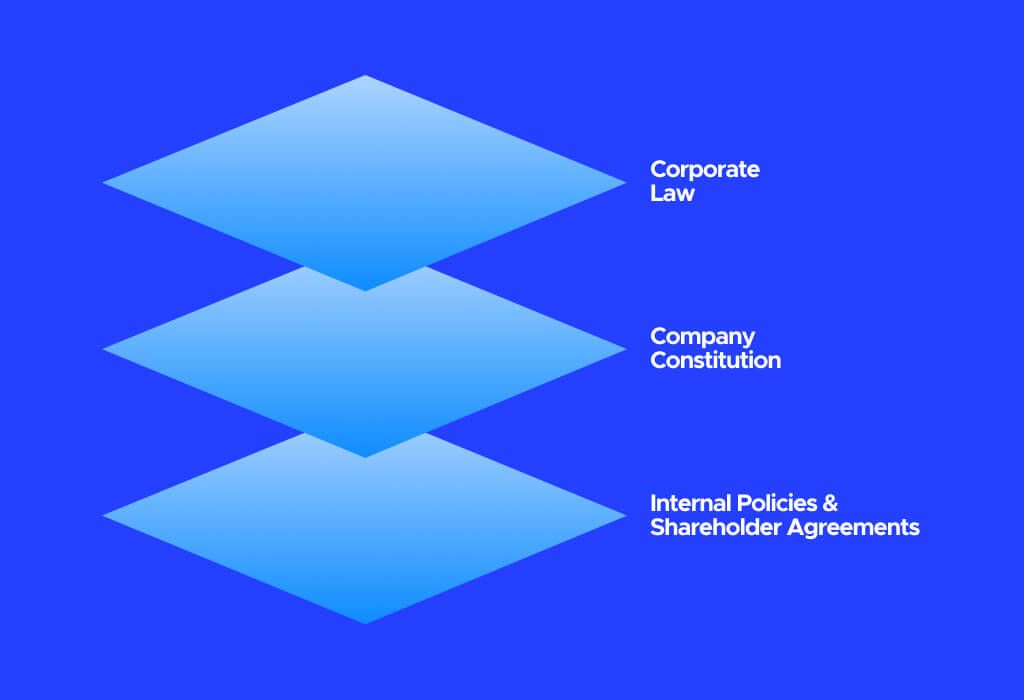
The company constitution operates alongside corporate and statutory law, but it does not override it. Instead, it functions as a contract between the company, its directors, and shareholders, filling in the operational details that legislation leaves open.

In most jurisdictions, the constitution ranks below national corporate law but above internal policies or shareholder agreements. For instance, if a clause in the constitution conflicts with mandatory statutory provisions, the law prevails. However, when statutes allow flexibility, the Constitution provides the binding rules.

This hierarchical balance ensures consistency:

  • Corporate law defines the baseline obligations.

  • The constitution customizes governance and decision-making.

  • Board resolutions and internal policies handle day-to-day execution.

Understanding where the corporate constitution fits legally helps founders design governance frameworks that are enforceable and aligned with the broader legal environment.


Practical benefits for founders, boards, and investors


constitution of the firm

A well-drafted constitution is not a mere formality — it provides tangible advantages for all key stakeholders.

For founders, it secures clarity of control and prevents misunderstandings as new investors join. By defining director powers and share classes early, founders can preserve strategic influence without discouraging capital inflows.

For boards, the constitution creates a clear decision-making framework. Defined procedures for meetings, voting, and conflict management protect directors from liability and promote efficient governance.

For investors, it provides transparency and predictability. Investors can review the constitution to understand how profits are distributed, what veto rights exist, and how key corporate changes will be handled.

In essence, the company constitution's meaning extends beyond compliance — it supports trust, stability, and professional management practices that attract long-term capital.


Risks and blind spots if you ignore it

company constitution example

Neglecting a company constitution or relying solely on default legal provisions exposes a business to serious governance risks. Without a clear document, the relationship between shareholders and directors becomes ambiguous, leading to potential disputes and delays in decision-making.

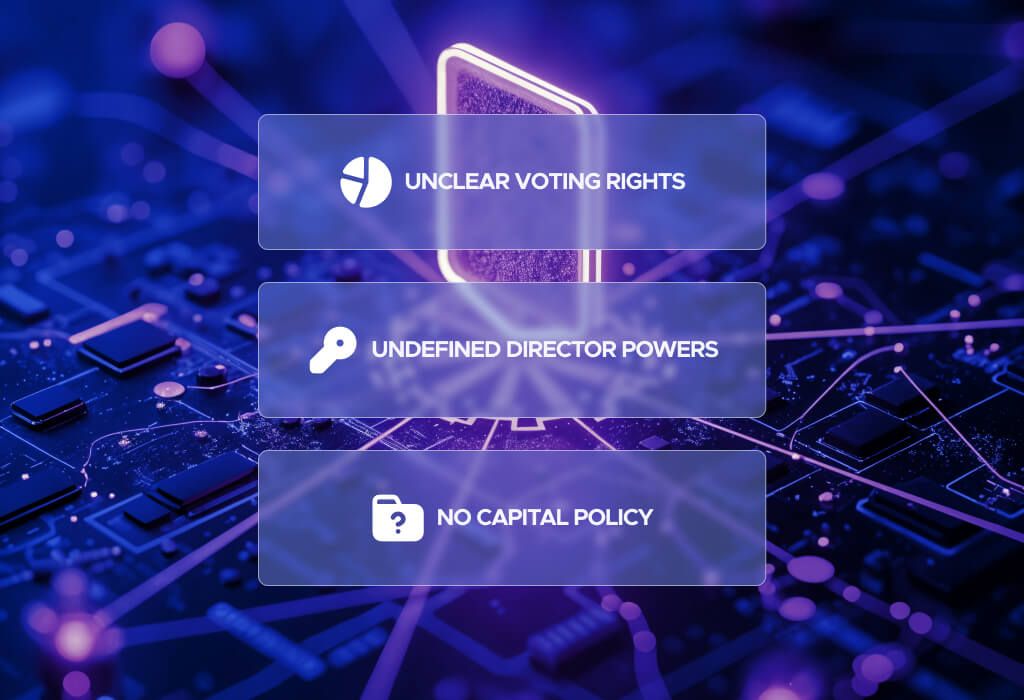
Common blind spots include:

  • Unclear voting rights, causing deadlocks during shareholder meetings;

  • Undefined director powers, which can result in unauthorized or contested actions;

  • Missing dispute-resolution clauses, forcing costly litigation instead of mediation;

  • No capital or dividend policy, creating tension over profit distribution.

For growing firms, these issues can block funding rounds or deter investors who prioritize transparency. A missing or outdated constitution may also conflict with evolving legislation, leaving the company exposed to regulatory breaches.

Establishing and maintaining a well-drafted corporate constitution minimizes legal uncertainty, protects minority shareholders, and supports investor confidence — all critical for long-term sustainability.


Company constitution example

To better understand the structure, consider a simplified company constitution example. While real documents vary in length and complexity, most follow a similar outline that includes key operational and governance rules.

Sample structure:

  • Preliminary information — company name, registered address, and legal form.

  • Objects and powers — scope of activities and business objectives.

  • Share capital — total capital, share types, rights, and transfer rules.

  • Meetings — procedures for general meetings, voting thresholds, and quorum.

  • Board of directors — appointment, duties, compensation, and removal.

  • Dividends and accounts — distribution policies and financial reporting.

  • Amendments — rules for modifying the constitution or issuing new shares.

  • Dispute resolution — arbitration or mediation clauses.

This corporate constitution structure provides transparency to all stakeholders and establishes predictable governance mechanisms from day one. Businesses often adapt these sections with the guidance of legal counsel to fit their specific jurisdiction and industry context.


Implementation checklist


company constitution meaning

Drafting a constitution is only the first step. For it to be effective, the company must implement and maintain it as a living governance tool.

Implementation steps:

  • Engage qualified legal advisors to ensure compliance with local laws and regulations.

  • Align the constitution with shareholder agreements and board charters to ensure consistency.

  • Obtain formal approval from all shareholders at the time of incorporation.

  • Store a signed copy in the company’s registered office and digital data room.

  • Review and update the document after major funding rounds or changes in ownership.

  • Communicate key provisions to directors and officers to ensure operational awareness and understanding.

Following this checklist helps integrate the company constitution into daily management, making it an active reference for decision-making rather than a forgotten formality.


Related posts

blog image

Bolt-On Acquisitions: A Strategic Path to Business Growth

A bolt-on acquisition is a deal where a larger company expands by adding smaller, complementary businesses into its structure. These targeted deals strengthen capabilities, expand market presence, and improve efficiency without the complexity of large-scale mergers. Bolt-on acquisitions deliver measurable value with lower risk by focusing on strategic alignment. This article examines their definition, benefits, target selection process, industry applications, execution steps, and potential obstacles, highlighting their role in driving scalable growth across diverse sectors. Defining Bolt-On Acquisitions A bolt-on acquisition occurs when a larger company purchases a smaller entity to enhance its operations. These deals target businesses that align closely with the acquirer’s core activities, such as adding product lines, entering new markets, or adopting advanced technologies. Unlike transformative mergers, bolt-ons prioritize seamless integration and immediate value creation. Private equity firms and corporations widely use them to achieve focused growth. For example, a retail chain might acquire a regional competitor to expand its footprint while leveraging existing logistics networks. Similarly, a manufacturing firm could acquire a supplier to streamline its production process, ensuring cost savings and supply chain reliability. Benefits of Bolt-On Acquisitions Bolt-on acquisitions provide multiple advantages for companies pursuing efficient expansion: These benefits make bolt-ons an attractive strategy for firms aiming to stay competitive while maintaining operational stability. For instance, a consumer goods company might acquire a niche brand to diversify its portfolio, appealing to new demographics without overhauling its business model. Selecting Suitable Bolt-On Targets Choosing the right acquisition target requires a disciplined approach to ensure alignment and value creation: For example, a software company might target a startup with a niche product that complements its existing suite, ensuring a stronger market position. Similarly, a food and beverage company could acquire a regional distributor to enhance its market penetration in underserved areas, leveraging local expertise and networks. Applications Across Industries Bolt-on acquisitions are versatile, addressing specific strategic needs across multiple sectors with tailored approaches. Private Equity and Platform Growth Private equity firms frequently use bolt-on acquisitions to strengthen platform companies. By acquiring smaller businesses, they diversify revenue streams, consolidate fragmented markets, and increase valuations before exits. For example, a private equity-backed logistics firm might acquire regional trucking companies to create a national network, enhancing operational scale and market dominance. These deals often target industries like manufacturing or retail, where consolidation creates economies of scale and competitive advantages. Technology and SaaS Development In the technology sector, bolt-on acquisitions expand software-as-a-service (SaaS) offerings. Acquiring specialized tools or complementary platforms allows companies to deliver integrated solutions, improve customer retention, and capture larger market shares. For instance, a SaaS provider might acquire a data analytics firm to enhance its platform, offering customers a more comprehensive solution. This approach also helps tech firms stay ahead of competitors by rapidly incorporating emerging technologies, such as artificial intelligence or cloud-based tools, into their ecosystems. Healthcare and Life Sciences Integration Healthcare companies use bolt-ons to consolidate services or expand specialized capabilities. Acquiring regional clinics, diagnostic labs, or biotech startups enables larger providers to extend their networks, access innovative treatments, or improve patient care. These deals prioritize regulatory compliance and operational synergy. For example, a hospital chain might acquire a telemedicine provider to meet growing demand for virtual care, aligning with industry trends toward digital health solutions. Similarly, a pharmaceutical firm could acquire a biotech startup to gain access to cutting-edge therapies, accelerating its research pipeline. Steps for a Successful Bolt-On Acquisition A bolt-on acquisition requires a structured process to maximize value and minimize risks across all stages. Target Identification The process begins by defining criteria aligned with strategic objectives. Companies analyze market trends, competitor activities, and internal gaps to identify targets that fit their vision. This step often involves market research, industry reports, and stakeholder consultations to ensure alignment with business goals. For example, a retailer might identify targets based on geographic gaps in its store network or emerging consumer trends. Initial Assessment Preliminary evaluations focus on the target’s financial performance, market position, and strategic fit. High-level discussions with the target’s leadership gauge mutual interest and confirm operational compatibility. This stage helps filter out unsuitable candidates early, saving time and resources. Financial metrics like revenue growth and profitability are assessed alongside qualitative factors like brand reputation. Due Diligence Comprehensive due diligence investigates the target’s financial records, contracts, legal status, and operational risks. This step examines customer retention rates, intellectual property, pending litigation, and potential liabilities to ensure the deal’s value is not compromised. External advisors, such as legal and financial experts, often assist in providing objective insights. For instance, a tech firm might scrutinize a target’s codebase and cybersecurity protocols to avoid future vulnerabilities. Negotiation Phase Negotiations address valuation, deal structure, and terms. Both parties aim to balance financial expectations with strategic goals, crafting a mutually beneficial agreement. Key considerations include purchase price, payment terms, earn-outs, and post-acquisition roles for key personnel. Effective negotiations require clear communication and a focus on long-term value creation rather than short-term gains. Final Agreement and Closing After finalizing terms, legal contracts are drafted, and regulatory approvals are obtained. This phase may involve securing clearances from industry regulators or antitrust authorities, particularly in highly regulated sectors like healthcare or finance. The closing phase completes the ownership transfer, formalizing the acquisition with signed agreements and finalized payments. Post-Acquisition Integration Integration aligns the target’s operations, systems, and culture with the parent company. This step involves merging IT systems, streamlining processes, and aligning employee roles. Effective planning, clear communication, and dedicated integration teams minimize disruptions and maximize synergies. For example, a manufacturing firm might integrate a target’s production facilities to optimize output while retaining key staff to maintain expertise. Obstacles in Bolt-On Transactions Bolt-on acquisitions, while advantageous, face several challenges that require careful management: Proactive planning, including contingency strategies and stakeholder engagement, helps mitigate these challenges. For instance, retaining target company leadership during integration can stabilize operations and preserve institutional knowledge. Closing Thoughts – Targeted Growth, Scalable Outcomes Bolt-on acquisitions offer a practical approach for businesses to achieve strategic growth. By acquiring complementary firms, companies can strengthen capabilities, access new markets, and improve efficiencies with reduced risk compared to large mergers. Success depends on meticulous target selection, thorough due diligence, and seamless integration. When executed effectively, bolt-on acquisitions deliver scalable outcomes, positioning companies for sustained competitiveness and long-term industry success. This bolt-on M&A strategy helps firms adapt to shifting market demands while keeping operational focus and financial stability.

Read more
blog image

Tuck-In Acquisition: What It Is and How It Works

Before developing or expanding a business, many companies look for ways to grow without significant disruptions. One proven approach is a tuck-in acquisition. This type of transaction enables a larger company to integrate a smaller one directly into its structure, enhancing capabilities and market reach while maintaining operational consistency. Understanding how a tuck-in acquisition works helps executives and investors evaluate its advantages, timing, and potential risks. What Is a Tuck-In Acquisition? A tuck-in acquisition occurs when a large company buys a smaller one and merges it into an existing business unit. The acquired company does not continue to operate independently; its employees, products, and systems become part of the acquirer’s organization. A tuck-in acquisition strategy is common in sectors where fast access to new technologies, customers, or specialized expertise is important. Instead of building a new capability from scratch, the acquiring company integrates the smaller firm’s resources into its current structure. This approach helps companies expand their product range, strengthen operations, or gain entry into niche markets with limited investment and lower risk compared with a large-scale acquisition. How a Tuck-In Acquisition Works The process begins with identifying a target company that fits the acquirer’s existing business model and long-term goals. The larger company then performs due diligence to evaluate the target’s assets, contracts, workforce, and financial stability. Once the acquisition is completed, the smaller firm is fully absorbed into the acquirer’s division. Redundant positions are often removed, and overlapping processes are combined. This integration enables both cost efficiency and the faster delivery of products or services under a single, unified brand. The success of this process depends on precise planning and communication. A clear integration roadmap helps align systems, teams, and objectives without interrupting business continuity. Example of a Tuck-In Acquisition Imagine a national manufacturer of office equipment that wants to expand into smart devices. Instead of launching an internal R&D department, it acquires a small company that designs sensor-based technology. After the acquisition, the target’s engineering team and designs are merged into the manufacturer’s innovation division. The acquired firm’s brand name disappears, but its technology and personnel become part of the larger company’s production line. This move helps the acquirer speed up development, save costs, and bring new products to market faster than through organic growth alone. Key Features of Tuck-In Acquisitions Tuck-in acquisitions share several core characteristics: This structure allows the acquiring company to absorb useful resources quickly while minimizing complexity and administrative overhead. Benefits of Tuck-In Acquisitions Tuck-in acquisitions can deliver measurable advantages for expanding companies. First, they provide immediate access to new technology, products, or customer segments. Instead of years of development, the acquirer gains ready-to-use assets and expertise. Second, the acquirer can reduce expenses by combining shared departments such as finance, HR, or marketing. Merging systems eliminates duplication and improves efficiency. Third, the approach helps increase market share by consolidating smaller competitors and strengthening the company’s position in its sector. Finally, tuck-in acquisitions often carry less financial risk than large mergers because of their smaller scale and simpler execution. Potential Risks and Challenges While tuck-ins are efficient, they are not without difficulties. Poor integration planning can lead to operational disruptions, employee turnover, or customer dissatisfaction. Cultural differences between the two organizations can also create friction. Employees from the smaller company may struggle to adjust to the acquirer’s policies and management style. Another issue is overestimating potential synergies. Expected savings or revenue growth may not appear if the businesses are less compatible than expected. To avoid these problems, companies should perform detailed due diligence and design a structured integration plan that addresses people, processes, and technology alignment. Tuck-In vs. Bolt-On Acquisitions Although both tuck-in and bolt-on acquisitions describe ways of combining businesses, the level of integration and strategic purpose differ considerably. Understanding these differences helps management teams choose the most effective approach for their long-term goals. A tuck-in acquisition is fully absorbed into the buyer’s existing organization. The target’s operations, employees, and systems are merged under the acquirer’s brand. The goal is complete consolidation — one company, one structure, and one identity. This model works best when the smaller business fills a specific gap or strengthens an existing function within the parent company. A bolt-on acquisition, in contrast, remains more independent. The acquired company often keeps its brand, management, and operating systems, even though ownership changes. Bolt-ons are typical in industries where customer loyalty or brand equity is strong, such as consumer goods, luxury items, or specialized services. The main operational distinction lies in autonomy. A tuck-in acquisition eliminates duplicate structures, while a bolt-on allows the target to continue functioning with limited changes. For example, a software corporation may tuck in a small analytics startup to expand its core platform. The same firm might acquire a design agency as a bolt-on to serve a different customer group without merging operations. Financially, tuck-ins typically require a lower investment and deliver faster synergies, since integration happens immediately. Bolt-ons, however, may take longer to produce results but preserve existing client relationships and independent revenue streams. From a cultural perspective, tuck-ins demand greater alignment because employees must adapt to new leadership, systems, and workflows. Bolt-ons involve fewer structural disruptions but may require coordination at the corporate level to align strategy and reporting. Strategically, tuck-ins support internal growth, helping a company deepen expertise and improve efficiency. Bolt-ons, on the other hand, expand market presence and diversify offerings across multiple brands or regions. In practice, many large corporations use both methods as part of a combined M&A plan. Tuck-ins strengthen internal capabilities, while bolt-ons expand the overall business portfolio. The right balance between the two approaches depends on the company’s objectives, available resources, and tolerance for integration complexity. When Should a Company Consider a Tuck-In Acquisition? A tuck-in strategy is most effective when the target aligns closely with the buyer’s core operations. It works well when: These situations make tuck-ins a practical option for steady, controlled expansion. How to Evaluate a Tuck-In Target Choosing the right target is critical for success. The evaluation process should include: A careful review helps identify whether the smaller company can be absorbed smoothly and deliver real value to the acquirer. Conclusion A tuck-in acquisition is a focused and efficient growth method that enables larger firms to integrate smaller, complementary businesses into their existing structure. The approach supports expansion, reduces costs, and helps capture new market opportunities without major organizational change. To succeed, companies must choose targets that fit strategically, conduct thorough due diligence, and plan integration in detail. When managed properly, tuck-in M&A creates lasting advantages and forms a reliable component of a long-term corporate growth strategy.

Read more
intercompany transactions

Intercompany Transactions Explained

It's rare for a large corporation to operate as a single, monolithic entity. Instead, most are complex webs of parent companies, subsidiaries, and related legal entities across different functions and geographies. This structure enables specialization and efficiency but also creates a significant volume of internal business activity. These activities, known as intercompany transactions, represent the flow of value between different parts of the same corporate group. While they occur internally, their impact on financial reporting, tax liability, and overall operational health is profound, demanding meticulous management and a robust understanding of complex accounting principles. What Are Intercompany Transactions? So, what is an intercompany transaction? It is a business exchange or transfer of resources, services, or obligations between two or more entities in the same consolidated group. In simpler terms, it's a transaction that happens within the corporate family—for example, between a parent company and its subsidiary, or between two sister subsidiaries. From the perspective of each entity's legal records, these events are recorded just like any external transaction, creating revenue and expense for the other. However, from the viewpoint of the consolidated financial statements—which present the entire group as a single economic entity—these transactions are internal movements of assets. The group cannot generate profit or create assets by simply dealing with itself. Therefore, a core principle of intercompany accounting is the elimination of these transactions during the consolidation process to prevent the artificial inflation of revenue and assets and to provide a true and fair view of the group's financial position to external stakeholders like investors and creditors. Types of Intercompany Transactions These internal dealings are diverse, reflecting the full spectrum of external business activities. They can be broadly categorized based on the direction of the transaction and the nature of what is being exchanged. These flows can involve various resources, including the intercompany sales of physical goods, centralized services (like IT, HR, or legal support), intellectual property licensing, and financing arrangements. Examples of Intercompany Transactions To better understand an intercompany transaction, consider a hypothetical multinational corporation, Global Products Inc., which has two subsidiaries: "Innovate Manufacturing Ltd." and "Retail Solutions LLC." How are Intercompany Transactions Typically Managed? Effective management is crucial to ensure financial accuracy, regulatory compliance, and operational efficiency. The process involves a multi-step workflow handled primarily by the finance and accounting departments. Recognizing Intercompany Dealing The first step is simply identifying that a transaction is "intercompany." It requires maintaining a clear and updated chart of all legal entities within the group. In modern ERP systems, each entity is tagged, and specific intercompany accounts are used to flag these transactions automatically at the point of entry. Recording in the Books Each entity involved in the transaction must record its side of the event in its general ledger. For instance, in an intercompany sale, the selling entity records revenue and a receivable, while the buying entity records an expense (or inventory) and a payable. These entries must be perfectly mirrored. Consolidation and Elimination During the month-end or year-end closing process, the parent company's accounting team consolidates the financials of all subsidiaries. All intercompany revenues, expenses, receivables, and payables are eliminated at this stage. For example, the revenue recorded by the seller and the expense recorded by the buyer cancel each other out, ensuring that only transactions with external parties are reflected in the group's income statement. Establishing Transfer Prices A price must be set for all intercompany transfers of goods and services, known as transfer pricing. For tax and legal purposes, this price must adhere to the "arm's length principle," meaning it should be the same as if the transaction had occurred between two unrelated, independent parties. This principle prevents companies from manipulating prices to shift profits to low-tax jurisdictions. Maintaining Compliance Records Rigorous documentation is non-negotiable. Every intercompany transaction should be supported by formal agreements, invoices, and clear records detailing the basis for the transfer price. This documentation serves as crucial evidence for auditors and tax authorities. Cross-Border Tax Considerations When transactions cross international borders, they become significantly more complex. Companies must navigate varying corporate tax rates, withholding taxes on dividends and royalties, customs duties, and differing transfer pricing regulations in each country. Managing Regulatory and Financial Risk Poor management of these transactions can lead to severe consequences, including misstated financial reports, hefty tax penalties, legal disputes, and operational bottlenecks. A dedicated focus on risk management is essential. Regulatory and Audit Considerations Intercompany accounting is under intense scrutiny from internal and external auditors and global tax authorities. Auditors ensure that transactions are correctly recorded and eliminated during consolidation to prevent material misstatements in financial reports. They will meticulously review intercompany agreements and transfer pricing documentation. Tax authorities, such as the IRS in the United States, are primarily concerned with transfer pricing. They actively audit multinational corporations to ensure the arm's length principle is being applied correctly, preventing tax avoidance strategies like base erosion and profit shifting (BEPS). Compliance with standards set by organizations like the OECD (Organisation for Economic Co-operation and Development) is critical. Different Technologies to Streamline IC Transactions Given the complexity and volume of these dealings, manual management using spreadsheets is prone to error and highly inefficient. Modern organizations leverage technology to automate and control the process. These technologies provide a single source of truth, reduce manual effort, enhance transparency, and strengthen internal controls over the entire inter-company workflow. Conclusion – Treat Internal Transactions Like External Ones The central takeaway for any growing business is to afford intercompany transactions the same level of diligence, documentation, and formal procedure as transactions with external customers and suppliers. While they may feel like internal administrative tasks, their implications for tax compliance, financial accuracy, and regulatory risk are external and significant. Organizations can transform this complex accounting challenge into a streamlined process supporting operational efficiency and robust corporate governance by establishing clear policies, leveraging modern technology, and adhering strictly to the arm's length principle.

Read more
View All