Companies don’t always grow by adding more—they sometimes grow by letting something go. When a business realizes that a certain division no longer fits its long-term plans or could perform better on its own, a carve-out becomes a practical way to reshape the company’s direction. It’s a tool that helps reorganize operations, sharpen focus, and create value in situations where a simple restructuring isn’t enough.
The Carve Out Process
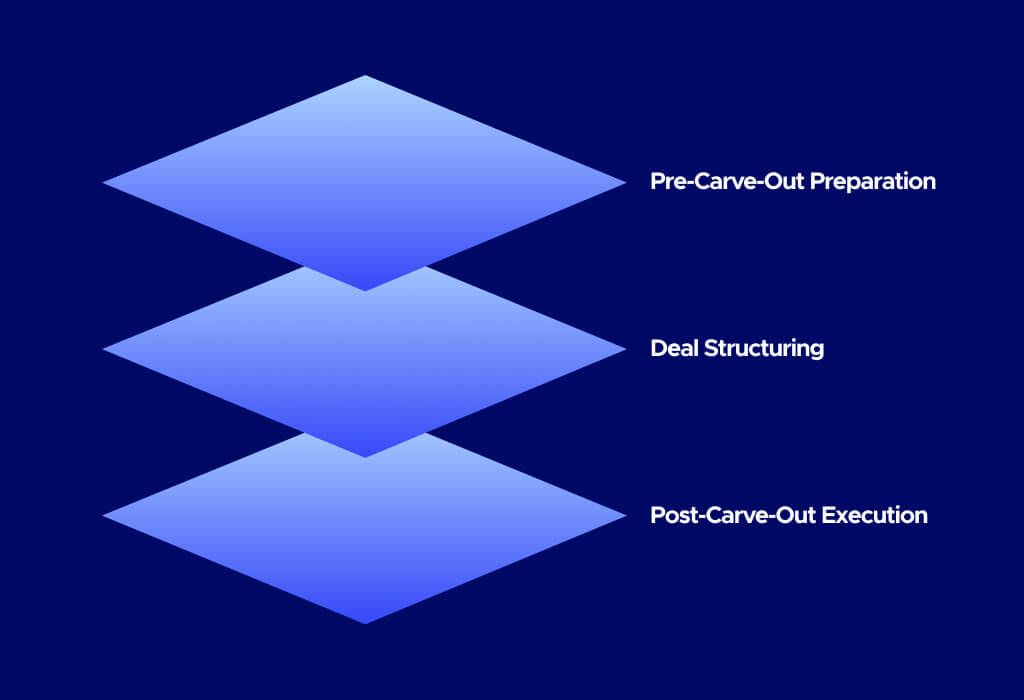
Successfully executing a carve-out requires careful planning and structured execution. The process generally falls into three main stages: pre-carve-out preparation, structuring the deal, and post-carve-out execution. Each stage ensures that both the parent company and the new entity can operate smoothly while preserving value and minimizing risk.
Pre-Carve Out Preparation
The first step is understanding exactly what is being separated. This involves identifying the assets, employees, contracts, and systems that will move to the new entity. Financial statements, operational workflows, and legal obligations must be reviewed to ensure clarity and transparency. At this stage, companies often conduct internal audits to map dependencies and determine potential challenges. Proper preparation sets the foundation for a smoother carve-out and reduces the likelihood of surprises during or after the transaction.
Structuring the Carve Out Deal

Once the scope is clear, the next step is deciding how the carve-out will be executed. This could be an equity carve out, where shares of the new entity are sold to investors or offered to the public, or a direct sale to another company. Deal structuring also involves negotiating terms, determining valuation, and setting governance arrangements for the spun-off unit. Legal, tax, and regulatory considerations are central at this stage to ensure compliance and optimize financial outcomes for both parties.
Post-Carve Out Execution

After the carve-out is legally complete, the focus shifts to operational separation and stabilization. This includes transferring systems, integrating independent management teams, and establishing reporting and financial structures. Communication is critical here—employees, customers, and investors need clarity on the new setup. Smooth post-carve-out execution ensures that the new entity can operate independently while the parent company continues its core operations without disruption.
Benefits of Carve Outs

Carve-outs are not just technical transactions—they offer tangible strategic and financial advantages. When executed thoughtfully, they can improve focus, unlock value, and reduce risk for both the parent company and the new entity.
Strategic Focus
One of the most significant corporate carve out benefits is the ability to sharpen strategic focus. By separating non-core or underperforming units, a company can concentrate resources, management attention, and investment on its main business areas. At the same time, the newly carved-out entity gains independence to pursue growth strategies that may not have aligned with the parent company’s priorities. This clarity often leads to faster decision-making, more innovative approaches, and a stronger market position for both organizations.
Financial Benefits
Financial gains are another key reason companies pursue carve-outs. By turning a division into a standalone entity or selling a portion of it, businesses can unlock hidden value that may have been underappreciated within the larger corporate structure. An equity carve out allows companies to raise capital by selling shares while still retaining partial ownership, providing both liquidity and investment potential. Additionally, carve-outs can improve financial reporting transparency, making it easier for investors to understand the performance of each unit.
Risk Management
Carve-outs also serve as a tool for risk management. By separating business units with different risk profiles, companies can isolate financial, operational, or regulatory exposure. This makes the parent organization less vulnerable to challenges affecting the carved-out unit. Similarly, the new entity can focus on its own risk management strategies, adapting to its specific market environment without being constrained by the parent company’s broader risk framework.
Example of a Carve Out
Recent years have produced several well-documented carve-outs across technology, healthcare, and consumer markets. These cases illustrate how large organizations separate business units to improve strategic focus, raise capital, or restructure operations.

IBM and Kyndryl (2021)
In 2021, IBM separated its managed infrastructure services division and launched Kyndryl as an independent publicly traded company. The decision was grounded in IBM’s shift toward cloud computing and AI, with leadership stating that the carve-out was designed to refocus the company on technology and consulting services with stronger growth potential. The transaction was executed as a tax-free spin-off, distributing Kyndryl shares to IBM shareholders. IBM kept a minority stake of 19.9%, which it planned to exchange to reduce debt. The separation allowed IBM to streamline its portfolio, while Kyndryl gained freedom to modernize enterprise IT infrastructure as its core area of activity.
Intel and Mobileye (2022)
Intel completed an IPO for Mobileye in 2022, offering a minority stake while maintaining majority ownership. The company emphasized that the listing would help recognize Mobileye’s expanding autonomous driving business and support Intel’s goal of raising funds for its semiconductor operations. Management highlighted Mobileye’s strong market position and the need for an independent valuation to reflect its momentum in the ADAS and self-driving sectors. The IPO raised approximately $861 million and created a structure where Mobileye could pursue its own development plans while remaining within Intel’s broader ecosystem.
Johnson & Johnson and Kenvue (2023)
Johnson & Johnson formed Kenvue as a separate entity for its consumer health brands—such as Tylenol, Listerine, and Band-Aid—and listed the company on the NYSE in 2023. This step aligned with J&J’s long-term plan to prioritize pharmaceuticals and medical technology. Kenvue’s IPO generated $3.8 billion and became the largest U.S. listing of its year. J&J initially held roughly 90% of the company before offering an exchange to complete the separation. With this carve-out, J&J created a dedicated consumer health company and improved strategic clarity across both organizations.
Merck & Co. and Organon (2021)
Merck separated Organon in 2021, establishing it as an independent company focused on women’s health, legacy medicines, and biosimilars. Merck described the move as a way to create two organizations with clear priorities: Merck would invest in innovative pharmaceuticals and vaccines, while Organon would grow within established therapeutic categories. According to Merck, the carve-out was expected to strengthen operational flexibility and support improved financial trajectories for both companies. Merck received approximately $9 billion in proceeds, which reinforced its capital position. Organon began trading independently with plans to expand its global footprint in women’s health.
Conclusion
A carve-out is more than just a financial maneuver—it’s a strategic tool that helps companies refine focus, manage risk, and unlock hidden value. Understanding what is a carve out and carefully planning each stage—from preparation to post-execution—is critical for success. Whether through an equity carve out, a sale, or a spin-off, the process creates opportunities for both the parent company and the new entity to thrive. In today’s fast-changing business environment, corporate carve-outs have become an essential part of M&A strategies, enabling companies to adapt, innovate, and grow in ways that might not have been possible within a single, undivided structure.