A Document Management System (DMS) is a software solution designed to store, organize, track, and control documents across their entire lifecycle. Instead of keeping files scattered across shared drives, email threads, and personal folders, a DMS centralizes everything in one secure, structured environment. Today, these systems are actively used in Real Estate, by construction companies and developers to manage blueprints and permits, as well as by HR companies and accounting firms to systematize reporting and protect personal data.
What is a Document Management System (DMS)?
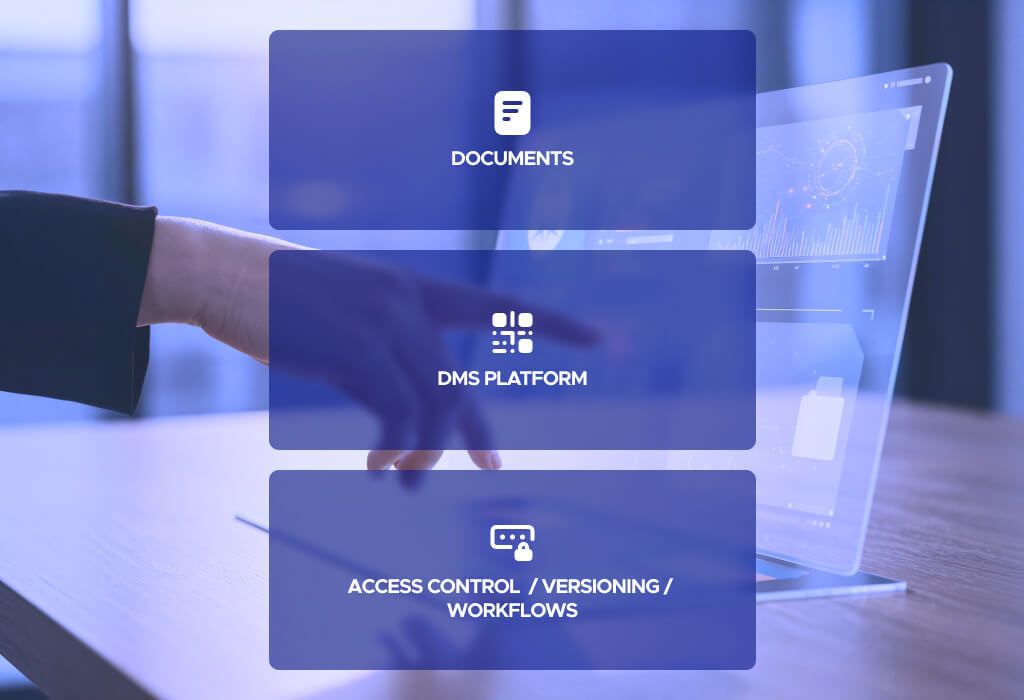
Modern platforms combine storage, workflow automation, permissions, and version control to help organizations manage information efficiently and reduce operational risks.
In practical terms, a DMS replaces manual filing cabinets, repetitive admin work, and the constant search for “the latest version” of a file. Whether a company handles contracts, policies, financial statements, marketing materials, or customer-related documents, a well-implemented system provides clarity and consistency. This is why document management system benefits today go far beyond simple digital storage—they improve collaboration, compliance, and decision-making across entire teams.
Document Management System Advantages
Faster Document Retrieval
One of the most frequently cited document management system advantages is the ability to locate files in seconds. Advanced search functions powered by metadata, tags, and optical character recognition (OCR) eliminate the need to sift through folders manually. Employees spend less time navigating chaotic file structures and more time doing meaningful work. For growing organizations, this speed compounds into higher productivity and a smoother daily workflow.
Collaboration Features
A strong collaboration framework is another core DMS advantage that directly affects team performance. With a DMS, multiple users can work on the same document simultaneously, leave comments, suggest edits, and track changes without creating version conflicts. This eliminates the old pattern of emailing files back and forth or trying to reconcile several “final” versions at once.
Modern systems also provide real-time notifications, workflow automation, and shared workspaces that streamline how teams coordinate tasks. Whether it’s legal teams reviewing contracts or marketing departments developing creative assets, a DMS ensures that everyone stays aligned and can contribute efficiently. Ultimately, it reduces communication friction and keeps projects moving without unnecessary delays.
Access Control and Permissions

A well-designed DMS allows organizations to define exactly who can view, edit, share, or delete specific documents. This level of granular access control is important for maintaining confidentiality, especially when dealing with sensitive data such as HR files, financial records, or customer-related documentation.
This is one of the most important document management system advantages, because it helps prevent unauthorized access and ensures compliance with internal policies and external regulations. Instead of relying on generic shared folders—which are often both messy and insecure—businesses can use permissions to build a structured, traceable, and safe document ecosystem. As a result, every employee sees only what they need, and nothing more.
Audit Trails and Compliance
For organizations operating in regulated industries, the compliance features of a DMS are often a decisive factor. Audit trails automatically record every action performed on a document: who opened it, what changes were made, when they were made, and how the file moved through approval workflows.
These capabilities simplify reporting and ensure that companies can demonstrate full transparency during audits. They also reduce the risk of non-compliance penalties by ensuring that document handling practices meet standards such as GDPR, HIPAA, ISO, or industry-specific guidelines. In this sense, compliance is not just a feature but a strategic document management system benefit that strengthens organizational integrity.
Reduced Paper Usage
One of the most practical and visible document management system benefits is the sharp reduction in paper usage. By digitizing documents and centralizing them on a single platform, companies minimize their physical storage needs, printing costs, and the administrative burden associated with maintaining paper archives. It also reduces the risk of losing critical information due to misplaced files or manual errors. Beyond operational efficiency, going paper-light supports sustainability goals and positions the organization as more environmentally responsible.
Automated Tagging and Classification
Automation is a defining feature of modern DMS solutions, and intelligent tagging is a prime example of its impact. Instead of relying on users to manually name, categorize, or sort documents, the system can apply metadata automatically based on content, templates, or predefined rules. This drastically improves search accuracy and ensures consistent organization across the entire database.
For teams that handle thousands of documents, automated classification eliminates repetitive work and reduces the likelihood of human error. It’s a clear DMS advantage that enhances both efficiency and data integrity.
Disaster Recovery
Disaster recovery is another area where a DMS offers strategic protection. Critical documents are backed up automatically and stored in secure, redundant environments, ensuring they remain accessible even during system failures, cyber incidents, or physical disasters such as fires or floods.
This resilience is far stronger than traditional on-premise storage or physical archiving. In practice, it means business operations can resume quickly, and teams don’t face costly downtime or irreversible data loss. For any organization that relies on continuous access to information, disaster recovery is not just a technical feature but a fundamental safeguard.
Disadvantages of DMS

Upfront Investment
Despite the clear document management system benefits, the initial cost can be a barrier for some organizations. Implementing a DMS often requires licensing fees, configuration, migration of existing files, and staff training. For companies with large volumes of legacy documents, the onboarding phase can become especially time-consuming and resource-intensive. While the long-term ROI is usually positive, the upfront commitment—both financial and operational—should be factored into planning.
Cybersecurity Risks
Although DMS platforms are designed with security in mind, storing sensitive documents in a digital environment always comes with potential risks. Vulnerabilities can arise from misconfigured permissions, insecure user behavior, outdated software, or targeted cyberattacks. This is one of the key disadvantages of document management system tools: even strong protection requires continuous effort.
Regular updates, multi-factor authentication, encryption, and user training are essential components of maintaining a secure system. Without proactive oversight, the very platform meant to safeguard information could become a point of exposure.
Scalability Issues
Not all DMS solutions scale smoothly as an organization grows. Smaller businesses may start with a lightweight platform only to discover later that it cannot handle increased storage, advanced workflows, or more complex permission structures. In such cases, limitations in scalability become a tangible disadvantage of DMS, forcing companies to migrate to a more robust system—an expensive and disruptive process.
Choosing a platform with long-term scalability in mind helps avoid these bottlenecks, especially for businesses with rapidly expanding digital footprints.
Change Management
Introducing a DMS can change how employees access, store, and share information. Even if the new system is intuitive, teams may resist altering their routines, especially when they are used to traditional shared drives or paper-based processes. Effective change management becomes critical: training sessions, clear internal guidelines, and ongoing support help teams adapt without frustration.
Without proper onboarding, adoption rates remain low, and the organization cannot fully realize document management system advantages such as automation or streamlined collaboration.
System Downtime and Technical Issues
Any software solution is vulnerable to downtime, updates, or unexpected technical problems. When a DMS becomes temporarily unavailable, teams may lose access to essential files, slowing productivity and delaying decision-making. Depending on the system architecture, even routine maintenance can interrupt workflows.
This unpredictability is one of the practical disadvantages of DMS, especially for fast-paced industries that rely on continuous access to documentation. Ensuring service-level agreements (SLAs), strong IT support, and reliable hosting can mitigate these risks.
When to Consider a Virtual Data Room (VDR)

A Virtual Data Room (VDR) becomes the better choice when an organization needs a highly controlled, transaction-focused environment for sharing sensitive documents with external parties. While a traditional DMS supports daily document workflows, a VDR is built for scenarios where confidentiality, temporary access, and rigorous monitoring are paramount. It is important to note that those who need a robust DMS can also effectively use a VDR. In essence, a VDR contains all the core functions of a DMS but adds an extra layer of high-level security and data control.
VDRs provide advanced security measures, including dynamic watermarking, restricted downloads, secure viewing windows, and more detailed activity tracking. These tools allow companies to share documents while maintaining full visibility into who accessed what and when. If a business frequently collaborates with external investors, auditors, or legal teams, a VDR may offer a level of protection and oversight that goes far beyond standard document management system benefits.
In short, organizations should consider a VDR when precision, confidentiality, and temporary yet secure external access are the priorities.
Comparing DMS and VDR: Which One Is Right for You?
While both platforms help manage and secure documents, their purposes diverge in meaningful ways. A DMS is designed for everyday internal use: organizing files, supporting team collaboration.
However, since a VDR is essentially an enhanced version of a DMS with a focus on security, it serves as a universal tool. By choosing a VDR, a company gains all the standard document management features plus powerful "out-of-the-box" security mechanisms that may be missing in a standard DMS.
Choosing between them depends on the context. If a company’s goal is to enhance productivity, a DMS is a natural fit. But for those who require all the standard features of a DMS plus maximum security for their information, a VDR is often the more comprehensive and reliable choice.
Conclusion
A Document Management System delivers clear operational value through faster document retrieval, better collaboration, structured access control, and improved compliance. These document management system advantages help organizations modernize their workflows and reduce dependency on manual or paper-based processes. At the same time, businesses must weigh the disadvantages of DMS—from upfront investment to potential security risks and change-management challenges—to ensure the solution aligns with their capabilities and long-term goals.